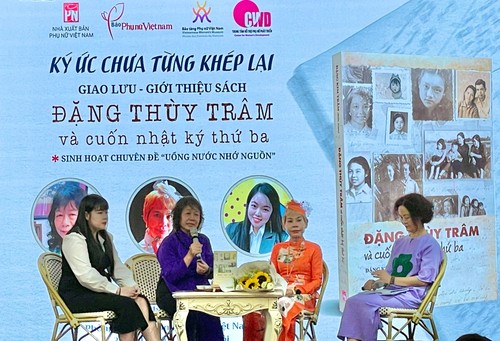
 Martyr Dang Thuy Tram's sister Dang Kim Tram (second from left) and literature researcher Ha Thanh Van (second from right) at the book launch (Photo: Thuy Du) Martyr Dang Thuy Tram's sister Dang Kim Tram (second from left) and literature researcher Ha Thanh Van (second from right) at the book launch (Photo: Thuy Du) |
The new book traces the young Hanoi woman's journey as a doctor who sacrificed herself during the anti-US war in one of Vietnam’s central provinces.
Tram, born in Hue in 1942, trained in Hanoi to become a medical doctor. She died on June 22, 1970, in Duc Pho, Quang Ngai province, while working in a remote clinic.
In 2005, two diaries written by Tram which chronicle the last two years of her life, were returned from the US after being lost for 35 years. They quickly became a publishing phenomenon, with more than half a million copies printed in Vietnam, and they were soon translated into 23 foreign languages.
The new book, compiled by the martyr's sister Dang Kim Tram, is actually the first diary penned by Thuy Tram in the years before she went to the battlefield in the south. That diary was kept by her mother for decades.
At the book launch, Ms. Kim Tram recalled, “Before heading to the southern front, Thuy Tram left behind many keepsakes for our family. Among them was a diary she had written over the two years leading up to her departure.”
“Those two years marked a pivotal time in her life, when she made the decision about which path to follow. What she wrote wasn't just for herself, it speaks for an entire generation, and we truly hope readers can understand and feel that through her words,” according to Ms. Kim Tram.
The book consists of two parts. The first comprises writings by Tram's mother and three younger sisters about her childhood, adolescence, and young adulthood.
The second part is Thuy Tram's unpublished diary kept during the end of her studies at Hanoi Medical University, from October 1965 to December 1966. At the time, she was already preparing to leave for the southern battlefield.
In these pages Thuy Tram appears full of femininity, exhibiting a heart filled with love for her country, family, friends, and romantic interests.
In her note on October 11, 1965, Thuy Tram wrote, “Is life really like what we read about? Are there truly people who completely forget themselves for a greater cause, like Alexey, like Georghi, like Tania? I long to witness lives like theirs. I want to live like them, to rise above like they did.”
Thuy Tram’s sister, Ms. Kim Tram said that the young people of this period held an almost absolute ideal of patriotism. Though everyone had their own struggles when deciding to enter the battlefield, most made that choice with resolve.
“My elder sister, Thuy Tram was resolute with her decision. It was not a rash or emotional impulse, as some might think. It was the mindset of an entire generation heading into war,” said Ms. Kim Tram.