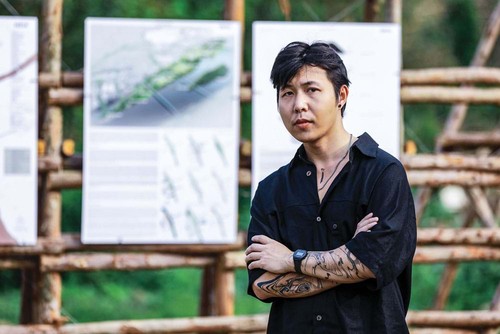
 Architect Trung Mai (Photo: Danh Khang/nguoidothi.net.vn) Architect Trung Mai (Photo: Danh Khang/nguoidothi.net.vn) |
Trung Mai, whose real name is Mai Hung Trung, was the first Asian architect to win at Europan, the largest European urban design competition for young architects under 40. In fact, he won the biennial competition, which focuses on innovative housing design and urban planning, three times in a row, in 2019, 2021, and 2023.
After studying, and working in Europe for 14 years, Trung Mai returned to Vietnam in 2023 with the aspiration of transforming existing architectural works into more livable spaces.
“Today, architecture is valued, not simply for its beauty, but also for the stories and messages it conveys. Through those messages, architecture can address social challenges. Bringing green design into a congested, polluted city like Hanoi is like administering medicine to an ailing body. That’s why many architects are now drawn to developing countries, where imperfections and challenges are sources of creativity,” he said.
In Hanoi, sidewalks are used for different purposes throughout the day, and old apartment blocks are often expanded without regulations. While these phenomena may appear messy, they also contain potential solutions for the future of urban life. Trung Mai observes how Hanoians have optimized their living spaces with multifunctionality for over a century. They use space flexibly to adapt to time, climate, and individual needs. Trung Mai views this adaptability as a strength of Vietnamese architecture and has made it the guiding philosophy of his work.
“For many people, sidewalk activities and the expansion of old apartment blocks are problems because they believe such things ruin the city’s appearance and disrupt order. But after living abroad for many years, I see them as solutions, especially for cities like Hanoi, where land within the inner city is so limited. One of the global strategies being discussed is the use of multifunctional, multi-purpose spaces. Maximizing spatial usability is the current trend,” he said.
Each year, Trung Mai undertakes one community-based urban research project. Upon his return to Vietnam, he became known for his project to transform the Gia Lam Train Factory into an exhibition center and creative hub. He and his team have continued to study and plan to undertake similar projects, converting abandoned factories into spaces that benefit the community.
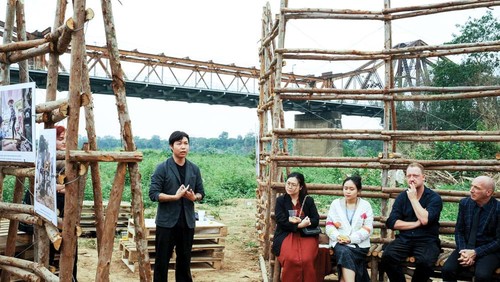 Trung Mai’s House of Forest project built under the Long Bien bridge in Hanoi (Photo: nguoidothi.net.vn) Trung Mai’s House of Forest project built under the Long Bien bridge in Hanoi (Photo: nguoidothi.net.vn) |
In 2024, Trung Mai’s House of Forest project came into operation. Built under the Long Bien bridge in Hanoi in an area locals call Bo Vo, the wooden structure was constructed using invasive trees commonly found along the Red River and has served as a space to conserve indigenous plants, birds, and wildlife. The project was introduced at the Venice Architecture Biennale 2025 in Italy.
“I think the definition of heritage should not be limited to architecture or construction work, but should be extended to trees, soil, and water. Nowadays, most cities are concrete landscapes built for humans. But it’s essential to set aside spaces for animals, especially when cities are overloaded with human activities. I advocate for the rights of animals and plants within the city as well,” he said.
For Trung Mai, architecture is not just bricks and concrete blocks. Every city has its own identity shaped by the lifestyle and mindset of its people. Each building has stories and messages that can be passed down through generations. Rather than building new structures, he prefers renovating and revitalizing old structures, making them more relevant. Trung Mai and his team are involved in multiple projects to preserve Hanoi’s historical architecture.
“I get to work on projects ranging from urban planning to architecture and museum exhibitions, which is very exciting. It’s a new, enriching experience for me,” said French architect Emma Reix, a member of Trung Mai’s team.
Trung Mai expresses his love for the capital through architectural solutions that aim to make Hanoi the best version of itself. His ideas, innovations, and international showcasing of Vietnamese architecture give the world a new perspective on Vietnamese architecture and insights into the mindset, lifestyle, and culture of modern urban communities in the country.