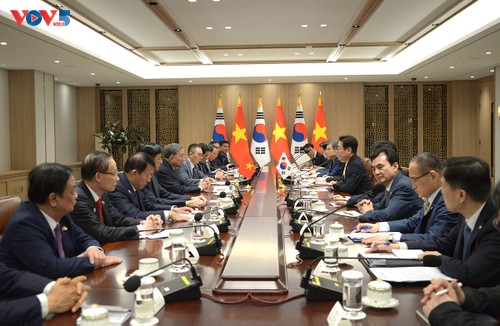
 General Secretary To Lam holds talks with South Korean President Lee Jae Myung. (Photo: Van Hieu/VOV) General Secretary To Lam holds talks with South Korean President Lee Jae Myung. (Photo: Van Hieu/VOV) |
The Joint Statement affirmed that both sides had reached important common understandings on comprehensively advancing and deepening the Vietnam–Republic of Korea Comprehensive Strategic Partnership, as well as on regional and global issues of mutual concern.
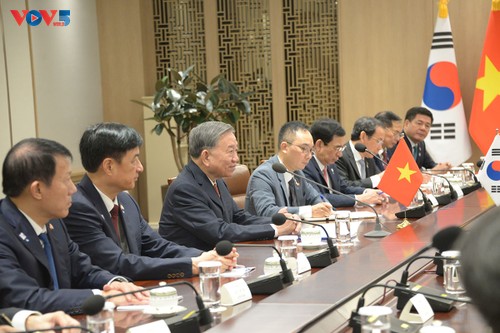 General Secretary To Lam and the Vietnamese delegation at the talks. (Photo: Van Hieu/VOV) General Secretary To Lam and the Vietnamese delegation at the talks. (Photo: Van Hieu/VOV) |
General Secretary To Lam and President Lee Jae Myung affirmed that the two countries are each other’s leading and most important partners across all fields. They agreed that the achievements attained over the past three decades provide a solid foundation and a lasting driving force for both sides to consolidate and develop the Comprehensive Strategic Partnership in a deeper, more substantive, and more effective manner, and move it into a new phase. The two leaders agreed to further intensify cooperation in all areas and reaffirmed the goal of raising bilateral trade of 150 billion USD by 2030.
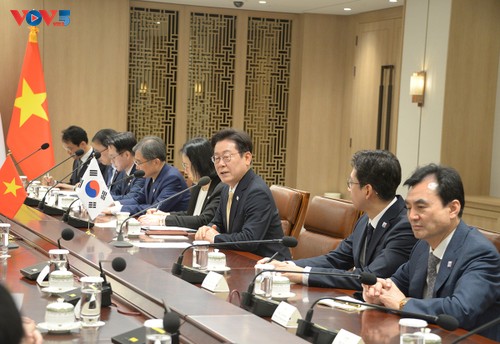 South Korean President Lee Jae Myung and the Korean delegation at the talks. (Photo: Van Hieu/VOV) South Korean President Lee Jae Myung and the Korean delegation at the talks. (Photo: Van Hieu/VOV) |
Both sides agreed to work closely and enhance mutual support at international and regional forums and organizations, including the United Nations (UN), World Trade Organization (WTO), Asia-Pacific Economic Cooperation (APEC) Forum, Partnering for Green Growth and the Global Goals 2030 (P4G), and the Organization for Economic Co-operation and Development (OECD).
The two sides reaffirmed the importance of maintaining peace, stability, respect for international law, and freedom of navigation and overflight in the East Sea, particularly the principle of resolving disputes peacefully in accordance with international law, especially the 1982 United Nations Convention on the Law of the Sea (UNCLOS 1982). They also stressed the importance of fully implementing the Declaration on the Conduct of Parties in the East Sea (DOC) and working towards the early adoption of an effective and substantive Code of Conduct in the East Sea (COC) consistent with international law, particularly UNCLOS 1982.