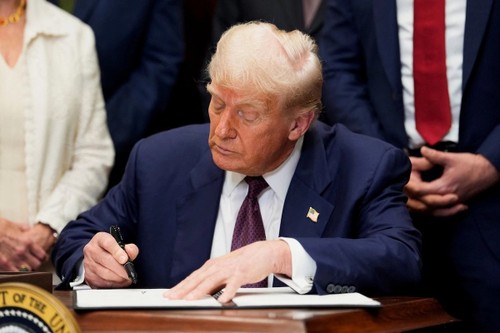
 US President Donald Trump signs the tariff executive order at the White House on July 31, 2025. (Photo: Reuters) US President Donald Trump signs the tariff executive order at the White House on July 31, 2025. (Photo: Reuters) |
Via a presidential executive order, Trump set rates of 35% on many goods from Canada, 50% on goods from Brazil, 25% on goods from India, and 39% on goods from Switzerland. In seven days, higher import duties of 10-41% will begin for 69 trading partners, some of whom have negotiated lower tariffs, and some of whom have had no opportunity to negotiate with the Trump administration. Trump included an exception for some goods shipped within the coming week.
Goods from all countries not listed will be subject to a 10% import tax. Trump had previously said the rate might be higher.
Economists say the newly announced US tariffs have been flexibly tailored to different trading partners, including those still in negotiations and yet to reach an agreement.
Barbara Matthews, CEO and founder of research firm BMCstrategy and a senior fellow with the Atlantic Council, said that it seems clear that the new normal is constant negotiation, a constant refinement with different boundaries and different priorities for different countries.
“It's a multi-dimensional negotiation. I think it’s dawning on people that you don't change a geoeconomic balance of power overnight and you don't do it all at once,” said Barbara.
On Thursday, Trump extended tariff negotiations with Mexico for an additional 90 days, instead of imposing a 30% tariff starting Friday. Two-way trade between totaled 840 billion USD last year, making Mexico the US’s largest trading partner. The US’s trade deficit with Mexico was 170 billion USD.