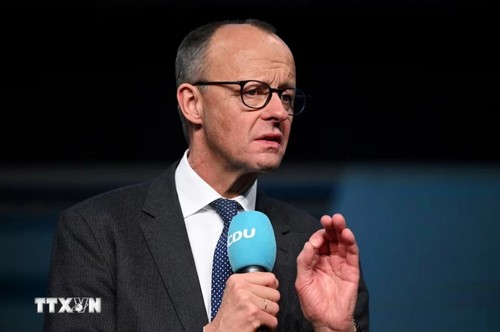
 Friedrich Merz, German chancellor candidate of the conservative Christian Democratic Union (CDU) and the Christian Social Union (CSU) bloc, speaks in Neubrandenburg, February 12, 2025. Photo: Reuters/VNA Friedrich Merz, German chancellor candidate of the conservative Christian Democratic Union (CDU) and the Christian Social Union (CSU) bloc, speaks in Neubrandenburg, February 12, 2025. Photo: Reuters/VNA |
Preliminary results announced by German public television channel ZDF and ARD at the time polling stations closed showed that with 29% of the vote, the CDU/CSU bloc came first in the snap election, which took place seven months earlier than planned.
The far-right party Alternative for Germany (AfD) won 19.6% of votes, followed by the Social Democratic Party (SPD) of Chancellor Olaf Scholz with 16% of votes. The Green Party ranked fourth with 13.3% and the left-wing Linke party won 8.6%. The far-left Free Democratic Party (FDP) and Sahra Wagenknecht Union (BSW) won 4.9% and 4.8% of the votes, respectively, hovering around the 5% threshold needed to win seats.
The result paves the way for lengthy coalition negotiations and potentially a three-party coalition consisting of the CDU/CSU with one or two of the three parties that formed the coalition government (SPD, Greens, and FDP) that collapsed last November.