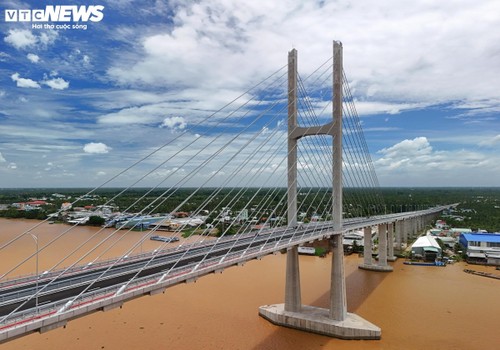
 Rach Mieu 2 bridge spans the Tien river and links Dong Thap and Vinh Long province. (Photo: VTC News) Rach Mieu 2 bridge spans the Tien river and links Dong Thap and Vinh Long province. (Photo: VTC News) |
The Rach Mieu 2 bridge, spanning the Tien river and linking Dong Thap and Vinh Long province, was inaugurated on August 19 this year after more than three years of construction.
The bridge will meet travel and cargo transport needs across the Mekong Delta’s coastal provinces and strengthen trade connections with Ho Chi Minh City. This will allow agricultural and seafood products to reach markets more easily, reduce logistics costs, attract investment, and foster industrial, handicraft, and tourism development.
Huynh Ngoc Quang, a resident of Vinh Long province, said that like other locals, he is delighted with the inauguration of Rach Mieu 2 bridge.
“From now on, traffic congestion will be a thing of the past, and travel will be safe and seamless. We sincerely thank the Party and the State for their attention in building this spacious bridge, which will serve the socio-economic development needs of the entire Mekong Delta region and open a new era,” said Quang.
Across Vietnam, from Lang Son to Ca Mau, new expressways are being opened, realizing the Party’s goal of completing 3,000 kilometers of expressways this year — a critical breakthrough in infrastructure. Key projects such as the North–South Expressway’s Eastern Section, Ho Chi Minh City’s Ring Road 3, Hanoi’s Ring Road 4, and routes connecting the Central Highlands and northern mountain provinces are shrinking geographical distances and boosting trade flows, tourism, and competitiveness.
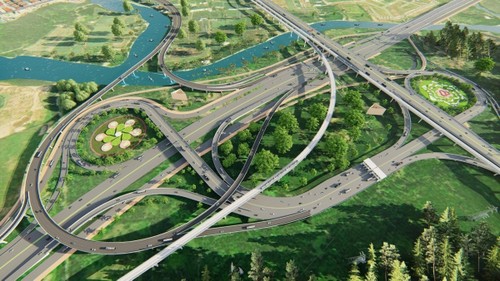 Ho Chi Minh City’s Ring Road 3 is a core infrastructure for the southern key economic hub. (Photo: VTC News) Ho Chi Minh City’s Ring Road 3 is a core infrastructure for the southern key economic hub. (Photo: VTC News) |
Urban transportation projects are creating change nationwide. Metro Line No. 1, linking Ben Thanh and Suoi Tien in Ho Chi Minh City, has become a new symbol of a modern metropolis.
At its inauguration in March, Nguyen Van Duoc, Chairman of the municipal People’s Committee, said, “The inauguration of Metro Line No. 1 is a source of joy and pride for Ho Chi Minh City and marks a new chapter in the development of modern urban transportation for our country.”
With a 3,260-kilometer coastline spanning 28 provinces and cities and a maritime area of over one million square kilometers, Vietnam views its seaport and logistics system as the nation’s gateway to the world and aspires to become a major regional logistics hub.
State-of-the-art deep-water ports now welcome vessels of hundreds of thousands of tons and directly connect Vietnam with international shipping routes. Modern inland container depots, warehouses, and logistics facilities allow Vietnamese goods to reach Europe and the Americas faster, at a lower cost, achieving greater competitiveness.
In April, the Hateco Hai Phong International Container Terminal in Lach Huyen, Hai Phong city — Vietnam’s first privately invested deep-water port — officially came into operation.
According to Nguyen Duc Tho, former Deputy Chairman of the Hai Phong People’s Committee, “The terminal inauguration is a milestone that meets both regional and international cargo transport needs. From here, Hai Phong port will be directly connected with major ports worldwide, reducing logistics costs and boosting the state budget.”
Large-scale power infrastructure projects are playing the role of the nation’s “energy arteries.” Projects such as the 500kV transmission grid, the Lao Cai-Vinh Yen 500kV line, the expanded Hoa Binh Hydropower Plant, and billion-dollar offshore wind and gas power projects not only ensure national energy security but also accelerate the transition toward sustainable green energy.
In the digital space, domestic tech groups are rolling out 5G infrastructure and data centers to provide a backbone for the digital economy, digital government, and digital society, while bolstering self-reliance in technology and cybersecurity.
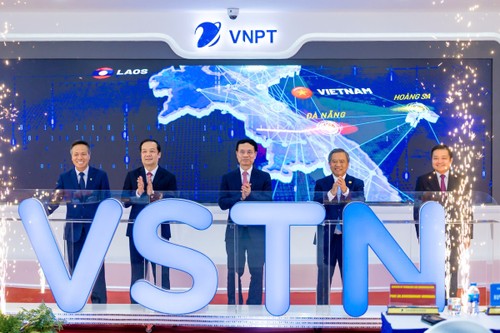 At the launch ceremony of the VSTN terrestrial cable system, spanning Vietnam, Laos, Thailand, Malaysia, and Singapore. (Photo: VNPT) At the launch ceremony of the VSTN terrestrial cable system, spanning Vietnam, Laos, Thailand, Malaysia, and Singapore. (Photo: VNPT) |
On August 4, the Vietnam Posts and Telecommunications Group (VNPT) launched the VSTN terrestrial cable system, a 3,900-kilometer network spanning Vietnam, Laos, Thailand, Malaysia, and Singapore.
Built entirely on land, it connects VNPT’s technical center in Da Nang with other data hubs in the region.
Nguyen Thanh Chung, Director General of the Department of Telecommunications at the Ministry of Science and Technology, said, “The VSTN international fiber optic cable is a symbol of Vietnam’s innovation, proactive integration, and mastery of digital infrastructure. It lays the groundwork for modern, interconnected, and efficient digital infrastructure both domestically and globally, demonstrating VNPT’s dynamism in building next-generation infrastructure that plays a pivotal role in the national digital transformation.”
These new projects demonstrate Vietnam’s growing confidence, resilience, and mastery of advanced technologies. They embody the collective efforts of the political system, stakeholders, and people, turning aspirations of a prosperous, strong, and thriving nation into a tangible reality — ready to stride confidently into the future.