 David Cumming joins a training course on commercial strategy for hotel directors. (Photo: Ascott Vietnam) David Cumming joins a training course on commercial strategy for hotel directors. (Photo: Ascott Vietnam) |
Reporter: Thank you, Mr. Cumming, for giving us this interview. As you know international arrivals to Vietnam are up 22% in the first 10 months of this year, according to the Vietnam National Authority of Tourism. What do you think the rapid growth is changing the requirements for human resource training?
David Cumming: International arrivals to Vietnam this year are up 22% against last year, and this will be a record year for tourism in Vietnam. The tourism nowadays is coming from many different countries, be it India, Australia, Europe, and all these different countries have different needs and requirements. We need to have the talent and the people who can handle this multicultural society and have the experience to deliver the service mindset. Above all, to be a leader in tourism, we need to be bringing in personalization into our daily job, because that's what will separate Vietnam from other countries, particularly here in Southeast Asia.
Reporter: With Ascott planning to open a large number of new properties through 2028, demand for skilled human resources is expected to rise sharply. Do you see talent availability as a major challenge to your expansion plans?
David Cumming: One thing that keeps me awake at night is the labor we need. Today we employ around 2,000 people within Ascott Vietnam, but by 2028, on our forecast, it looks like we’ll need between 5,000 and 7,000 employees. We’re going to more than double in the next three years. That resource is in all parts of our business, be it a waiter, a chef, a housekeeper, or a revenue manager, or into more senior leadership positions. We find there is a complete lack of that resource in the market that we all need to solve. Working with the education sector is one way we can move forward.
 Ascott Limited leaders share insights and experiences during a Career Talk with students from leading universities in Hanoi. (Photo: Ascott Vietnam) Ascott Limited leaders share insights and experiences during a Career Talk with students from leading universities in Hanoi. (Photo: Ascott Vietnam) |
Reporter: Strengthening links between universities and businesses is widely seen as key to aligning training with real-world needs. How is Ascott working in practice with colleges and universities to develop future talent?
David Cumming: We've been in the country for 31 years, and we see it as one of our core priorities, our responsibility to make a difference. Through our CapitaLand Hope Foundation, we have over the years built five schools in the areas of local minorities. We have, in the last 5 to 10 years, really been working with the universities, the vocational colleges, to give internships and training programs for their students in the bid that we attract these people to our industry. Education can give the knowledge, the theory, but getting the students into the industry, into the field, gives them real hands-on experience where they can start to learn about service mindset, the basics of leadership skills, and many other things. We’re opening up a well-structured opportunity for real-life learning, because there’s never enough real-life learning.
Reporter: For young workers in rural areas or second- and third-tier cities, is relocating to Hanoi or Ho Chi Minh City still necessary to access international career opportunities, or are those opportunities increasingly emerging locally?
David Cumming: There is huge potential in areas such as Sapa, Vung Tau, the Mekong Delta, all of these areas in second- and third-tier cities is growing very quickly. Ascott just signed two months ago a Citadines Riverside in Can Tho in the Mekong Delta, so that's showing international chains are going out into these second- and third-tier cities and seeing opportunity there. That, of course, brings opportunity to the young people living in those areas. You don't have to leave your local area. You can be part of the local community working in an international brand and really helping develop your local community and bring success to that community.
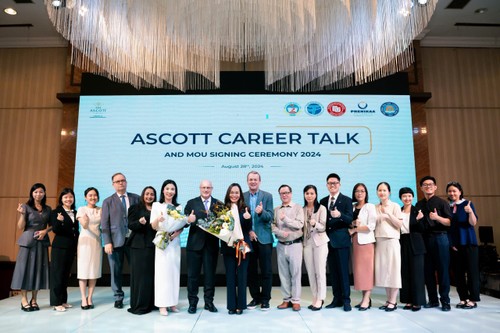 David Cumming joins the career talks and orientations for students and aspiring professionals in the hotel industry. (Photo: Ascott Vietnam) David Cumming joins the career talks and orientations for students and aspiring professionals in the hotel industry. (Photo: Ascott Vietnam) |
Reporter: In a rapidly evolving global hospitality industry, what should training institutions do to ensure their graduates are equipped with the skills the international market now demands?
David Cumming: I think it's very important that we continue to work with the colleges and the universities to help them build their syllabus to keep it relevant to today's ever-changing world. Much of that is looking at digital marketing, revenue management, sales, and operational excellence, and making sure the college has things up-to-date in what is expected by the industry. One good move forward is with the Vietnamese government now allowing industry to go into the college to bring their knowledge, as well as all the college lecturers allowed to go out into industry to see what's happening. That's a great move forward that can only really help polish and round the syllabus and making it the best it can to develop and set up our students to be the best they can once they go out into industry. In addition, as AI moves into many different industries, tourism is one area, or hospitality and hotels is one area that AI will never take over all the jobs. It still remains and is a people's industry.
Reporter: Thank you, Mr. David Cumming, for joining us today.