 Philip Chua, APAC Director of Public Policy, Products for Meta, speaks at the ViGen launch ceremony as part of the Innovate Viet Nam 2025 and the Vietnam International Innovation Expo in Hanoi on Oct 2, 2025. (Photo: Meta) Philip Chua, APAC Director of Public Policy, Products for Meta, speaks at the ViGen launch ceremony as part of the Innovate Viet Nam 2025 and the Vietnam International Innovation Expo in Hanoi on Oct 2, 2025. (Photo: Meta) |
Bao Tram: Thank you for granting VOV24/7 this interview. Tell us more about this Vietnamese dataset for AI?
Philip Chua: This isn’t just another open-source model—it’s one that represents Vietnamese culture, norms, and society. These are aspects that have been historically underrepresented in global AI systems.
With the datasets, the platform, and a three-year roadmap, this project creates a great opportunity for Vietnam to contribute, innovate, and make an impression on the international AI stage.
Bao Tram: How can this open-source dataset help Vietnam make an impression on the international AI stage?
Philip Chua: Global AI models often lack Vietnamese representation because their training data don’t include enough Vietnamese language or cultural context. With ViGen and its 50 billion tokens, that changes.
This dataset empowers Vietnamese developers to build “Made-in-Vietnam” AI solutions while helping international developers create systems that better understand and reflect Vietnamese culture. We’re very excited about its potential to open up new opportunities for innovation.
Bao Tram: How do you think this project will impact Vietnam’s AI research and startup ecosystem?
Philip Chua: This is a foundational step and the beginning of a multi-year journey. We’re working closely with government agencies, universities, and research institutes. For the first time, Vietnam has a comprehensive dataset that complements other open-source models globally.
This will provide a strong foundation for Vietnam’s researchers and startups to experiment, train models, and deploy AI applications suited to local contexts.
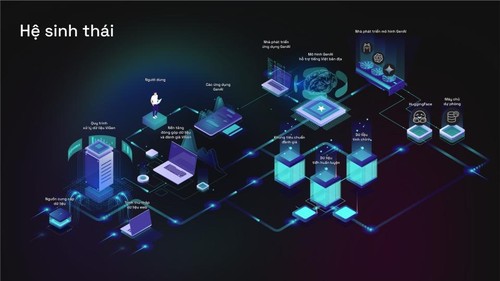 A panoramic view of the ViGen ecosystem (Photo: Meta) A panoramic view of the ViGen ecosystem (Photo: Meta) |
Bao Tram: From a technical perspective, what made ViGen project possible?
Philip Chua: The early stages are always the hardest. Fortunately, Meta had the chance to work with Vietnam’s leading research and government institutions that already had strong momentum in this space.
The main challenge was ensuring data quality—compiling and filtering open data so it accurately represents Vietnamese language and passes key technical benchmarks. By open-sourcing the dataset and inviting public contributions, we can continuously improve it together.
Bao Tram: What’s your vision for upscaling the project in the coming years?
Philip Chua: Over the past six months, we’ve gathered 50 billion tokens together as a community. In the next two years, we’ll expand and fine-tune this dataset, possibly integrating multimodal data in the future.
It’s an open invitation to the Vietnamese AI community—researchers, startups, and innovators alike—to contribute, collaborate, and create. Together, we can build something that truly represents Vietnam’s voice in the global AI space.
Bao Tram: What kind of talent are you seeking in Vietnam for initiatives like this?
Philip Chua: The talent is already here. Vietnam has a young, dynamic, and ambitious population eager to innovate—and, importantly, it has strong government backing for digital transformation.
At Meta, our role is to provide opportunities. With Meta AI integrated across our apps and tools for businesses, we hope to inspire Vietnamese talent to innovate, not just for Vietnam, but for the world.
Bao Tram: What kind of partnerships do you envision to drive Vietnam’s AI innovation further?
Philip Chua: Education and skills development will be key. We’ve invested heavily in AI literacy—building curricula with universities, and soon, launching Llama-powered AI agents to help high school educators develop AI lessons.
Beyond that, we’re excited about Vietnam’s creative industries—like Gameverse and iContent—where local startups and creators are thriving. Meta is here to partner, support, and grow with Vietnam’s tech ecosystem for the long term.
Bao Tram: Thank you again, Mr. Chua, for spending time with VOV24/7.