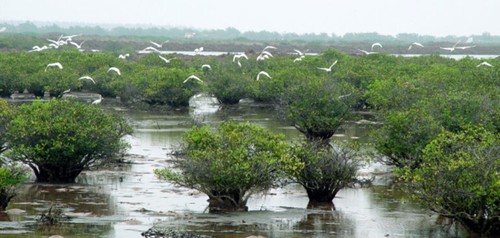
 A view of Xuan Thuy National Park A view of Xuan Thuy National Park |
Xuan Thuy National Park was established in Giao Minh, Giao Hoa, and Giao Phuc commune to protect coastal estuary wetland ecosystems. Its rich biodiversity includes hundreds of waterbird species, many of which are rare, endangered, and of global conservation value.
Vu Quoc Dat, Deputy Director of the park, said: "Xuan Thuy National Park is a typical wetland ecosystem of Vietnam’s coastal estuaries. Covering a total area of 7,100 hectares, including 1,500 hectares of mangrove forest. It’s an important stopover site for migratory birds, especially waterbirds."
In 1989, the wetland area of Xuan Thuy was designated the first Ramsar site in Vietnam and Southeast Asia, making Vietnam the 50th member of the Ramsar Convention. The park is home to more than 200 plant species, 155 fish species, and more than 400 insect species.
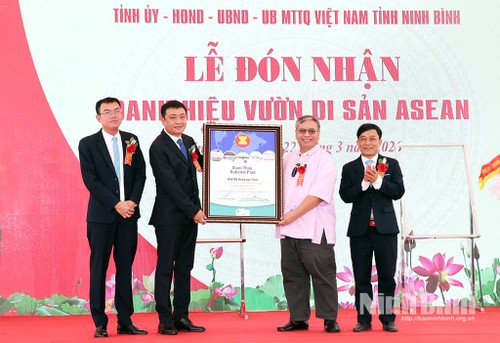 Mr. Jerome Montemayor (second from the right), Director of the ASEAN Biodiversity Centre, presents the ASEAN Heritage Park certificate to Xuan Thuy National Park. (Photo: baoninhbinh.org.vn) Mr. Jerome Montemayor (second from the right), Director of the ASEAN Biodiversity Centre, presents the ASEAN Heritage Park certificate to Xuan Thuy National Park. (Photo: baoninhbinh.org.vn) |
Mr. Dat said that, because it’s located on the East Asian-Australasian Flyway, Xuan Thuy plays an important role in international biodiversity conservation.
"Of the more than 220 bird species in Xuan Thuy, about 150 are migratory. The park is currently monitoring several rare species, including 9 listed in Vietnam’s Red Book, such as spoonbills and wild ducks. The population of black-faced spoonbills has shown signs of recovery in recent years," said Dat.
In the coming years, Ninh Binh province will continue to strengthen forest protection, and ecosystem and biodiversity conservation, particularly for rare flora and fauna and migratory birds of high conservation value, while enhancing management and monitoring within the park.
Efforts will also focus on environmental education, especially among younger generations. At the same time, scientific research and international cooperation will be promoted, along with more experience sharing with other ASEAN heritage parks.