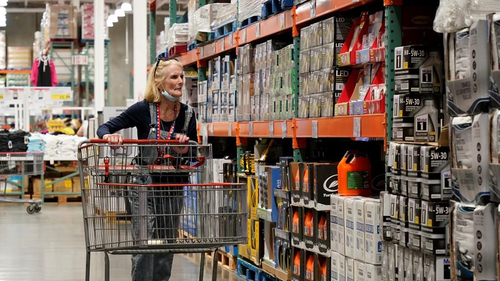
 At a supremarket in Foster City, California, the US (photo: XHN/ VNA) At a supremarket in Foster City, California, the US (photo: XHN/ VNA) |
Global growth in the second half of the year is forecast to be 2.5% by UBS and Goldman Sachs and 2.9% by Morgan Stanley. These figures are less optimistic than earlier projections by the International Monetary Fund.
Less positive outlook for the US and Europe
The United States, the world’s largest economy, is projected to grow 1 to 2% this year, due to tariff-induced price hikes and a cooling job market. US stocks have risen by more than 30% since hitting a low in April, after President Donald Trump announced new tariff rates on countries and territories worldwide. In their latest forecasts, Citigroup and UBS Global Research have raised their year-end target for the S&P 500 index, signaling that policy risks are easing and corporate earnings remain stable.
But some economists say the prolonged uncertainty from early April to early August caused by the Trump’s new tariff policies has negatively affected the US investment and business environment, which will be more visible in the second half of the year. Gary Hufbauer is a senior fellow at the US Peterson Institute for International Economics.
“I think the US economy is slowing down anyway because a lot of households are heavily indebted and the business investment. I know that Trump announces all these deals, but in fact business investment has not been good in the first half of the year. Because many firms just don't know what's going to happen next, so they delay. I think we're headed for a slower period of economic growth and maybe even some drop, some small recession,” said Gary Hufbauer.
The growth outlook for EU countries is also bleak. Data released by the EU’s statistical office Eurostat on Monday showed that the GDP of 20 eurozone countries increased only 0.1% in the second quarter and 1.4% year-on-year. Eurostat's assessment indicates that the EU economy is experiencing modest growth, especially after the US officially imposed a 15% import tariff on European goods under the EU-US trade agreement reached on July 27. This tariff is expected to raise export costs, forcing European companies either to increase their selling prices or accept lower profits.
Franziska Palmas, chief Europe economist at Capital Economics, estimated that the US’s 15% tariff could reduce eurozone GDP by about 0.2%, dragging down the annual growth. Palmas also noted that Germany, Europe’s largest economy, will be hit harder than other major economies by the US tariffs. In Q2, Germany’s economy contracted 0.1% and has just rebounded close to its 2019 size, as its manufacturing and export sectors face increasingly fierce competition.
Positive outlook for China and the UK
Unlike the gloomy forecasts for the US and EU, some major economies show a brighter outlook. The International Monetary Fund’s World Economic Outlook update in late July raised its growth forecast for China from 4% in April to 4.8%. China's GDP growth in 2026 was also revised upward to 4.2%. Major banks like UBS, Goldman Sachs, and Deutsche Bank also project China’s growth will be between 4.5% and 4.7% this year.
According to the IMF, the upward revision in China’s growth forecast is mainly driven by domestic demand, exports, and innovation. In the first half of this year, domestic consumption contributed 68.8% to China’s GDP growth. The US’s recent extension of the tariff deadline by 90 days has eased pressure on Chinese exporters ahead of the year-end consumption season in the US and Western countries.
The UK, the world’s sixth-largest economy, also recorded positive growth. Data released by the UK Office for National Statistics on Thursday showed that the economy grew 0.3% in the second quarter, well above the earlier projection of 0.1%, making the UK the fastest-growing economy in the G7 in the second quarter.
UK Chancellor of the Exchequer Rachel Reeves said: “Growth was broad-based in the first half of this year with increases in manufacturing, in services, the biggest part of our economy, and also in construction as well, reflecting this government's focus on getting Britain building again.”
However, observers say the UK economy still faces many challenges in the second half of the year. Ruth Gregory, an economist at Capital Economics, said the UK will struggle to maintain this growth rate due to weak global economic growth and the full impact of the April tax increase on business.