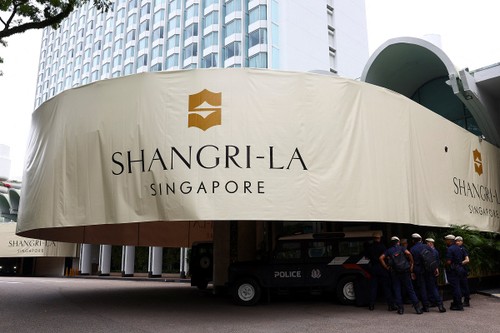
 Police guard near the entrance of the Shangri-La Hotel in Singapore, where the Shangri-La Dialogue is taking place, May 30, 2025. (Photo: REUTERS/Edgar Su) Police guard near the entrance of the Shangri-La Hotel in Singapore, where the Shangri-La Dialogue is taking place, May 30, 2025. (Photo: REUTERS/Edgar Su) |
The Shangri-La Dialogue, one of Asia's most prominent annual forums on defense and security, brings together more than 600 international scholars and senior officials. Notable participants this year are French President Emmanuel Macron, Malaysian Prime Minister Anwar Ibrahim, and US Secretary of Defense Pete Hegseth.
Rising geopolitical uncertainty
This year’s dialogue takes place amid growing concerns about the global strategic environment. The Trump administration’s tariff policies have disrupted global trade dynamics, adversely affecting many Asia-Pacific economies. At the same time, South Asia has witnessed its most severe military confrontation in decades between two nuclear powers, India and Pakistan. These developments raise urgent questions for regional nations regarding how to balance competing strategic interests.
According to the London-based International Institute for Strategic Studies (IISS), the organizer of the Shangri-La Dialogue, this year’s event has a packed agenda, with seven plenary sessions and numerous side discussions. Topics have expanded beyond traditional security challenges like military conflicts to include cybersecurity, outer space security, maritime safety, global supply chain resilience, food and water security under climate stress, as well as migration and immigration.
For Southeast Asia in particular, the Dialogue will focus on emerging non-traditional threats such as transnational fraud and illegal fishing. IISS Executive Director Bastian Giegerich said: "We convene here in Singapore at a time of rising geopolitical uncertainty, at a time where alliances and partnerships are under pressure. The Shangri-La Dialogue is an opportunity for governments to explain policy, to debate policy choices, and to together seek solutions to the region's pressing security challenges."
A highlight of this year’s agenda is a session devoted to assessing the global impact of US policies during President Donald Trump’s second term. According to Evan Laksman, a researcher at IISS, this is a matter of special concern to Southeast Asian nations, who are seeking to assert ASEAN’s centrality, maintain a strategic balance between ASEAN and major powers, and explore new multilateral partnerships.
"Out of the geopolitical uncertainty and out of the need to secure domestic legitimacy, I do think Southeast Asian states are more willing to entertain alternative, multilateral settings or groupings such as BRICS and others. Now, there are certainly debates even within the respective Southeast Asian states about the utility of some of these mechanisms such as BRICS, OECD, and others. But certainly, the search for alternative partners and more equitable international system is certainly a part of that conversation," said Evan Laksman.
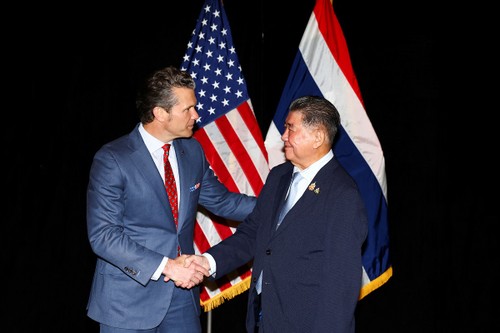 US Secretary of Defense Pete Hegseth meets with Thai Deputy Prime Minister and Defense Minister Phumtham Wechayachai on the sidelines of the Shangri-La Dialogue in Singapore, May 30, 2025. (Photo: REUTERS/Edgar Su) US Secretary of Defense Pete Hegseth meets with Thai Deputy Prime Minister and Defense Minister Phumtham Wechayachai on the sidelines of the Shangri-La Dialogue in Singapore, May 30, 2025. (Photo: REUTERS/Edgar Su) |
US-China relations in the spotlight
As in previous years, US-China relations and their impact on the region will be a dominant theme. The absence of Chinese Defense Minister Dong Jun means the expected first meeting of US and Chinese defense leaders since President Trump returned to office will not take place, but US Secretary of Defense Pete Hegseth’s appearance shows that the US continues to prioritize the Indo-Pacific region. A big concern is how the US’s policy and approach to the Indo-Pacific region under Biden will change under Trump. Ahead of his departure for Singapore, Hegseth said the US is not seeking conflict with anyone but “will deter that” to protect US interests.
"Under this administration, we will achieve peace and deterrence through strength. That's by working with and through allies and partners specifically in the Indo-Pacific. So that's why it's been a focus of ours from the beginning. It will continue to be. We're going out to Singapore to hold a series of meetings to ensure that region understands America will be strong," said Hegseth.
Observers say that following unexpected developments at European security forums earlier this year, most notably the Munich Security Conference, where senior US officials including Vice President Vance and Secretary of Defense Hegseth publicly signaled a scaling back of US security commitments to Europe in favor of other regions, this year’s Shangri-La Dialogue will clarify Washington’s evolving strategic defense and security priorities in the Asia-Pacific. Such a shift will have far-reaching implications for regional security. Douglas Bandow of the Cato Institute of the US said: "Our most important duty is to preserve peace today. And for the two leading nations, the PRC and USA, to maintain peace with each other and in the Asia Pacific, which preserve communication, promote conciliation, and encourage cooperation. Creating a shared future for all must not be treated as a zero-sum game."
Experts said the attendance of President Macron and Prime Minister Ibrahim, who are both known for advocating more neutral and balanced foreign policy approaches, reflects the region's emphasis on dialogue, cooperation, and maintaining strategic equilibrium between major powers.