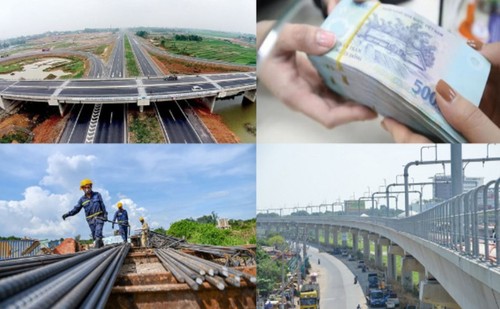
 (Illustrative photo: chinhphu.vn) (Illustrative photo: chinhphu.vn) |
Prime Minister Pham Minh Chinh has urged for the acceleration of public investment capital disbursement, saying by the end of the third quarter the disbursement rate of public investment capital must reach at least 60% of the annual plan and 100% by the end of this year.
Disbursement is accelerated to boost the economy
Capital disbursement is a key factor in creating jobs, stimulating growth, improving infrastructure, and ensuring social security.
In the reviewed period, Vietnam disbursed over 19 billion USD. Local budget capital recorded a disbursement rate of 58.3%, reflecting the active role and determination of local authorities in implementing public investment.
Thanh Hoa province reported a disbursement rate of 47.8% of the plan. Many projects, investors, and departments in the province completed 100% of their disbursement plans in the first eight months of 2025.
The Ministry of Construction is pushing the inauguration of 18 major projects, including key infrastructure works like expressways, railways, and large bridges. In the fourth quarter, 8 large-scale projects are scheduled to start, providing strong “leverage” for disbursement in the final stretch.
Deputy Minister of Construction Le Anh Tuan said public-invested finance will form a strategic infrastructure framework for guiding attracting private investment.
An important driver of growth
The Vietnamese Government is set to disburse 100% of public capital by the end of this year. All directives, instructions, and resolutions issued since the beginning of the year have required ministries, sectors, and localities to perform this top political task with close, focused supervision.
To accelerate disbursement, they will quickly allocate the remaining capital before September 30, resolve obstacles in land clearance, and improve decentralization and delegation mechanisms consistent with the two-tier local government model.
For national key projects, especially in transportation, the Government is demanding faster progress to complete at least 3,000 kilometers of expressways and 1,000 kilometers of coastal roads this year. ODA projects must quickly finalize investment procedures, bidding, and contract signing.
Localities must carefully manage revenues, promptly proposing adjustments in case of shortfalls to avoid capital shortages for implementation. It’s mandatory to strictly comply with progress reporting regulations on the National Public Investment Information System, which is the basis for monitoring and assessing the responsibility of each unit.
Deputy Minister of Finance Tran Quoc Phuong said: “Ministries, sectors, and localities must continue reviewing capital allocation. If there is no other demand, they must quickly complete procedures and report to the Prime Minister to reallocate funds to other localities, ministries, sectors, and projects. Implementation must be accelerated to ensure disbursement volumes in the remaining months of the year. Any obstacles within their authority must be promptly reviewed and resolved.”
Vietnam has set a GDP growth target at 8.3–8.5% for this year. Effective implementation of public investment disbursement will be crucial to achieving this goal, while also generating spillover effects for other socio-economic sectors.