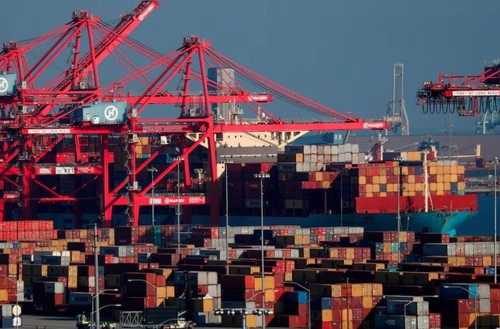
 (Illustrative photo: Reuters/ Mike Blake) (Illustrative photo: Reuters/ Mike Blake) |
According to the latest World Economic Outlook report released by the IMF ahead of its annual meeting, the global economy is projected to grow by 3.2% this year, more than the 3% forecast in July, but growth is expected to slow to 3.1% next year.
Dim long-term outlook
The IMF said the upward revision for this year’s growth mainly stems from a temporary surge in business and household spending ahead of higher tariffs taking effect. While a weaker dollar amplified the tariff shock, it also boosted global trade, keeping global financial conditions fairly stable.
The report noted, however, that medium- and long-term prospects are gloomy because global trade tensions are escalating. On October 10, US President Donald Trump announced an additional 100% tariff on Chinese goods starting November 1 in response to Beijing’s rare earth export restrictions. On October 15, Trump declared the US “in a trade war with China.” Although both sides later signaled a willingness to ease tensions and negotiate soon, economists believe US-China economic relations will continue to negatively impact the world’s medium- and long-term economic outlook.
WTO Director-General Ngozi Okonjo-Iweala said: “Our modelling shows that any kind of decoupling that divides the world into two trading blocks is going to result in significant global GDP losses in the longer term, up to 7% global GDP losses and double digit welfare losses for developing countries."
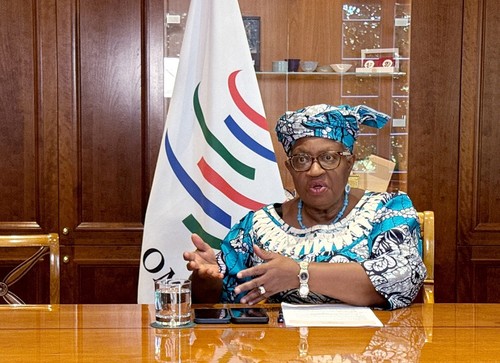 WTO Director-General Ngozi Okonjo-Iweala (Photo: Cecile Mantovani/Reuters) WTO Director-General Ngozi Okonjo-Iweala (Photo: Cecile Mantovani/Reuters) |
The IMF report indicated modest growth prospects for many economies. It forecast a slowdown in the US economy to 2% growth this year, a significant decline from last year, and only a slight increase to 2.1% growth in 2026.
The Eurozone is forecast to grow 1.2% this year and 1.1% next year. China’s economy is projected to decelerate to 4.8% growth this year and 4.2% next year. The IMF report said the effects of higher tariffs are spreading, particularly in the US, where inflation and unemployment have increased.
The IMF cautioned that inflation remains above target levels in many countries, and price outlooks are uncertain, which will complicate monetary policy. IMF Managing Director Kristalina Georgieva said: “Medium-term growth prospects remain weak, public debt is near record highs and continues to climb and the global economy is excessively imbalanced. The forces of change are making the global economy less predictable and it is impacting people.”
New hope
Despite the serious risks facing the global economy in the medium term, the IMF and other institutions have highlighted several factors that could drive growth. IMF Chief Economist Pierre-Olivier Gourinchas said one factor that helped offset tariff shock in the first half of 2025 was a surge in investment in artificial intelligence. The IMF estimates that AI may contribute between 0.1% and 0.8% of global growth, a relatively high figure given an average growth rate of just 3% in recent years.
In its Global Trade Report released on October 8, the WTO underscored AI’s growing role in global trade and its contribution to growth. WTO Chief Economist Marc Bachetta said: “Trade in AI-related goods was a key driver of the strong growth in the first half of 2025, with trade in these products rising 20% year-on-year in value terms, accounting for nearly half of year-on-year increase at the global level, despite representing less than 10% of total merchandise trade. The rise in AI-related trade seems to have been fueled by structural investments in digital infrastructure, from semiconductors to cloud servers.”
According to the IMF chief, another factor that may help the global economy avoid a collapse is that most countries have decided not to retaliate against Trump’s tariffs. She viewed this as one of the key factors strengthening economic resilience and avoiding a trade war that could severely harm global growth. Amid global trade uncertainties, many countries have chosen to diversify trade relations and seek new partners other than the US and China.
The European Union is seeking a connection with the Comprehensive and Progressive Agreement for Trans-Pacific Partnership, a free trade bloc of 11 countries, and is accelerating trade negotiations with India. On September 3, the EC approved a Free Trade Agreement with the Southern Common Market (MERCOSUR), a South American bloc.
Southeast Asian nations, Australia, New Zealand, and major African economies are diversifying trade partners. Egypt’s Minister of Planning, Economic Development, and International Cooperation Rania Al-Mashat said enhancing regional cooperation is an inevitable consequence of recent global events and will be a priority for most countries in the near future.