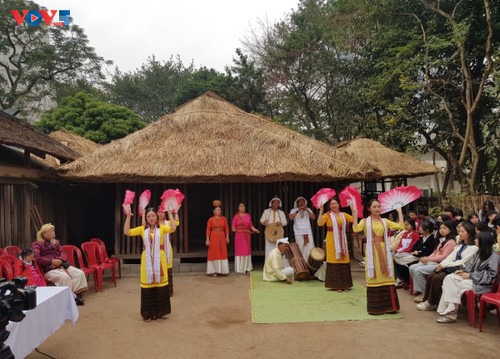
 The fan dance of Cham people (Photo: Ngoc Anh/ VOV5) The fan dance of Cham people (Photo: Ngoc Anh/ VOV5) |
The Cham people's cultural legacy is most notable in their temples, towers, and religious statues. Surviving Cham temples show that the Cham reached an advanced level of architectural sophistication. Cham towers, especially the My Son sanctuary, are regarded as on a par with Cambodia’s Angkor Wat and other temple complexes in Southeast Asia.
Khanh Hoa province has a Cham tower, the Po Klong Garai tower, that has been recognized as a special national relic. The tower was built in the late 13th century.
Thanh Nhay, Deputy Director of the Ninh Thuan Museum, said Po Klong Garai tower is the best-preserved example of Cham tower architecture still in existence today. Since it was officially recognized as a special national relic by the Prime Minister, the number of tourists it attracts has grown significantly, he said, adding information about the tower is available in both Vietnamese and English.
“We also provide an electric shuttle service. Musical performances which traditionally took place only during the Kate Festival, are now available on weekends, on public holidays, and during the Lunar New Year festival,” Thanh Nhay said.
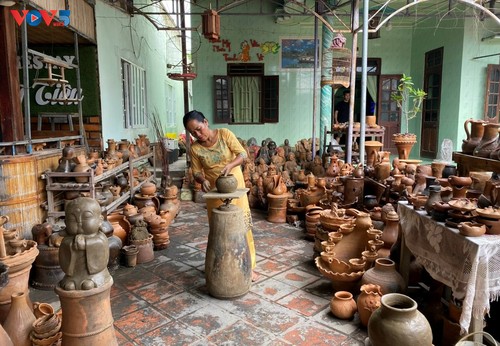 An artisan from Bau Truc pottery village works on a ceramic item. (Photo: Ngoc Anh/VOV5) An artisan from Bau Truc pottery village works on a ceramic item. (Photo: Ngoc Anh/VOV5) |
The cultural identity of the Cham people is also reflected in their traditional houses. Cham houses are spacious, with a unique architectural style consisting of 5 to 7 houses arranged in the shape of the letter "I" along an East–West axis.
“The Cham always locate a water source before building a house. The water well is always to the northeast, and the kitchen faces the northwest. The walls are made from mud and straw, mixed with water,” Dang Chi Quyet, a resident of Ninh Phuoc commune, said.
The Cham people have approximately 80 traditional dances, each associated with one of the 80 deities in their belief system. Most dances have a religious or ritualistic character, representing divine worship and royal ceremonies. Common dances depict the god Shiva and the goddesses Uma and Apsara. These dances may be performed solo or in groups.
Another prominent feature of the Cham culture is their festivals, the best-known being the Kate Festival.
Kate is a sacred folk festival held in the seventh month of the Cham calendar (from September 25 to October 25 in the Gregorian calendar). It’s a time to honor ancestors and commemorate national heroes, who are revered by the Cham as deities.
The Cham people have created a music that uses instruments not found in other cultures, including the ginang drum, the paranung drum, the saranai horn, the kanhi lute, and various gongs and rattles.
“The ginang drum consists of two long drums symbolizing human legs, the paranung drum represents the human torso and internal organs, and the saranai horn, with its seven holes, symbolizes two eyes, two ears, two nostrils, and one mouth,” said a Cham man named Camry.
The Cham drum is played in a unique manner. A Cham man named Ka Phiu said the drumsticks symbolize human hands. One person plays the ‘yin’ drum with their hand while another plays the ‘yang’ drum with a stick.
The Cham population is approximately 180,000, less than 1% of the national population , but they have a rich and unique culture that, together with 53 other ethnic groups, contributes to Vietnam’s cultural diversity.