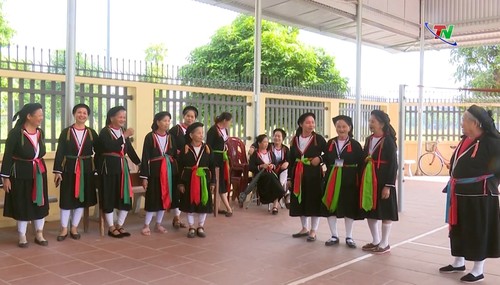
 The Tam Thai Soong Co Club in Dong Hy commune (Photo: Thai Nguyen TV) The Tam Thai Soong Co Club in Dong Hy commune (Photo: Thai Nguyen TV) |
In Dong Hy commune, members of the Tam Thai Soong Co Club gather at the local cultural house every week to practice Soong Co singing of the San Diu ethnic group. In their brightly colored traditional costumes, middle-aged women and men sit together in a circle, singing a call-and-response song.
“We have been preserving Soong Co singing for years. At this age, we can still participate in activities, gather, and sing together. That brings me the greatest joy,” said club members Au Thi Pham.
Another member Do Thi Tuyet said, “The culture of the San Diu people is deeply rooted in my heart. Every time I sing Soong Co, I feel happy.”
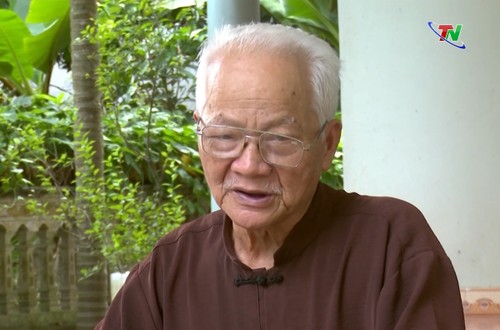 Emeritus Artisan Diep Minh Tai, the head of the Tam Thai Soong Co Club (Photo: Thai Nguyen TV) Emeritus Artisan Diep Minh Tai, the head of the Tam Thai Soong Co Club (Photo: Thai Nguyen TV) |
Since Soong Co singing in Dong Hy was recognized as a National Intangible Cultural Heritage in 2015, club activities have become even more widespread. Emeritus Artisan Diep Minh Tai, the head of the Tam Thai Soong Co Club, has been translating ancient books, recording Soong Co songs, and teaching them to the younger generation.
“Initially, the Tam Thai Soong Co Club operated only within the village. Over time, other clubs came to learn from its experience, sparking a shared movement that connects one commune to another, and even one province to another,” said Tai.
Tam Thai Soong Co Club member Le Van Tien said,“We still wear traditional costumes and sing Soong Co when we work in the fields or welcome guests. Our club has helped to promote the cultural identity of the San Diu people.”
In Vo Tranh commune, the San Chay people are working to preserve their Tac Xinh dance, a form of performing art that has been recognized as a National Intangible Cultural Heritage.
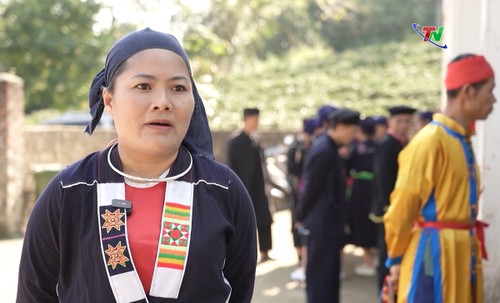 Tran Thi Bac, a member of the Vo Tranh commune Tac Xinh club (Photo: Thai Nguyen TV) Tran Thi Bac, a member of the Vo Tranh commune Tac Xinh club (Photo: Thai Nguyen TV) |
Tran Thi Bac, a member of the Vo Tranh commune Tac Xinh club, said: “I’m very proud to be a San Chay. I always keep in mind that I must preserve our Tac Xinh dance so it won’t fade away. This is an intangible culture, so we have to pass it on to one another.”
The club has 20 members who regularly practice and perform at cultural exchange events. Their dedication to preserving their cultural identity and the support of local authorities have made Tac Xinh dance a focus of the province’s efforts to safeguard its folk culture.
A similar effort to preserve traditional culture is being made by the Tay ethnic community at the Thai Hai Ecological Village, where Then singing and the melodies of the Tinh instrument can be heard.
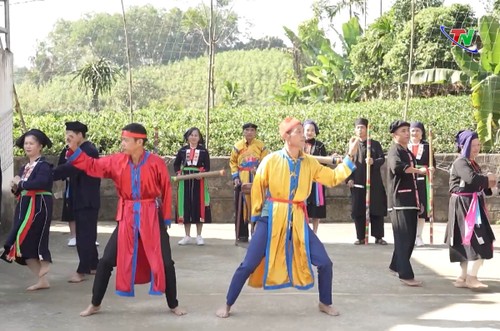 Tay artisans perform Then singing. (Photo: Thai Nguyen TV) Tay artisans perform Then singing. (Photo: Thai Nguyen TV) |
In Thai Hai, Then melodies continue to accompany festive occasions and New Year celebrations. The Thai Hai Ecological Village preserves the traditional stilt houses and customs of the Tay people and organizes classes where young people can learn to play the Tinh instrument and sing Then.
“Here, the traditional cultures of ethnic groups have been passed from generation to generation. I was taught by my grandparents and elders, and I have a responsibility to pass it on to my children and grandchildren,” villager Le Thi Hang said.
Thai Nguyen province is working to preserve hundreds of intangible cultural heritages. Clubs of Soong Ca, Tac Xinh, and Then singing have been established to preserve these heritages, engage the community in cultural activities, and meet the cultural needs of the local people.