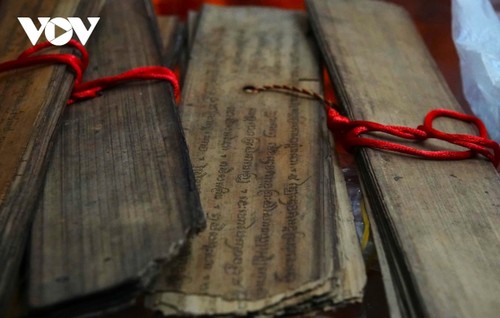
 To write Buddhist scriptures on Buong leaves, the writer must be able to read Pali and ancient Khmer scripts. (Photo: Hong Phuong/VOV) To write Buddhist scriptures on Buong leaves, the writer must be able to read Pali and ancient Khmer scripts. (Photo: Hong Phuong/VOV)
|
More than 4,000 manuscripts are preserved at a library located on the top floor of the Pitu Khosa Rangsay Khmer pagoda in Ninh Kieu district, Can Tho city. Among them are 30 century-old scriptures written in Pali on palm leaves. This library, considered a priceless treasure of the pagoda, has attracted visitors from more than 60 countries.
"These ancient palm-leaf scriptures cover various topics, such as Buddhist teachings, the Buddha’s past lives, and rituals of the Khmer people. At Pitu Khosa Rangsay pagoda we’ve gathered many of these scriptures for future monks to study and learn from," Venerable Ly Hung, Deputy Head of the Buddhist Sangha of Can Tho city and abbot of Pitu Khosa Rangsay pagoda, said.
The Buong leaf is a type of long, thick palm leaf that resembles layered plywood. Each leaf can be split into three strips, each measuring 50–60 cm in length and 5 cm in width. After harvesting, the leaves must be soaked in tree resin to keep them fresh, mold-free, and durable.
Engraving letters onto Buong leaves requires precise manual dexterity to ensure that the etchings are consistently deep. The stylus is made of polished wood with a sharp metal tip. After engraving, the monks apply a mixture of water, kerosene, and charcoal to the leaves, then let them dry. This process reveals the letters in sharp, beautiful contrast. A complete scripture may consist of 20 to 60 leaves.
Buong leaf scriptures fall into four categories: Buddhist sutras (the most sacred, only read on important occasions), folk tales, festivals and traditional games, and moral teachings.
"In Khmer culture, people do not store Buong scriptures at home—they are kept only in pagodas for ceremonial use. These leaves hold ancient inscriptions, which are very difficult to read except by someone trained in a pagoda," Chau Mo Ni Soc Kha, a Khmer cultural researcher, said.
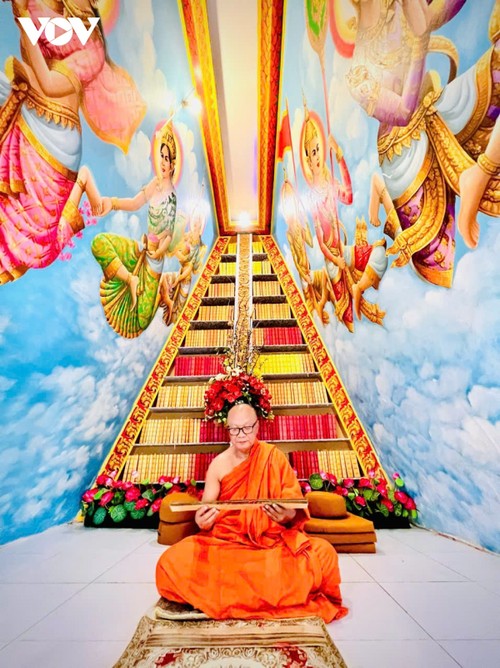 The centuries-old collection of ancient books at Pitu Khosa Rangsay Pagoda in Can Tho City attracts visitors from all over the world. (Photo: Hong Phuong/VOV) The centuries-old collection of ancient books at Pitu Khosa Rangsay Pagoda in Can Tho City attracts visitors from all over the world. (Photo: Hong Phuong/VOV) |
83-year-old People’s Artisan Venerable Chau Ty, the abbot of Soai So pagoda in An Giang province, is the only person in the province who has fully mastered the technique of writing on Buong leaves. He is the ninth-generation successor of the head monk of Xvay Ton Pagoda. For many years, he has taught the technique to young monks and the Khmer community.
Writing these scriptures requires a deep understanding of Pali and ancient Khmer scripts, both of which are challenging to master. Furthermore, Buong leaves are becoming rare, so preservation is urgent. An Giang province recently approved a project to preserve the Khmer Buong-leaf writing which includes digitizing, archiving, and restoring damaged scriptures. The project will focus on reproducing key manuscripts for heritage education, tourism development, and extracurricular school programs and competitions.
"In An Giang, Venerable Chau Ty has been teaching young monks to write these palm-leaf scriptures for many years. We want to expand this effort to other areas. We invite artisans and young monks from across the Mekong Delta to come and study at the Khmer Theravada Buddhist Academy to help preserve these ancient scriptures for later generations,” Venerable Ly Hung said.