Ha Hoi 2025 features talk shows, art experience tours, podcasts, and documentaries to provide a contemporary perspective on Tuong, Vietnam’s most scholarly theatrical form.
The project started with an event called “Ha Hoi Talkshow – The Next Chapter”, held on July 14 in Hanoi, drawing a large audience of young people. The talk show involved researchers and artisans discussing the history of Tuong and why it is considered a scholarly art.
“Tuong is a traditional Vietnamese art form with a long history. In the 18th and 19th centuries, during the Nguyen dynasty, it was elevated to the status of national theatre. The playwrights were often highly educated officials, and Emperor Tu Duc himself wrote Tuong,” said Ta Van Sop, former Deputy Director of the Vietnam Tuong Theatre.
The art developed with a strict set of rules and principles, from literature to music, visual arts, makeup, costumes, and the integration of singing, dancing, and acting to create a complete Tuong performance, he added.
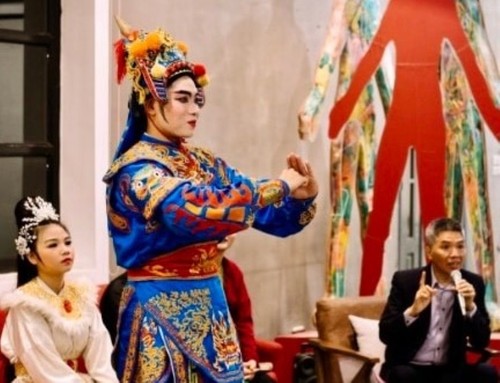 “Ha Hoi Talkshow” offers the audience a chance to interact and engage in dialogue about Tuong with renowned artists. (Photo: Organizing Board) “Ha Hoi Talkshow” offers the audience a chance to interact and engage in dialogue about Tuong with renowned artists. (Photo: Organizing Board)
|
At the talk show, Sop engaged with younger artists and content creators about nurturing a love for traditional arts and strengthening intergenerational bonds in the digital age.
“This community-oriented project aims to bring Tuong closer to the public. I’m very happy to be part of the Ha Hoi project. It’s encouraging to see so many young people come to learn about Tuong. Ha Hoi is really sparking an interest in traditional arts,” said young artist Nguyen Thi Thanh Phuong.
A significant component of Ha Hoi 2025 is a documentary called “Ha Hoi – Dreams of Tuong”. The film, directed by Nguyen Huu Thai Son, was shot in Phu Man, a traditional Tuong village in Bac Ninh province. Son, who studied for years in Canada, portrays Tuong as a dialogue between its long tradition and today’s youth. He made the film with the intention of introducing Tuong to a global audience.
“It takes an artist years to master one line or one hand movement. It’s not easy. The film captures my personal emotions as a newcomer to Tuong,” said Son.
Ha Hoi 2025 will produce “Ha Hoi Tour – River of Tuong”, a fusion of outdoor performances and immersive theater, in August; the “Reverie on Tuong” podcast series from September to December; and a screening of Son’s documentary in January. The project hopes to build a sustainable mechanism for Tuong artists to perform regularly, pass down their skills, and create new work.
“Today, people see theatre as something that can exist anywhere. When you see it that way, new approaches to preserving Tuong emerge. Our project emphasizes how indigenous factors affect local culture. We hope that people can experience traditional theater anywhere, especially in village communal houses, places that nurtured the traditional values of Tuong,” said project leader Bui Yen Linh.
Ha Hoi 2025 suggests that the younger generation still values traditional arts and wants to contribute to preserving and promoting them.