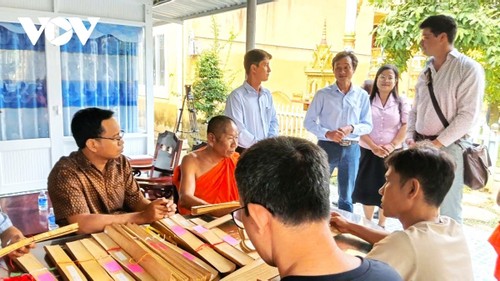
 Representatives of the Canada Fund for Local Initiatives in the Mekong Delta work with Vietnamese partners in the “Digitizing Palm-Leaf Manuscripts” project. (Photo: VOV) Representatives of the Canada Fund for Local Initiatives in the Mekong Delta work with Vietnamese partners in the “Digitizing Palm-Leaf Manuscripts” project. (Photo: VOV) |
Originating in Southern Vietnam in the mid-19th century, palm-leaf manuscripts are invaluable cultural treasures that carry profound spiritual and religious significance for the Khmer community.
Today, however, these manuscripts are increasingly vulnerable to environmental damage, and the traditional craft of inscribing characters on palm leaves is gradually disappearing.
In response to this urgent situation, a digitization project has been launched to preserve and safeguard this unique heritage.
“The project has attracted experts from Tra Vinh University, as well as monks from local pagodas and teachers from the Vinh Long Pali-Khmer Continuing Education School. However, the implementation has encountered several challenges, including a lack of equipment,” said Dr. Huynh Sang, Deputy Head of the Administration Section at the School of Southern Khmer Language, Culture, Arts and Humanities.
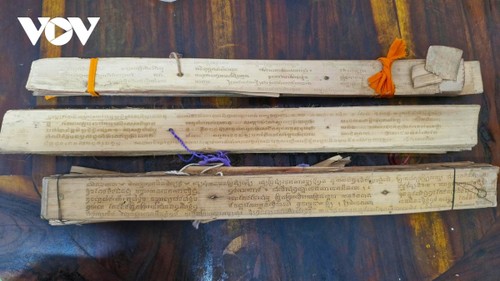 Palm-leaf manuscripts are invaluable assets containing cultural, technical, aesthetic, and artistic values. (Photo: VOV) Palm-leaf manuscripts are invaluable assets containing cultural, technical, aesthetic, and artistic values. (Photo: VOV) |
1,300 palm-leaf manuscripts – over 60,000 pages – have been collected. Around 84% of them contain written text from 13 special categories, including sutra, teachings, and words of wisdom.
Dr. Ngo So Phia, Rector of the School of Southern Khmer Language, Culture and Arts and Humanities, said these digitized resources constitute a rich linguistic corpus, enabling lecturers and students to learn about the evolution of the Khmer language and gain insights into their cultural heritage.
“The project’s primary aim is to preserve the invaluable heritage handed down by our ancestors and make ancient palm-leaf manuscripts more accessible to students and researchers. These materials allow us to study and compare ancient and modern language forms and pursue specialized academic paths,” said Phia.
Digitizing palm-leaf manuscripts begins with identifying, classifying, and summarizing the contents of each manuscript collection. Next, the manuscripts are photographed, the images undergo post-processing, including lighting correction, alignment, cropping, and organization, and a digital database is built.
Digitizing palm-leaf manuscripts is not a simple matter of changing the storage format. It’s a multi-step process of translation, from physical objects to digital data and from digital data to readable text. At each stage, there’s a risk of distortion or loss of the original meaning, calling for the highest level of care throughout the process.
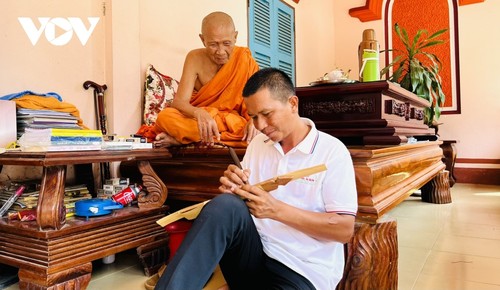 Kim Som Ri Thi, a teacher of Khmer palm-leaf inscription at Soai So pagoda in Tri Ton commune, An Giang province, learns the craft from Venerable Chau Ty. (Photo: VOV) Kim Som Ri Thi, a teacher of Khmer palm-leaf inscription at Soai So pagoda in Tri Ton commune, An Giang province, learns the craft from Venerable Chau Ty. (Photo: VOV) |
Several Theravada Khmer Buddhist pagodas have placed special emphasis on passing down traditional knowledge to younger generations.
Kim Som Ri Thi, a teacher of Khmer palm-leaf inscription at Soai So pagoda in Tri Ton commune, An Giang province, said engraving the texts helps learners gain a deeper understanding of phonetics and ancient scripts, and exposes them to the moral values and life philosophies that their ancestors embedded in each page.
“I hope the younger generations will cultivate a deep and lasting interest in this craft, along with a genuine curiosity in ancient Khmer script,” he said.
“They should learn how palm leaves are prepared for inscription and explore the rich collections of manuscripts passed down by our ancestors.”