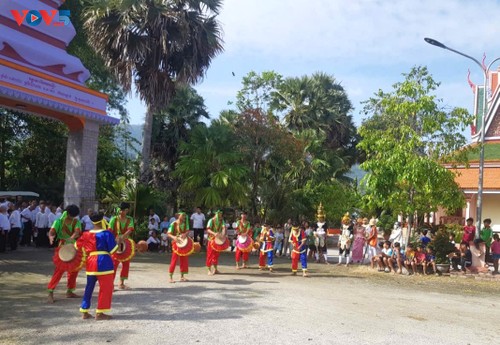
 A performance of the Chhay-dam drum dance at Soai So Pagoda, An Giang Province (Photo: Ngoc Anh/VOV5) A performance of the Chhay-dam drum dance at Soai So Pagoda, An Giang Province (Photo: Ngoc Anh/VOV5) |
The Chhay-dam drum dance originated from the Khmer epic Reamker in which good confronts evil and justice ultimately triumphs. The main instrument is the Chhay-dam drum, shaped like an elephant’s leg. It is crafted from hollowed jackfruit or areca wood, with a drumhead made of stretched buffalo hide or cowhide and decorated in bright colors such as yellow, red, and blue.
The dance is distinctive in its movements. Performers sometimes lie flat on the floor while playing a drum. Two dancers might pass a drum back and forth as they strike it.
The costume for the Chhay-dam dance usually involves a sarong, the traditional wrap worn by both Khmer men and women. Female performers also wear a chang pong, a cloth wrapped across the chest that leaves the midriff exposed.
Strong, rhythmic drumbeats evoke the heroic battles of Khmer warriors, pay tribute to the deities, and express hopes for bountiful harvests and peaceful lives, creating an atmosphere that’s exciting yet solemn and deeply meaningful.
The Chhay-dam drum dance troupe at Snaydonkum pagoda in O Lam commune, includes 50 young males aged 12 to 20. Experienced artists train the troupe and once members become skilled, they pass on what they have learned to others.
“We practice in the evenings, each session lasting 2 to 3 hours. At first, it was quite difficult because the movements must be precise and strong. I’ve liked the Ogre character since I was a child, and the more I practice, the more fascinated I become. The Ogre, who symbolizes evil, usually wears black or blue,” said member Chau Ne Som Nath.
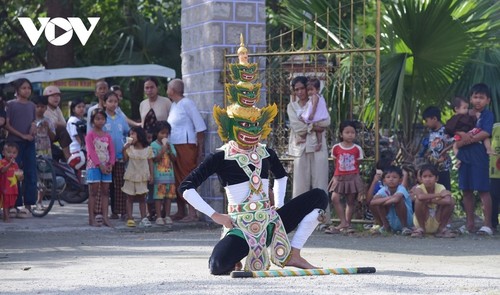 Chau Ne Som Nath as the Green Ogre (Photo: Le Hoang/VOV) Chau Ne Som Nath as the Green Ogre (Photo: Le Hoang/VOV) |
Chhay-dam drum dance may also include the monkey god Hanuman, whose playful gestures – laughing, bowing, scratching, jumping, and showing affection – add lively humor to the show. Watching a Chhay-dam dance often puts visitors in a happy mood.
The dance is indispensable at major Khmer festivals like Chol Chnam Thmay (Khmer New Year), Dolta (the ancestral remembrance festival), and Ok Om Bok (the Moon Worship Festival), as well as in Buddhist processions.
“We often perform for Khmer festivals and holidays. I play the role of the hermit’s wife, which requires soft, flexible gestures. We usually have 12 to 14 performers playing drums and fiddles and wearing masks and crowns. It’s very enjoyable to perform for visitors,” said Chau Kranh, another member of the troupe.
To a catchy drum rhythm, the young performers of the Chhay-dam troupe at Snaydonkum pagoda portray familiar characters from the Reamker epic. They include Prince PreahReam - the main character - who symbolizes compassion, virtue, and justice; Princess Sita - a faithful and virtuous woman; the Ogre King Reap - the main antagonist - who symbolizes evil and brutality; and the monkey god Hanuman - one of the most powerful and revered figures of Hindu mythology.
Hanuman is known from the epic Ramayana as the loyal companion of Prince Rama. As the son of the wind god Vayu, Hanuman symbolizes courage, absolute loyalty, wisdom, and extraordinary strength.
Each character is distinguished by their typical costume, body movements, and identifying drum rhythms.
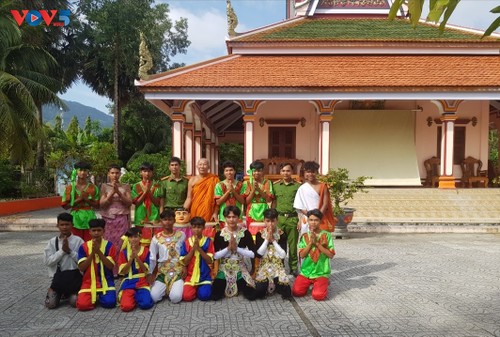 The Chhay-dam drum dance troupe of Snaydonkum Pagoda takes photo with Venerable Chau Son Hy. (Photo: Ngọc Anh/VOV5) The Chhay-dam drum dance troupe of Snaydonkum Pagoda takes photo with Venerable Chau Son Hy. (Photo: Ngọc Anh/VOV5) |
“I first got to know the dance through TikTok videos and found it very interesting. When I heard there was a class to learn the dance, I signed up. Anyone who wants to, can participate,” said Chau Phak Kday, another member of the Snaydonkum troupe.
“At first it was very difficult, but after a time you begin to catch on. It takes one or two months to become skillful. The team leader assigns roles according to each person’s suitability. We used to invite teachers to train us at the pagoda in the evenings, but now we can teach one another,” he added.
Last year, Chhay-dam drum dance in An Giang province was recognized as a National Intangible Cultural Heritage.