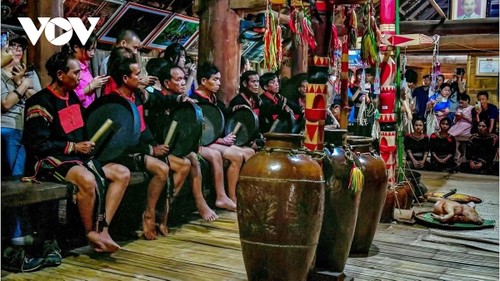
 Jars of rice liquor are indispensable offerings in the maturity ceremony of the E De people in the Central Highlands. (Photo: Thanh Ha/VOV) Jars of rice liquor are indispensable offerings in the maturity ceremony of the E De people in the Central Highlands. (Photo: Thanh Ha/VOV) |
Cultural diversity is reflected in Vietnam’s three major cultural regions, each with its own distinct identity and heritage.
In the North, centered around the Red River Delta, culture i s deeply rooted in wet rice cultivation. This region preserves traditional village life, the worship of tutelary gods, agricultural rituals, and a wide range of folk music forms, including quan ho folk songs, ca trù (ceremonial singing), and chèo (popular opera).
The Central region is a cultural crossroads of Vietnamese, Cham, Chinese, and Khmer influences, known for Cham architecture, Hue royal court music, Tuong theater, and numerous traditional craft villages.
Meanwhile, the South is a multi-ethnic region, home to Vietnamese, Chinese, Khmer, and Cham communities, characterized by an open and dynamic lifestyle, rich spiritual beliefs, distinctive folk festivals such as Ok Om Bok and Nghinh Ong (Whale Worshipping), and the traditional musical genre don ca tai tu (amateur singing).
“Throughout history, despite differences in natural conditions and living environments, the ethnic groups and regions of Vietnam have shared a common journey of national construction and defence. They have faced historical changes, overcome challenges, and celebrated socio-economic achievements together. It is this close interaction between natural conditions, history, and society that has shaped Vietnamese culture that is unified in diversity,” Dr. Nguyen Duy Bac, Vice President of the Ho Chi Minh National Academy of Politics, said.
Localities that effectively preserve cultural heritage and meet the spiritual and cultural needs of their people tend to experience strong socio-economic development. To achieve this, it is essential first to raise public awareness about the importance of preserving and promoting cultural heritage. This is not only a patriotic act but also a way to enrich and diversify Vietnamese culture while strengthening resilience against external cultural influences.
At the same time, fostering national pride and confidence in Vietnam’s cultural identity is particularly important. Moreover, cultural preservation must go hand in hand with promoting heritages, which can stimulate tourism development and directly contribute to the socio-economic growth of each locality.
“First, we need to regard communities as the subjects of culture, not merely as objects to be preserved. Places like Hoi An ancient town, Duong Lam ancient village, or the Mekong Delta all need to be empowered and provided with resources to maintain their identity. Second, investment should be strategic and targeted. It is also essential to take care of the living treasures, including artisans, and those who uphold the spirit of cultural identity. We also need mechanisms to encourage and reward younger generations to carry on this legacy,” Associate Professor Dr. Bui Hoai Son, permanent Member of the National Assembly's Committee for Culture and Social Affairs, said.
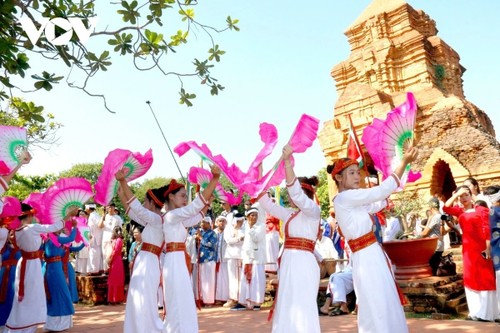 The Khmer people’s Kate Festival at the Po Sah Inu Temple Tower, Lam Dong province (Photo: Doan Si/VOV) The Khmer people’s Kate Festival at the Po Sah Inu Temple Tower, Lam Dong province (Photo: Doan Si/VOV) |
In the process of international integration, cultural diversity and unity not only generate internal vitality for Vietnam but also provide the foundation for the country’s soft power.
“Vietnam is a nation of multiple ethnicities, religions, and regional identities, which gives its culture a profound and inherent diversity. Yet, despite these differences, Vietnamese culture rests on a strong, unified foundation, grounded in core values shaped over thousands of years. The interplay between unity and diversity in cultural development is not only a practical reality but also a fundamental theoretical concern. Understanding this relationship provides guidance for cultural policies, helps safeguard national identity, and fosters openness, creativity, and international integration,” Associate Professor Dr. Pham Duy Duc, from the Institute of Culture and Development, said.
It is clear that, when valued as a special resource, cultural diversity contributes to preserving national identity, promoting tourism, fostering creative industries, and driving socio-economic development, while strengthening national solidarity.
In the context of international integration, harmonizing preservation with innovation, and maintaining traditions while promoting modern representation will enable Vietnamese culture to become global, helping affirm Vietnam’s position and identity on the international stage.