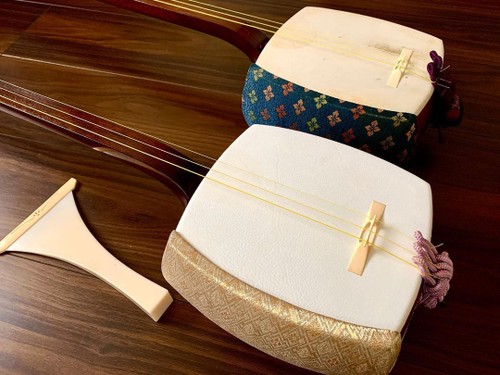
 The Shamisen is Japan’s iconic three-stringed instrument and popular in Japanese folk music (Photo credit: Yasushikita) The Shamisen is Japan’s iconic three-stringed instrument and popular in Japanese folk music (Photo credit: Yasushikita) |
Minyo is the name given to the folk songs that the common people of Japan sing as they go about their daily lives. Loved by men and women all ages and passed on orally, there are over 58,000 of these songs with many regional rhythms and styles. Some of these traditional songs are extremely old – there is an ancient one still sung today called “Kokirikobushi” that's been performed annually for over 1,000 years in Gokayama, a farming village in Toyama.
Minyo songs are often accompanied by traditional instruments like the shamisen, a three-stringed, plucked musical instrument similar to a guitar, and the shakuhachi, a type of bamboo flute.
After watching a minyo performance, Ibusuki Momoko said, “Listening to the lyrics, I remember that these songs were part of people's everyday life, and the lyrics still feel very familiar and relevant. It's a music that calms you down and helps you relax.”
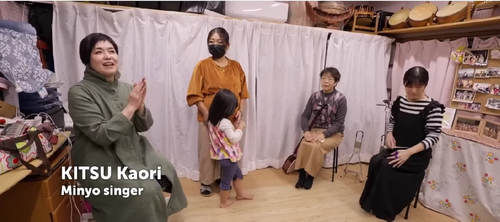 Singer Kitsu Kaori teaching children to sing minyo (Photo: screen shot of the video provided by the Embassy of Japan) Singer Kitsu Kaori teaching children to sing minyo (Photo: screen shot of the video provided by the Embassy of Japan) |
Minyo folk songs were passed down orally and never written down. Because they're learned by ear, even children too young to read can master them. A distinctive characteristic of minyo is the special vocal technique known as kobushi, which produces a vibrating, growling effect.
Minyo singer Kitsu Kaori said that in kobushi technique you repeat sounds but in a different way each time. This produces a short, irregularly vibrating effect.
“These lyrics, handed down to us from people in the past, are full of their feelings and emotions. When I sing, I try to feel the way they did and convey that to the listeners,” said Kitsu Kaori.
Most minyo originated in farming villages. In Gokayama village in Toyama, famous for its well-preserved thatched farmhouses, locals sing “Kokiriko-bushi”, said to be the oldest folk song in Japan. It dates back over 1,000 years. Farmers originally sang it in the fields before planting rice, as a prayer for good harvests. These days it's sung at the shrine, with dancing, as part of the autumn harvest celebration.
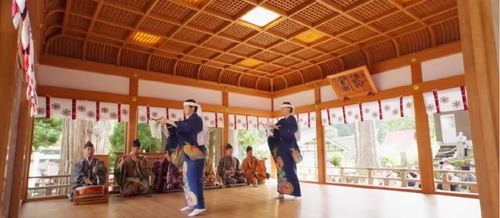 A minyo performance organized by Gokayama villagers in Toyama (Photo: screen shot of the video provided by the Embassy of Japan) A minyo performance organized by Gokayama villagers in Toyama (Photo: screen shot of the video provided by the Embassy of Japan) |
The lyrics say: “A bird is chirping on the hillside. It flies up, chirping. It flies down, chirping.” When a Japanese farmer hears birdsong in the early morning, he knows it's time to go out and weed his fields.
Iwasaki Kihei, Chair of the Ecchu Gokayama Kokiriko Preservation Society, said, “When a farmer hears this bird chirping at dawn, he realizes it's morning and he must go to work. It's like an alarm clock – time to get up and go cut the weeds. It’s a picture of daily life in the mountains. Every line of the songs tells us something about how people lived in the old days.”
The roots of minyo are in Japan’s agricultural society, where music was an integral part of work and community life. Folk songs, sung for work, festivals, and social gatherings, reflected the rhythms and patterns of everyday life.