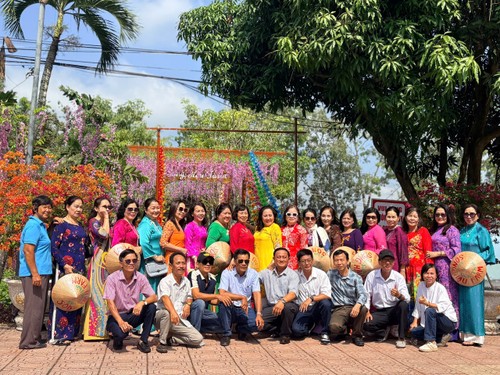
 Visitors take photos at Song Hau Farm Visitors take photos at Song Hau Farm |
In Thoi Hung Commune of Can Tho City, Song Hau Farm sits among canals and cajuput trees, covering nearly 14 hectares of open countryside. The splash of water. The sudden laughter. Children calling out as fish dart through muddy hands.
Here, visitors do not stand on the banks and watch. They step down into the canal. One of the most popular experiences is draining a small waterway and catching fish by hand, just as farmers once did. Trousers rolled up, feet sinking into soft clay, guests search beneath the surface for snakeheads and catfish, slipping and laughing as they go.
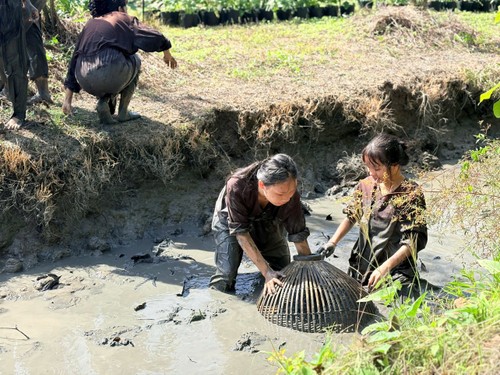 One of the most popular experiences is draining a small waterway and catching fish by hand, just as farmers once did One of the most popular experiences is draining a small waterway and catching fish by hand, just as farmers once did |
“When we came here, I saw how happy my children were. They didn’t ask for phones or tablets. They just played in the water and tried to catch fish. Watching them, I suddenly remembered my own childhood. We used to play outside like this, carefree. Here, the space is wide and peaceful. You can sit together, eat together, talk without being rushed. What I like most is that feeling of slowing down.”
For Dat Bach, a visitor, the trip was a short family getaway. He came to Song Hau Farm with his wife and two children on a weekend, hoping the kids could spend more time outdoors instead of indoors with screens. Not far away, straw is gathered. The freshly caught fish are placed directly onto the fire, a simple, traditional way of grilling. The crackle of burning straw mixes with conversation.
Nearby, visitors try their hands at pouring rice batter into hot pans to make sizzling pancakes, the scent of coconut milk drifting through the air. For Tran Minh Cuong, Deputy Head of the site’s management board, the philosophy behind the farm is straightforward.
“At Song Hau Farm, we focus on green, clean, and safe values. What we serve comes directly from what we grow and raise here. Vegetables are cultivated naturally, and the fish, frogs, and eels are raised in clean conditions. We want visitors not only to enjoy the food, but to understand how rural life works," Tran Minh Cuong said.
Guests can also take small motorboats into the cajuput forest, where the air cools and the sounds of the city feel far away. Beyond water games and folk activities, the farm prepares traditional Ao ba ba, a long-sleeved, button-down silk shirt with a scooped neck paired with silk pants and Ao dai, a long, fitted silk tunic with high side slits worn over loose-fitting trousers. They are for rent so guests can take photos in authentic Southern attire. For those joining muddy canal games, appropriate clothing is also provided, ensuring that visitors can participate comfortably and naturally. According to Tran Nhu Dien, a staff member at Song Hau Farm, the eco-tourism site places as much emphasis on emotion as it does on service quality.
“Besides joining the water games and traditional folk activities, visitors can also enjoy a variety of Southern folk cakes such as sizzling pancakes and steamed rice rolls. These are typical Mekong Delta specialties. So guests can have fun, enjoy light dishes, and sit together to chat and relax at the same time,” Tran Nhu Dien said.
You are listening the Sunday Show, highlighting the nostalgic journey where the past is relived through familiar sights and sounds. The simple idea - creating a space where people can slow down and reconnect - is not unique to the river plains. In Hua Tat Village, Van Ho District, Son La Province, communities are also finding their own ways to keep traditions alive while opening their doors to visitors.
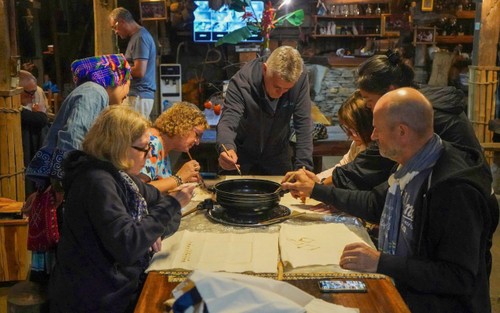 Visitors enjoy an experiential activity at Hua Tat Village, Van Ho District, Son La Province. Visitors enjoy an experiential activity at Hua Tat Village, Van Ho District, Son La Province. |
The lively rhythm of bamboo being pounded echoes through the courtyard of Homestay A Chu. It is part of a hands-on experience that many visitors eagerly join — the traditional craft of making dó paper. In the fresh spring air of Hua Tat Village, the activity brings both laughter and quiet concentration.
After spending a day exploring the village, walking past traditional wooden houses and trying his hand at paper-making, Mr. Philippe, a French visitor, says what impressed him most was the authenticity of the place.
“Vietnam’s landscape is very beautiful and peaceful. Especially here in Hua Tat Village, tourism has not been overly commercialized. It’s wonderful that the culture remains authentic. Daily life and traditional customs are still preserved, something that many other places have unfortunately lost,” said Philippe.
This authenticity survives because villagers continue to practice what their ancestors handed down. For Trang A Cua, a Hmong artisan in Hua Tat, making Do paper is not simply a demonstration for tourists, it is part of his family’s heritage.
“This paper-making craft has been handed down from my grandparents and parents. I continue to preserve it both for our own community and to introduce it to visitors. I hope that in the future, my children and other families in the village will join us in maintaining this traditional Hmong occupation, so it doesn’t disappear,” Trang A Cua.
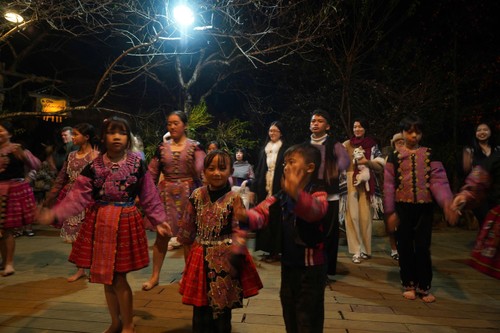 A performance by local children at Hua Tat Village, Van Ho District, Son La Province. A performance by local children at Hua Tat Village, Van Ho District, Son La Province. |
As night falls, a fire is lit in the yard. Villagers and guests gather around, talking and sharing food. The sound of the Hmong flute rises clearly in the cool evening air, a familiar melody often heard during festivals and community gatherings. In Hua Tat, culture is not performed on a stage. It is part of daily life — in the crafts people practice, the games they play, and the music they continue to pass down from one generation to the next.
And in another ancient village in northern Vietnam, heritage is also preserved in everyday life — this time through old houses, communal courtyards, and traditions that have endured for centuries. Not far from Hanoi’s bustling urban center lies Duong Lam Ancient Village in Son Tay Town. Passing through its laterite gate feels like stepping into a quieter rhythm of time.
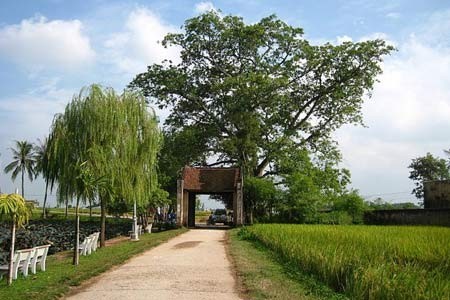 The village gate is strongly imbued with architectural features of the Viet old village with banyan tree and river wharf. (Photo: www.vietbao.vn) The village gate is strongly imbued with architectural features of the Viet old village with banyan tree and river wharf. (Photo: www.vietbao.vn) |
The traffic noise fades, replaced by narrow brick lanes and wooden doors that have stood for centuries. Here, tourism unfolds gently within everyday life. Nguyen Van Hung, owner of one of the village’s oldest houses in Mong Phu Hamlet, has welcomed visitors into his home for many years.
“When visitors come, we invite them in for tea. We sell traditional sweets like Che Lam or nutty ginger sticky rice bar. Doing tourism at home means guests can experience our daily life. My family has several dozen bicycles for rent. Groups can cycle around the village, then come back here to eat. Some days we serve up to ten foreign tour groups. Sometimes we arrange short farming activities including digging sweet potatoes or harvesting cassava, so they can understand rural work. We can also organize folk singing performances. Foreign visitors really enjoy those experiences,” Nguyen Van Hung said.
Inside these old houses, guests learn to make soybean sauce, prepare traditional sweets, or simply sit in quiet courtyards shaded by ancient trees. One visitor shared her reflection: “I feel really proud that Vietnam has preserved villages like this for hundreds of years. Sitting in this old house and taking part in these simple activities helped me understand how our grandparents once lived. I hope these villages can be protected for a long time, so future generations can come here and experience this way of life themselves. It’s peaceful, clean, and the people are so kind.”
Tourism is not about building something new. It is about opening daily life to visitors. They catch fish by hand. They press bamboo pulp into paper frames. They grind corn with heavy stone mills. They cycle along brick paths worn smooth by generations.
In return, communities gain income and renewed pride in their traditions. Young people see that heritage is not just something to remember, but something to practice. Experiential tourism in Vietnam does not keep visitors at a distance. Rather, it invites them to step in and truly be a part of local life.