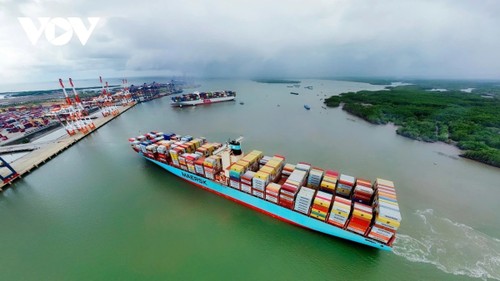
 Cai Mep port has a distinct advantage of wharf length and its capacity to accommodate ultra-heavy vessels. (Photo: Luu Son/VOV-Ho Chi Minh City) Cai Mep port has a distinct advantage of wharf length and its capacity to accommodate ultra-heavy vessels. (Photo: Luu Son/VOV-Ho Chi Minh City) |
Over the 2021–2025 period, the city’s total export turnover rose from 80.26 billion USD to 95.8 billion USD, while imports increased from 79.73 billion USD to 98.2 billion USD. The export structure has been diversified, centered on key processing and manufacturing industries such as electronics, computers and components; machinery and equipment; textiles and footwear; wood and wood products; pharmaceuticals and chemicals; technical rubber; and high-tech plastics.
The city’s exports have maintained growth in the United States, the European Union (EU), China, Japan, and the Republic of Korea, while expanding into markets covered by free trade agreements, including the Comprehensive and Progressive Agreement for Trans-Pacific Partnership, the Regional Comprehensive Economic Partnership, the EU–Vietnam Free Trade Agreement, and the UK–Vietnam Free Trade Agreement. The city has also begun to penetrate into emerging markets in the Middle East, South America, and Africa.
Entering a new phase, alongside maintaining a strong presence in traditional markets such as the United States, China, the EU, Japan, and the Republic of Korea, Ho Chi Minh City is aiming to expand to the Middle East, South Asia, Africa, Latin America, and high-standard niche markets. The city is also leveraging industrial shifts toward high-tech sectors, including advanced electronics, industrial machinery, pharmaceuticals, biotechnology, application software, and fintech.
Local authorities are reviewing and developing high-potential product lines such as Halal-certified goods, Kosher-certified products, fresh fruit for the European and US markets, as well as green, circular, and low-carbon-emission products.