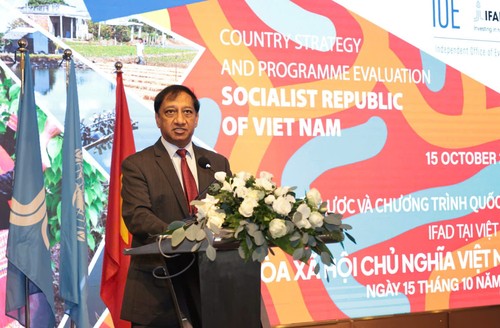
 Dr. Indran A. Naidoo speaks at the Vietnam Country Strategy and Program Evaluation National Roundtable in Hanoi on October 15, 2025. (Photo: IFAD) Dr. Indran A. Naidoo speaks at the Vietnam Country Strategy and Program Evaluation National Roundtable in Hanoi on October 15, 2025. (Photo: IFAD) |
Bao Tram: Thank you, Dr. Indran Naidoo for taking the time with us. You have recently made field visits to the Mekong Delta to evaluate projects there. Could you share with us the key findings?
Indran Naidoo: Thank you very much. This has been a positive and encouraging evaluation. Over the period assessed, covering close to 700 million USD in programming, IFAD’s support has had a significant impact on improving the livelihoods of smallholder farmers — particularly in market access, value chain development, and access to rural finance.
During our field visits in the Mekong Delta, we saw firsthand how projects are helping smallholders adapt to climate change. Early warning systems, for example, now deliver real-time weather updates directly to farmers’ smartphones, allowing them to make informed decisions.
We interviewed more than 500 stakeholders, and many confirmed visible improvements in their lives since project implementation — reaching roughly two million beneficiaries nationwide. This success reflects not only IFAD’s partnership with Vietnam but also the country’s strong rural development strategy, which effectively integrates policies aimed at empowering local communities.
Bao Tram: There has been significant progress, but what about the challenges?
Indran Naidoo: Reaching the most vulnerable — including women, ethnic minorities, and people in remote areas — is a central pillar of IFAD’s work. Our evaluation found that while progress has been made, challenges remain due to geographical and infrastructural constraints.
The government’s strong commitment to inclusiveness is evident, and future country programs will build on these efforts. One of our key recommendations is to further strengthen targeting mechanisms to ensure that resources reach those who need them most. We believe that with continued focus, the next evaluation — in about eight to ten years — will show even more positive results.
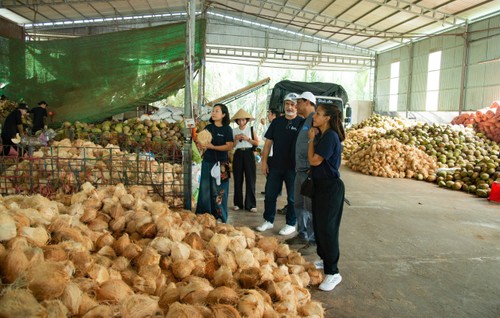 The IFAD evaluation team visits a coconut workshop in Ben Tre province. (Photo: IFAD) The IFAD evaluation team visits a coconut workshop in Ben Tre province. (Photo: IFAD) |
Bao Tram: How would you describe IFAD’s approach to working with Vietnam that makes this partnership stand out?
Indran Naidoo: IFAD’s model is unique — it supports governments rather than leading programs. The Government of Vietnam determines priorities and implements projects, while IFAD provides financial resources, technical expertise, and global knowledge.
This partnership has been highly effective over the past three decades. Vietnam’s strong implementation capacity ensures that programs deliver tangible results. Moving forward, with IFAD’s regional office now based in Bangkok, we are even closer and better positioned to provide technical backstopping and regional expertise.
Our evaluation presented five broad recommendations, all of which have been accepted by both IFAD and the Government of Vietnam. These will form part of a formal “completion point agreement,” outlining specific actions for the next programming cycle. This reflects a strong spirit of accountability and shared commitment to achieving sustainable rural transformation.
Bao Tram: As Vietnam and IFAD celebrate 30 years of partnership, what do you see as the key ingredient behind such long-standing cooperation?
Indran Naidoo: The success lies in trust and collaboration. IFAD brings international experience, but Vietnam provides the leadership and implementation strength. The results we’ve seen — from improved livelihoods to greater climate resilience — are a testament to that partnership. This 30-year journey demonstrates how consistent policy direction, government ownership, and long-term commitment can make development cooperation truly transformative.
Bao Tram: As Vietnam and IFAD look ahead to the next phase of cooperation, their shared commitment to innovation, inclusiveness, and climate resilience continues to light the way for sustainable rural transformation. Thank you, Mr. Indran, again for spending time with VOV24/7.
The International Fund for Agricultural Development (IFAD) is a United Nations specialized agency and international financial institution dedicated to eradicating rural poverty and hunger.
Working in partnership with governments, rural communities, and the private sector, IFAD invests in rural people to build inclusive, resilient, and sustainable food systems.
Over the past 30 years of partnering with Vietnam, IFAD’s initiatives have strengthened food systems, created market opportunities for smallholders, and fostered innovations that are now being replicated nationwide.