|
Many thanks for your letters to VOV. It’s always a pleasure to read your thoughts.
|
B: A letter from Stanislaw Solak of Poland said: “I’m a shortwave radio listener. Recently I had the pleasure of tuning into your English language broadcast for the first time on June 12, 2025. The signal was pretty strong, considering the distance, but occasionally it would fade and some parts of the transmission were difficult to understand.”
A: That’s great to hear! We’re always happy when new listeners find us on shortwave. Despite the occasional signal issues, it’s wonderful that our broadcast on the frequency of 11885 could reach Poland.
B: We also love the postcard you sent us showcasing Brzesko, a charming town in southern Poland known for its beautiful architecture, historical buildings, and crowded public spaces.
A: Thank you, Stanislaw, for tuning in and for taking the time to write us a letter. It really means a lot to us.
 Vietnam’s DK1 platforms (Photo: VOV) Vietnam’s DK1 platforms (Photo: VOV) |
B: Here are some warm greetings and best wishes from Azam Ali Soomro of Pakistan.
A: We wish you all the best, too. Soomro told us that last Saturday he tuned in to a deeply moving and inspiring radio program about Vietnam’s DK1 platforms, the “steel fortresses” that have proudly stood on Vietnam’s southern continental shelf for 36 years.
B: He told us: “I was moved by the courage and resilience of the soldiers stationed there. In the face of violent storms, towering waves, and extreme isolation, these brave men continue to stand guard over Vietnam’s maritime sovereignty with unyielding determination.”
A: What impressed him the most, he said, was their unwavering spirit. Even without basic comforts – no fresh water, no warmth of family – they remain optimistic, united, and proud.
B: Soomro added: “Their words echoed with honor, sacrifice, and unwavering loyalty to the homeland. I admire their strong will, their commitment to Uncle Ho’s military ideals, and the way they turn hardship into strength.”
A: He concluded: “Listening to this story reminded me that patriotism is not just a word — it’s something lived every day by these heroes. I believe such meaningful, informative programs are the best way for me to feel closer to Vietnam and to better understand the many beautiful aspects of this wonderful country.”
B: Thank you, Soomro, for your kind words of appreciation. We're always happy to hear that our stories are connecting with listeners around the world.
A: Japanese listener Hayato Furukawa sends us air mails every month. This letter, received on July 10, is a reception report for our July 3 program on the frequency of 12020 kHz. Hayato gave it a SINPO rating of all 4s.
B: Hayato thanked us for sending him a QSL card, which encouraged him to report again.
A: We sincerely thank you, Hayato, for your continued support and dedication. It's wonderful to know you're tuning in so faithfully from Japan.
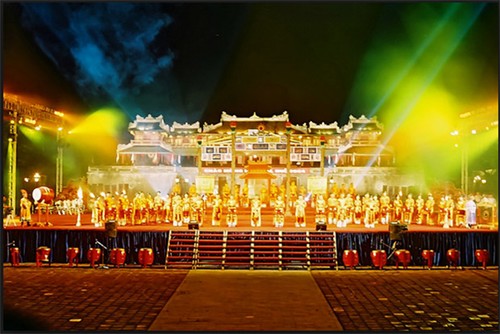 A performance of the Hue Royal Court Music inside the Hue Imperial Citadel (Photo: hoangthanhthanglong.vn) A performance of the Hue Royal Court Music inside the Hue Imperial Citadel (Photo: hoangthanhthanglong.vn) |
B: Since some of you have asked about Vietnam’s traditional music, we’ll be exploring Hue Royal Court Music, Nha nhac, one of Vietnam’s most refined and historically significant music traditions. In 2003, Nha nhac was recognized by UNESCO as a Masterpiece of the Oral and Intangible Heritage of Humanity. The value of Hue Royal Court Music comes from its musical structure, its musical instrument ensemble, and the combination of Hue Royal Court Music and dance.
A: “Nha nhac”, which means “elegant music”, refers to a broad range of musical and dance styles performed at the Vietnamese royal court from the fifteenth to the mid-twentieth century. It was often featured at the opening and closing ceremonies associated with anniversaries, religious holidays, coronations, funerals, and official receptions.
B: Nha nhac performances formerly featured numerous singers, dancers, and musicians dressed in sumptuous costumes. Large-scale orchestras included a prominent drum section and many other types of percussion instruments as well as a variety of wind and string instruments. All performers had to maintain a high level of concentration since they were expected to follow each step of the ritual meticulously.
A: As a symbol of the dynasty’s power and longevity, Nha nhac became an essential part of the court’s many ceremonies. But the role of Nha nhac was not limited to musical accompaniment for court rituals. It also provided a means of communicating with and paying tribute to the gods and kings as well as transmitting knowledge about nature and the universe.
B: One example is the fan dance, which was often performed at banquets and wedding celebrations for the queen, concubines, and princesses. This graceful dance symbolizes romantic love and offers blessings of harmony and happiness for the royal family.
A: The “Ghost Hunting” dance tells a story of an ancient time when the world was plagued by monsters who brought chaos and suffering to humankind. It’s a moral tale about the triumph of good over evil. Then there's the “Lantern Dance”, originally performed during Buddhist rituals, which features six symbolic offerings – incense, flowers, lanterns, tea, fruit, and food – and was later adapted to celebrate the birthdays of the Emperor and other members of the royal family.
B: Visitors to Hue can enjoy Nha nhac at the Duyet Thi Duong theater, located inside the Hue Imperial Citadel. Built during the Nguyen Dynasty from 1802 to 1945, this was the first theatre opened to perform Royal music and is one of the oldest performance spaces in Vietnam.
A: You can now enjoy this genre of music on a Perfume River boat ride, an enjoyable way to learn about the cultural heritage of Vietnam.
B: This week we received feedback from Mr. Najimuddin of India, who tuned in to our program on the frequency of 7220 kHz, using a Grundig YB 80 receiver with a telescopic rod antenna. He rated SINPO 44343 with a moderate overall signal.
A: Bangladeshi listener Omar Faruk reported listening to VOV’s program on July 13 on the frequency of 7220 kHz and noted a good signal and clear sound quality. He rated SINPO all 4s.
B: Faruk said he likes the news, Digital Life, Discovery, Village Life, the Letter Box, and cultural and economic stories. “All programs are very informative, and I also like the music program. I’ll send you a reception report regularly and I hope I’ll receive your verification cards.”
A: Thank you all for tuning in to VOV’s English Service and for taking the time to write to us. We’ll verify your reception reports and send QSL cards to you promptly.
B: Wishing you all the best. Until next Wednesday, take care!