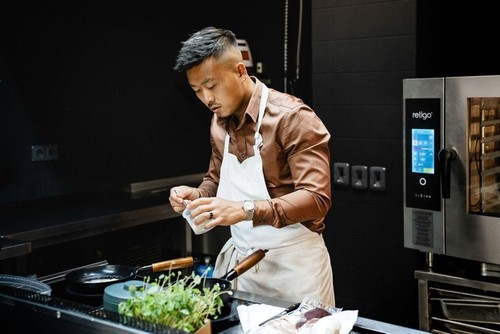
 Chu Phuong Duy, also known as Christian Chu, is the first chef of Vietnamese origin to win a Michelin star in the Czech Republic. (Photo courtesy of Chu Phuong Duy) Chu Phuong Duy, also known as Christian Chu, is the first chef of Vietnamese origin to win a Michelin star in the Czech Republic. (Photo courtesy of Chu Phuong Duy) |
A: You’re listening to Food Delight on VOV24/7. Now join us on a fine-dining expedition, one that begins far from the traditional Michelin spotlight.
B: That’s right. And this journey takes us to Prague, where, for the first time in the Czech Republic, a chef of Vietnamese origin has been awarded a Michelin star, the most prestigious honor in global gastronomy.
A: He is Chu Phuong Duy, also known as Christian Chu - head chef and owner of the fine-dining restaurant LEVITATE.
“When I opened the restaurant, I wanted to create a high-end, experiential style of cuisine, so that guests would feel as if they were “LEVITATING,” embarking on a special culinary journey. It’s like taking part in an extreme sport, that unique sensation appears right from the start and stays with you forever. That is the kind of experience I want my guests to have through my food,” Duy said.
A: An extreme sport, that’s quite an image for fine dining.
B: Yes, it suggests excitement, risk, and emotion, not just eating, but really feeling the experience.
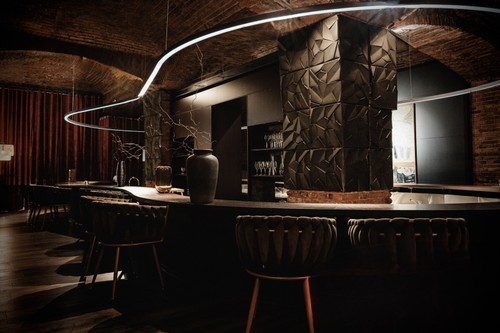 LEVITATE is a venue where gastronomy and art come together, with each course forming part of a story unique to every guest. (Photo courtesy of Chu Phuong Duy) LEVITATE is a venue where gastronomy and art come together, with each course forming part of a story unique to every guest. (Photo courtesy of Chu Phuong Duy) |
A: LEVITATE’s concept is inspired by Duy’s travels and his own creative vision, blending Nordic and Asian cuisines.
B: Duy said he mainly works with local ingredients, complemented by carefully selected products from around the world, all guided by one core principle: respect for nature and seasonality.
“The menu is structured around three key pillars: Flora, showcasing the finest seasonal vegetables and fruits; Aqua, featuring primarily freshwater fish from South and Central Bohemia, complemented by seafood from Japan and Scandinavia; and Fauna, presenting a selection of premium meats from around the world, including Japanese wagyu, wild game from the Šumava region, and poultry from France,” said Duy.
A: LEVITATE spans four underground levels, allowing guests to move through distinct atmospheres and sensory experiences.
B: There are two tasting menus to choose from: the mystery menu with 18 courses, and the elite menu featuring 12 courses, each designed for a different kind of diner.
A: And the experience begins the moment guests arrive. The door is closed, so guests must ring a bell, instantly creating a sense of exclusivity and privacy.
“The guest experience unfolds through 18 courses, each prepared across four distinct spaces. Spanning 350 square meters, the restaurant is spacious, yet instead of rising above ground, it is built downward into four underground levels. As guests step inside, they are welcomed into a tranquil Japanese garden, deliberately designed to create a striking contrast with the bustle outside. In this Zen garden, they are served their very first dish,” said Duy.
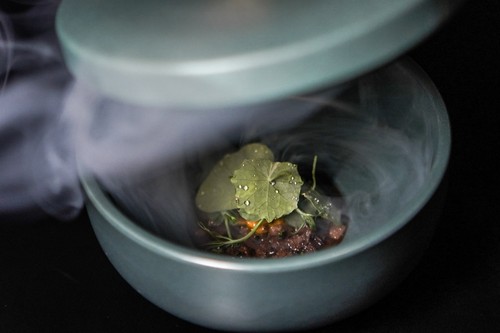 Duy mainly works with local ingredients, complemented by carefully selected products from around the world, all guided by one core principle: respect for nature and seasonality. (Photo courtesy of Chu Phuong Duy) Duy mainly works with local ingredients, complemented by carefully selected products from around the world, all guided by one core principle: respect for nature and seasonality. (Photo courtesy of Chu Phuong Duy) |
A: Guests then move to the fourth level, the lounge, where the journey really begins with an aperitif and a series of amuse-bouches.
B: Here, there’s a twist. They can visit a boutique hall and choose their own plates and glassware, items that will later be used in the main dining room.
“On the fourth underground floor, we serve 3 dishes. The first dish is marinated lotus seed, what we call an amuse-bouche. It comes with goji, gingeng, and mung bean puree. The second dish features brown crab, jellyfish, sea snails, and trout roe, similar to salmon roe. The third dish is foie gras, paired with matcha meringue and hibiscus jelly,” said Duy.
A: After that, guests move up to the main dining room on the third level, where the main courses are served.
B: This is where the heart of LEVITATE’s cuisine comes alive with dishes featuring vegetables, duck breast, and pigeon.
“There is also a signature dish we’ve been serving for eight years. While the protein changes, the sauce remains the same. Currently, it features French pigeon, dry-aged with cognac to preserve the meat. Only the breast is used, simply grilled, then cooked sous-vide with brown butter. It’s finished with a vegetarian truffle sauce made from Alba truffles, local Czech mushrooms, mirin, sake, soy sauce, and honey - rich and creamy, yet perfectly balanced, never too salty or too sweet,” said Duy.
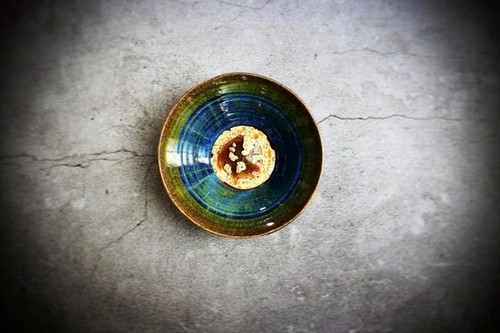 (Photo courtesy of Chu Phuong Duy) (Photo courtesy of Chu Phuong Duy) |
B: After three courses in the main dining room, guests move up to the experimental studio on the second level. This intimate space features a small kitchen and a living-room setting, where the chef develops new dishes, explores new ingredients, and experiments with new techniques while guests can interact directly and chat with him along the way.
“Here, we serve three snacks, made with truly special ingredients under the flora theme, the focus is on mushrooms. The dish features five different types of mushrooms: enoki, shiitake, shimeji, maitake, and truffle. Each mushroom comes from a different country: enoki from Japan, shiitake from the Czech Republic, shimeji from Korea, maitake from Japan, and truffle from Italy. The dish is accompanied by a broth, essentially a soup, prepared in the style of Vietnamese phở,” said Duy.
B: After the studio experience, guests return to the main dining room for the next three courses. The journey concludes back on the fourth level, where dessert is served alongside digestifs, fine spirits, or Vietnamese coffee, including the iconic ca phe chon (weasel coffee).
A: What an incredible experience!
B: And that’s exactly why Chu Phuong Duy earned a Michelin star, not just for cooking food, but for creating a true culinary expedition.
A: You’ve been listening to Food Delight on VOV24/7. Thank you for joining us on this remarkable culinary expedition.