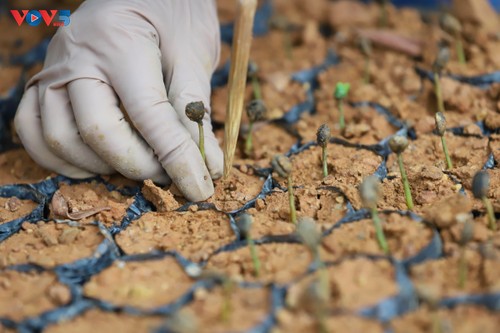
 Cultivating coffee seedlings is done manually. (Photo: Tran Long/VOV) Cultivating coffee seedlings is done manually. (Photo: Tran Long/VOV)
|
In the 80 years since the first coffee tree was grown in Son La, coffee has become one of the locality’s most profitable crops. Son La is emerging as Vietnam’s largest producer of Arabica coffee, accounting for approximately half of its Arabica cultivation area and 43.5% of its Arabica output. This strong foundation provides Son La with a major advantage in developing premium specialty coffee that aligns with global trends toward eco-conscious consumption.
Ta Manh Cuong of the Vietnam Trade Promotion Agency at the Ministry of Industry and Trade said, “Son La’s Arabica coffee holds great promise. It’s not by chance that among 10 coffee growing and producing provinces in Vietnam, Son La is one of only three to have received national geographical indication protection. This is a valuable opportunity for Son La coffee to assert its brand and market position.”
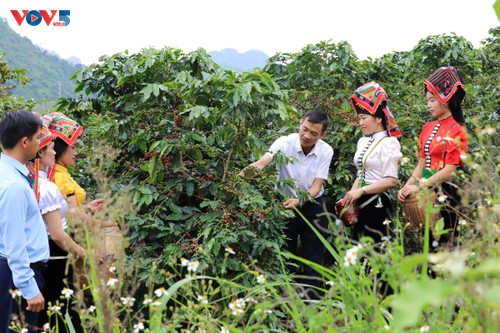 Coffee has provided a sustainable livelihood and become one of Son La’s key agricultural products. (Photo: Tran Long/VOV) Coffee has provided a sustainable livelihood and become one of Son La’s key agricultural products. (Photo: Tran Long/VOV)
|
Son La is taking steps to expand its market. Ideal natural conditions and the dedication of its farmers have made Son La’s Arabica exceptional in flavor, earning both domestic and international certifications. According to Associate Professor Dr. Nguyen Van Bo, former Director of the Vietnam Academy of Agricultural Sciences, “Son La has earned a significant certification-geographical indication status. Thanks to this, Son La province has been able to sell coffee at higher prices and expand into more export markets.”
These certifications validate quality and guarantee traceability and sustainable practices. Vu Ngoc Huy of the Phuc Sinh Son La Company said that the company’s coffee-growing regions have received internationally-recognized certifications such as Rainforest Alliance and 4C. These are two of the most widely accepted certifications in the global sustainable coffee industry.
“The key to success lies in adhering to sustainable farming practices. Farmers are the decisive factor and that’s why we focus heavily on farmer training—improving skills and guiding cultivation techniques right on the farm,” Huy noted.
Coffee used to be grown just to alleviate poverty. Now it has become a spearhead crop in Son La. High-quality Son La specialty products are gaining traction in demanding markets and helping to secure the global reputation of Vietnamese coffee.
To achieve new development goals, Son La is tackling challenges and aligning with international standards. Nguyen Thanh Cong, Deputy Chairman of the provincial People’s Committee, said, “Our first solution is to pursue sustainable coffee production, establish clean farming practices based on RA, 4C, and UTZ certifications, and comply with EU anti-deforestation regulations. Next, we must invest in better seed varieties that suit local growing conditions, and replant old, low-quality coffee trees with younger, healthier ones to produce the best beans possible.”
As global coffee markets are increasingly competitive, securing the Son La coffee brand is no longer just a matter of volume, but a matter of quality and sustainability. The locality is taking a holistic approach that includes zoning raw material regions, improving seed quality, adopting international standards in production, strengthening links between farmers, businesses, and government agencies, and investing in deep processing and branding.
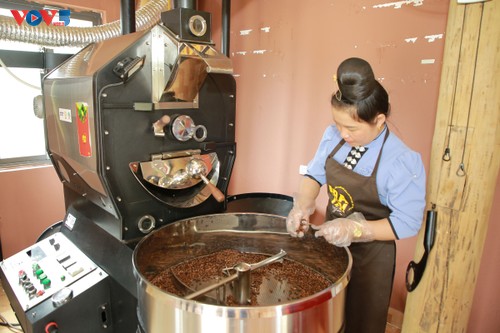 Investment in production and processing increases the value of Son La’s coffee. (Photo: Tran Long/VOV) Investment in production and processing increases the value of Son La’s coffee. (Photo: Tran Long/VOV)
|
Associate Professor Dr. Bo said, “The sector plans to focus on linking farmers under the same process and then linking farmers with companies who can help them meet quality, origin, and certification standards. Farmer participation in these interconnected activities is the first requirement.”
Under its coffee development strategy, by 2030, Son La aims to expand its coffee-growing area to 25,000 hectares with an output of 40,000 tons, including 6,000 hectares for specialty coffee and 18,000 hectares certified under sustainable practices, with 80-90% of new plantings using high-quality varieties.
Under the vision to 2035, the coffee cultivation area will increase to 27,000 hectares and yield 47,000 tons, 6,500 hectares for specialty coffee, deep-processed coffee accounting for 20-25% of output, and exports representing 80-85% of total production.
The strategy envisions establishing at least five high-tech coffee production zones. This ambitious vision demonstrates Son La’s determination to become Vietnam’s top producer of high-quality Arabica, paving the way for its coffee to conquer the world’s most demanding markets.