Joining us is psychotherapist Vu Anh Quan, a US-trained and New York-licensed mental health practitioner with extensive experience in school mental health, community care, and family communication. Drawing from years of working with parents, teachers, and young people, Quan explains how attentive listening builds trust, strengthens connection, and helps transform discipline from control into collaboration at home.
Reporter: Hello Anh Quan. Welcome to Doctor at home. You are a psychotherapist. Tell us why listening matters in parenting?
Anh Quan: I'm Vu Anh Quan, and part of my work over the years has been training doctors, social workers, teachers, and parents in the psychology of communication. How emotions, stress, and needs shape the way we speak and listen. Whether in clinics or in classrooms, I've seen how the quality of a connection with a child often depends less on what we say and more on how we listen.
Reporter: Parents often feel they need to give advice or instruction all the time. Why is it sometimes more effective to pause, listen, and let the child express themselves first?
Anh Quan: Parents often give advice because they care, they've lived longer, learned lessons the hard way, and want to spare the child unnecessary pain. Advice usually comes from love, but it often rests on hidden assumptions: that parents' life paths are the right ones, that past experiences still apply today, and that children are fundamentally similar to their parents, and will follow advice once they understand the logic.
But in reality, children are emotional and relational learners before they are logical ones. They may understand what's right, but if it doesn't feel right, or if they feel unheard, compliance becomes fragile. At best, you get forced obedience. At worst, resistance. Pausing to listen first helps parents understand their child's inner world. Only after that understanding is established does guidance land as support rather than control.
Reporter: What are some common signs that a parent is talking at their child rather than talking with them?
Anh Quan: A simple rule of thumb is to notice who is doing most of the talking. In healthy conversations, including therapy, education, and parenting, the listener usually speaks less, not more. If a parent is talking 80 to 90 percent of the time while the child responds mostly with yes, no, silence, or nodding, that's no longer a conversation. It's a lecture. And even lectures only work when they're interactive. In education, we know learning happens best when students actively participate. The same applies at home. If a child isn't speaking at least half the time, parents are missing critical information: what the child understands, what they resist, what they fear, and what they actually want. When parents dominate the conversation, children may appear compliant, but internally they often disengage, resentful, or emotionally checked out.
Reporter: Active listening requires a certain skill. What simple techniques can parents use, such as reflective listening or asking open-ended questions?
|
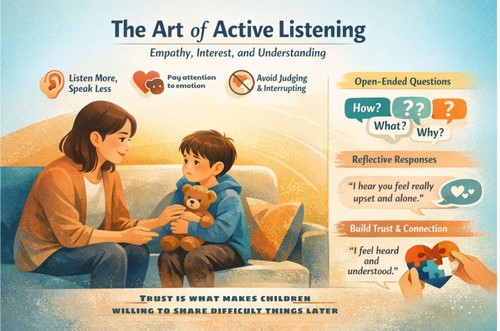
Anh Quan: Active listening is not just staying quiet. It's a set of skills that communicate empathy, interest, and safety. The first skill is listening more than you speak, even when the child's story feels messy, repetitive, or unimportant by adult standards. This means resisting the urge to interrupt, correct, or jump to conclusions.
Active listening also means paying attention to both content and emotion, what the child is saying and how they seem to feel while saying it. Not all questions help conversation. Close-ended questions, ones that can be answered with yes or no, tend to shut things down. Open-ended questions, starting with how, what, when, or in what way, invite more sharing.
Another powerful tool is reflective statements. This is when parents summarize what they heard, especially the emotional core. For example, “So it sounds like you felt really frustrated and alone when that happened.” This tells the child, “I listened to everything, not just the parts I liked.” That feeling of being fully heard is what builds trust, and trust is what makes children willing to share difficult things later.
Reporter: What can parents do to create a safe, non-judgmental environment where children feel comfortable sharing their thoughts and feelings?
Anh Quan: One of the most effective and often overlooked strategies is modeling. Children don't learn emotional safety from rules; they learn it from what they witness at home. When parents model respectful, open conversation with each other, expressing feelings, acknowledging struggles, and listening without attacking, children absorb that as normal. This does not mean parents should overshare or emotionally unload on their children. Boundaries still matter. Conversations should stay age-appropriate and emotionally contained. But when children see parents taking turns, listening, regulating emotions, and repairing misunderstandings, they learn that emotions are allowed and manageable. In some cases, inviting a child's perspective into a discussion, when developmentally appropriate, further reinforces that their voice matters. Safety is built not by perfection, but by consistent repair. Healthy discipline isn't about control.
Reporter: Why does listening actually strengthen connection and healthy discipline? Could you share a case from your experience where listening to a child made a real difference?
Anh Quan: Healthy discipline isn't about control; it's about collaboration. Rules work best when children understand their purpose, see the consequences, and feel some ownership over them. When rules are imposed without understanding or consent, children may follow them temporarily, but they rarely internalize them.
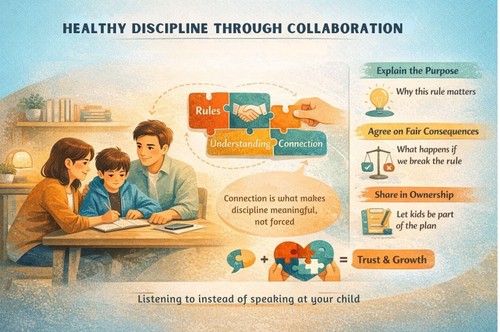 |
This reminds me of a case I worked with involving an adolescent who had been labeled the problem child. At an age when young people are forming their identity, this child acted out not because they didn't care, but because they felt unseen and unheard under rigid expectations about school and career paths set by their parents. After several conversations with the parents, it became clear that what the child wanted most wasn't freedom from rules, but acceptance of who they are, including their strengths and limits. The parents agreed to adjust their expectations and listen more closely to what their child actually wanted for their future. The shift was remarkable. Problematic behavior decreased, motivation returned, and the child eventually sought out and secured an internship that matched their strengths. The relationship improved not because discipline disappeared, but because listening came first. Children don't resist guidance because they lack structure. They resist guidance when they feel unheard. Listening doesn't weaken authority; it strengthens connection. And connection is what makes discipline meaningful, not forced.
At its heart, parenting isn't about having all the right answers. It's about building a relationship where your child feels safe enough to share their questions, doubts, and emotions with you.
Thank you for spending time with me. I'm Quan. Take a breath, take a pause, and take good care, everyone.
Reporter: Listening may seem simple, but it can change the way families understand each other. Today’s conversation reminds us that small shifts in communication can make a lasting difference at home. Thank you for listening to Doctor at Home. Goodbye, and take care.
Psychotherapist Vu Anh Quan is a clinical social worker and a former project lead of a five-year National Institute of Health-funded mental health program that supported more than 1,600 adults living with depression in northern Vietnam. He has been working closely with community health providers and saw firsthand how everyday stress can quietly evolve into distress, the kind that affects sleep, relationships, and work. He is currently a contracted speaker for Intellect Vietnam, an adjunct practicum instructor for the Advanced Psychological Counseling course for master’s-level social work students at Hanoi University of Public Health, and a guest lecturer at Vin University.