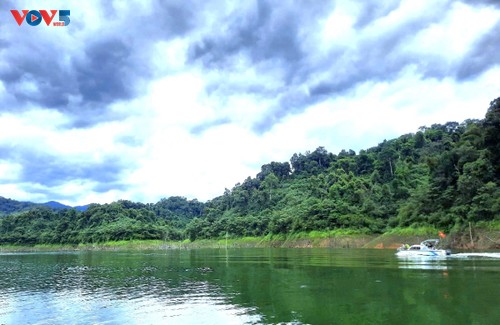
 It takes a one-hour boat ride across the Ngan Truoi irigaiton lake to reach Vu Quang National Park. (Photo: Kim Lieu) It takes a one-hour boat ride across the Ngan Truoi irigaiton lake to reach Vu Quang National Park. (Photo: Kim Lieu) |
Nestled deep within the Truong Son range, Vu Quang National Park is also called the "Green Gem" of Ha Tinh Province. To reach the park from the Ho Chi Minh Trail, travelers must take a scenic one-hour boat ride across the Ngan Truoi irrigation lake.
The Park is home to 94 endangered and rare species listed in the Red Book of the International Union for Conservation of Nature and Natural Resources and Vietnam’s Red Book, which require strict protection. There are 686 medicinal plant species and 339 timber species, including those of high economic values like Fokienia (po mu), Magnolia conifera (vàng tâm), and Michelia trees (dổi).
Director of Vu Quang National Park Nguyen Danh Ky introduces: “In 2018, Vu Quang National Park was recognized as an ASEAN Heritage Park. This is a great honor for the park itself, for Ha Tinh province, and for Vietnam in biodiversity conservation. We have strictly protected the biosphere and biological diversity zones.”
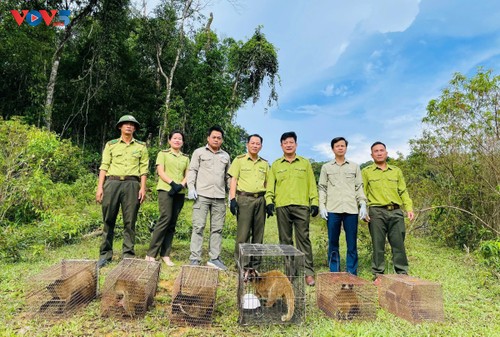 Animals are rescued and released back in to the forests. (Photo: Kim Lieu) Animals are rescued and released back in to the forests. (Photo: Kim Lieu) |
Studies have recorded hundreds of species of mammal, bird, reptile, fish, and butterfly, of which 26 mammal species, 10 bird species, and 16 reptile species are classified as endangered and require protection. Vu Quang is also the only forest in the world having discovered the Saola (Vietnam’s Asian unicorn) in 1992 and the large-antlered muntjac (also known as the Vu Quang giant muntjac) in 1993.
Tran Binh Tu, a former official of Vu Quang National Park, said: “The Saola in Vietnam has straight, black horns, standing upright and parallel. This species is found only in Vu Quang. Journalists and scientists of Vietnam and around the world were astonished that Vietnam still has such a biodiversity-rich forest.”
Recently, USAID’s Biodiversity Conservation project in Vietnam has supported Vu Quang National Park in training and conducting biodiversity surveys using a camera trap system of 85 stations, and evaluating biodiversity threats using spatial monitoring and reporting tool, SMART.
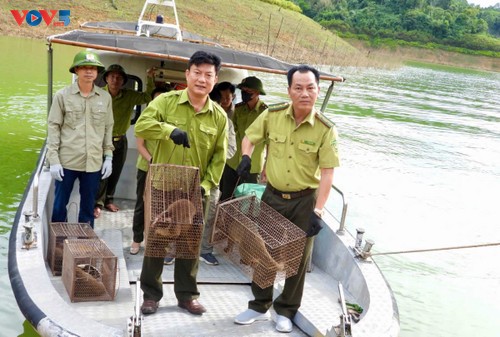 The staff of Vu Quang National Park rescue wild animals. (Photo: Kim Lieu) The staff of Vu Quang National Park rescue wild animals. (Photo: Kim Lieu) |
Nick Cox, Director of the USAID Biodiversity Conservation in Vietnam, said: "Vu Quang National Park is one of the few sites in Vietnam that still has elephants. It also has the large antlered muntjac, which until recently was only seen in a few sites. That's good news. It's good signs that the conservation work in Vu Quang is protecting wildlife."
In addition to its conservation work, Vu Quang National Park also successfully rescues, rehabilitates, and releases hundreds of wild animals back in to the forests. Over the past two years, it has received and cared for over 640 animals, and released 590 of them back into their natural habitat.
Nguyen Viet Hung, Head of the Science and International Cooperation Department of Vu Quang National Park, said: “Vu Quang National Park places great emphasis on rescuing, conserving, and releasing wildlife.We’ve received up to 1,500 animals, most of them are listed in Vietnam’s and the IUCN Red List of Threatened Species global Red Books. Rescued and released wildlife contributes significantly to biodiversity protection.”