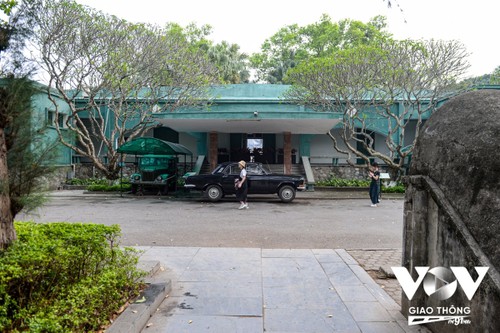
 The House and Bunker D67, built in 1967, is the headquarters of the Politburo and the Central Military Commission from 1968 to 1975. (photo: Phuc Tai/vovgiaothong.vn ) The House and Bunker D67, built in 1967, is the headquarters of the Politburo and the Central Military Commission from 1968 to 1975. (photo: Phuc Tai/vovgiaothong.vn ) |
The house and bunker D67 was the venue where the leaders delivered policies and strategies to battlefields across Vietnam and in Indochina. They included the New Year Offensive 1968, the Road 9-Khe Sanh Campaign 1968, the Road 9-Southern Laos Campaign 1971, the Hanoi 12-day-and-night Campaign against airstrikes in December, 1972, international missions in Laos and Cambodia, and operations to liberate seas and islands.
First Secretary of the Party Central Committee Le Duan, Prime Minister Pham Van Dong, and General Secretary Truong Chinh were present at the headquarters several times to monitor the war situation. Commander-in-Chief General Vo Nguyen Giap regularly chaired meetings there.
Former Deputy Director of the Institute of Military History of Vietnam Nguyen Manh Ha said: "In 1967, when the US army escalated its destructive war in the North, the Central Military Commission and the General Command decided to build a safe house to resist bombing. If the enemy bombed Hanoi, the commanders could quickly move from their nearby working offices to house D67. Its very thick walls and solid doors can endure direct bombs and resist noise, radiation, and chemical toxins. This house was reserved for important meetings. It has a simple design, is easy to use, but is very sturdy and safe. Its construction was completed in 1967, thus named house D67."
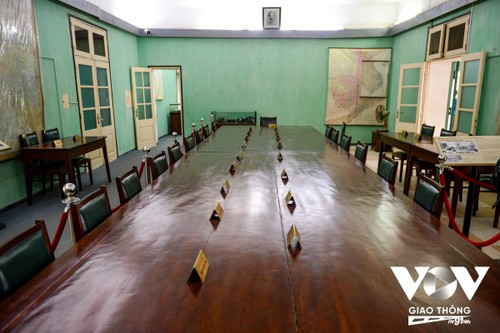 The meeting hall for the Politburo and the Central Military Commission in the House D67 (photo: Phuc Tai/vovgiaothong.vn) The meeting hall for the Politburo and the Central Military Commission in the House D67 (photo: Phuc Tai/vovgiaothong.vn) |
House D67 is a flat-roofed, one-story building with a special underground bunker designed by the Architectural Design Institute. There are four rooms, with the large central room serving as the meeting hall for the Politburo and the Central Military Commission. The small room to the east was General Vo Nguyen Giap’s office; and the small room to the west was General Van Tien Dung’s office.
Bunker D67 is an integral section of the complex serving as a backup command center during emergencies. The bunker has three stairways and two corridors connecting to the revolutionary house D67. In emergency cases, the special ventilation and lighting systems can ensure continuous operation even under harsh combat conditions.
From December 18, 1974 to January 8, 1975, at bunker D67, the Politburo convened expanded meetings and resolved to liberate the South in 1975 and 1976. From this place, many decisions were made to change the course of the war.
Colonel Nguyen Manh Ha said: "When we launched the 1975 General Offensive, the Politburo and the Central Military Commission held several meetings there. The bunker joyfully received the victory news from the South on April 30, 1975."
The historical house D67 stands as a symbol of Vietnam’s unyielding revolutionary spirit and resilience in the face of hardship, and steadfast determination for independence.
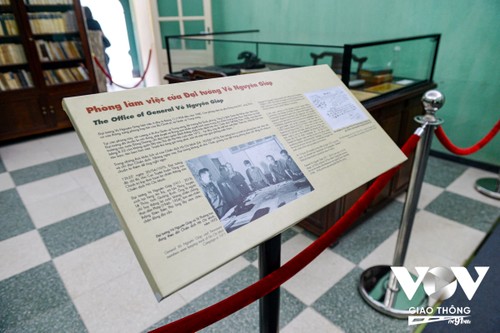 General Vo Nguyen Giap’s office in the House D67 from Nov 1968 to 1980 (photo: Phuc Tai/vovgiaothong.vn) General Vo Nguyen Giap’s office in the House D67 from Nov 1968 to 1980 (photo: Phuc Tai/vovgiaothong.vn) |
Today, the interior of House and Bunker D67 remains well-preserved. In the meeting room, the table and chairs are intact, along with the nameplates and titles of those who attended critical meetings. Command maps still hang on the walls, and small corners are arranged with communication devices.
Nguyen Thanh Quang, Director of the Thang Long-Hanoi Heritage Conservation Center, said: "The artifacts remain intact, from the set of tables and chairs to the telephones. Everything can tell stories of that time. This revolutionary relic site is still 'alive', where generations born after the wars can understand how their ancestors fought with all their might to achieve total victory and lasting independence."
One of the most special artifacts in bunker D67 is the "Number 1" telephone.
It was directly connected to President Ho Chi Minh’s phone at his stilt house in the Presidential Palace, so the leaders of the operation command could immediately answer the President’s inquiries about the battlefield situation and convey his encouragement to the personnel on duty.
After 1975, when Vietnam was reunified, the bunker was mainly closed. Since 2017, house and bunker D67 have been opened to the public to learn about Vietnam’s military history.