 Three-level Cu Chi tunnels (Photo: Nhan Dan newspaper) Three-level Cu Chi tunnels (Photo: Nhan Dan newspaper) |
The Cu Chi tunnels began to take shape during the resistance war, around 1948. The earliest tunnels were built in Tan Phu Trung and Phuoc Vinh An commune. The entire tunnel network spans approximately 250 kilometers and has three underground levels: the uppermost is 3 meters below the surface; the middle layer is 6 meters deep; and the lowest reaches down to 12 meters. In addition to living areas and weapons storage, the tunnel system has several branches leading to spike pits, trap holes, and minefields.
Truong Van Quy, who works as a tour guide at the Cu Chi Tunnels Historic Site, said: “Underground, there are meeting rooms, kitchens, and dining areas. Deeper down, there are medical rooms, sleeping areas, and the Command room of the Saigon-Gia Định Military Zone.”
Cu Chi's soldiers and civilians constructed this vast tunnel network using only rudimentary tools like hoes and bamboo scoops. The numerous branches that extend from the “backbone” tunnel are interconnected or independent depending on the terrain. Several tunnels open out to the Sai Gon river, where people could cross to the Bến Cát base in Bình Dương on the other side of the river. All along the tunnels are air vents, which are disguised or hidden wherever they surface.
Some entrances to the tunnels doubled as battle stations or sniper posts. Around each entry point were traps to deter intruders, such as spike pits, mines, anti-tank explosives, and anti-helicopter grenade launchers. Each entrance, carefully camouflaged with earth and leaves, was just large enough for one person at a time to squeeze through. Today, some of the entrances have been widened for tourists.
The tourguide instructed tourists, “Hold the hatch lid with your arms straight up and slide down smoothly. Keep your arms straight up and your shoulders and body won’t get stuck. During the war, guerrillas attached grenades or mines under the lid, so if the enemy tried to pull it up, it would explode and collapse the tunnel.”
The underground tunnels could withstand artillery, tanks, and armored vehicles, and, the deeper sections could withstand small bombs. Some parts of the tunnel have two or three levels, with secret trapdoors and barriers to block enemies or chemical weapons.
 98-year-old Colonel Nguyen Van Tau, alias Tu Cang (Photo: VTV) 98-year-old Colonel Nguyen Van Tau, alias Tu Cang (Photo: VTV) |
98-year-old Colonel Nguyen Van Tau, alias Tu Cang, is a Hero of the People's Armed Forces who fought in Củ Chi from 1962 to 1971. Every corner of the tunnels reminds him of the patriotism, ingenuity, courage, and unyielding will to protect the homeland. He read us a poem that he wrote in 1967, five years after his first battle here.
"Though five years have passed, it’s been etched in my heart
Five long years. A US division struck our post A18
With their B52s, B57s, ships, tanks, chemicals, and tear gas.
Grass and trees died. The ground was scorched – but people stood firm.
The tunnels remain a stronghold of our group.
Oh, so precious, so beloved, worthy of history,
The tunnels of Cu Chi soil."
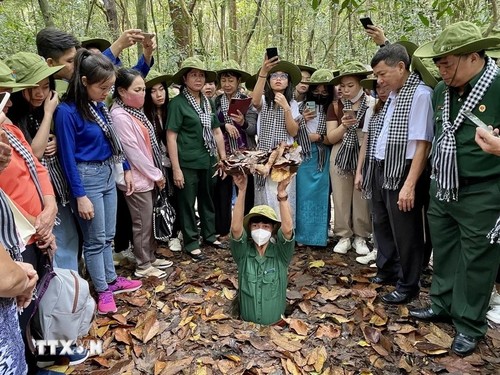 A tourguide instructs tourists to how to get into Cu Chi tunnels. (Photo: VNA) A tourguide instructs tourists to how to get into Cu Chi tunnels. (Photo: VNA) |
Two sections of the Cu Chi tunnels have been restored – Ben Duoc tunnel (the base of the Party Committee and Military Command of the Saigon-Cho Lon-Gia Dinh Military Zone) in Phu My Hung commune, and Ben Dinh tunnel (base of the Cu Chi District Party Committee) in Nhuan Duc commune. The Ben Duoc site is open for tourists to explore the tunnels and command bunkers where revolutionary leaders lived and worked during the war.
The Cu Chi Tunnels were recognized as a Special National Historical Site in 2015. Ho Chi Minh City is planning to submit the site for recognition as a UNESCO World Heritage by 2027. Nguyen Minh Tam, Deputy Director of the site’s Management Board, said: “It would be an encouraging milestone. If the Củ Chi Tunnels are inscribed as a world heritage site, it will help attract visitors and draw the world’s attention to the bravery, intelligence, and patriotism of the Vietnamese people.”
The Cu Chi tunnels already receive over 1 million Vietnamese and foreign visitors every year. The site, a marvel of Vietnamese military art, is also a testimony to the resilience and unyielding spirit of the Vietnamese people.