 A Lai Chau border guard instructs local residents on how to use smartphones. (Photo: Khac Kien) A Lai Chau border guard instructs local residents on how to use smartphones. (Photo: Khac Kien) |
In the chilly mountain air, a smartphone training session organized by officers of the Vang Ma Chai Border Guard Station drew dozens of ethnic villagers from Si Choang border hamlet, now part of Si Lo Lau commune. On each smartphone screen, every gesture and tap was patiently guided by the green-uniformed trainers.
Local resident Cheo Thi Hoa said that, since gaining access to smartphones and the internet, she and others have applied new technologies to farming and daily life. The digital literacy classes have helped them avoid online scams as well as illegal border-crossing schemes.
“Today’s program gave us valuable knowledge about digital transformation and social networks, and helped us recognize online scams. I’ll share what I’ve learned with my family, relatives, and neighbors so that we all become more aware, cautious, and able to apply this knowledge to improve our livelihoods,” said Hoa.
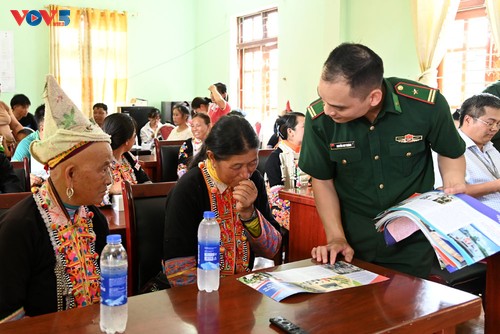 Each border post along the Lai Chau frontier has established a team of 3–5 “teacher-soldiers” to deliver digital transformation knowledge to the locals. (Photo: Khac Kien) Each border post along the Lai Chau frontier has established a team of 3–5 “teacher-soldiers” to deliver digital transformation knowledge to the locals. (Photo: Khac Kien) |
As part of the “Digital Literacy for All” initiative, the Vang Ma Chai Border Guard Station launched an “Anonymous E-mail Box” model in May. Now, instead of traveling to the station to report crimes, residents can simply scan a QR code displayed at local community centers, clinics, and markets to send crime reports digitally.
Major Nguyen Duy Khanh, deputy political commissar of the border station, said that this solution improves legal awareness and digital literacy among local residents.
“The ‘Green-Uniformed Teachers Accelerate Digital Transformation’ program has organized 17 training sessions for 850 participants, taught digital skills, and created 17 QR codes linked to legal education materials. Thanks to the program, villagers now understand the law better, and all local officials, village heads, and Party cell secretaries can use digital tools to share legal information,” said Khanh.
 Dozens of training and communication sessions under the “Digital Literacy for All” movement have been organized by border guards in Lai Chau province. (Photo: Khac Kien) Dozens of training and communication sessions under the “Digital Literacy for All” movement have been organized by border guards in Lai Chau province. (Photo: Khac Kien) |
Within just a few months, the anonymous mailbox system has received hundreds of crime reports, many of them contain actionable information. These citizen tips have helped border guards detect and stop crimes, including human trafficking, illegal border crossings, and drug or weapon smuggling.
Beyond these tangible results, the initiative has reshaped villagers’ understanding of the law and their sense of responsibility for community safety.
 Dozens of poor households have received smartphones from Lai Chau border guards to participate in the “Digital Literacy for All” movement. (Photo: Khac Kien) Dozens of poor households have received smartphones from Lai Chau border guards to participate in the “Digital Literacy for All” movement. (Photo: Khac Kien) |
Following the pilot’s success, every border guard station in Lai Chau province has replicated the model. 40 digital literacy classes have been held in remote hamlets for local Mong, Dao, Ha Nhi, and Thai ethnic communities.
Colonel Nguyen Van Hung, Political Commissar of the Lai Chau Border Guard Command, said that the “Digital Literacy for All” campaign has provided dozens of smartphones to disadvantaged households to help them get and stay connected.
“Each border station has established a team of 3-5 ‘trainer-soldiers’ who travel to hamlets to teach digital skills and smartphone use. This helps people stay connected with family members and enables them to report suspicious activities or crimes to border guards,” said Hung.
 Colonel Nguyen Van Hung, Political Commissar of the Lai Chau Border Guard Command, presents gifts to the residents participating in the “Digital Literacy for All” program. (Photo: Khac Kien) Colonel Nguyen Van Hung, Political Commissar of the Lai Chau Border Guard Command, presents gifts to the residents participating in the “Digital Literacy for All” program. (Photo: Khac Kien)
|
Along the border, technology has become a tool used by civilians and soldiers in their shared mission to protect the homeland, and green-uniformed teachers are leading the digital transformation of Lai Chau’s border villages.