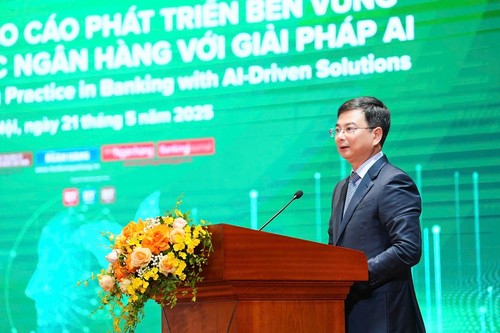
 Deputy Governor of the State Bank of Vietnam Pham Thanh Ha (photo: sbv.gov.vn) Deputy Governor of the State Bank of Vietnam Pham Thanh Ha (photo: sbv.gov.vn) |
At a recent seminar titled “Practicing Sustainability Reporting in the Banking Sector with AI Solutions,” Deputy Governor of the State Bank of Vietnam Pham Thanh Ha said that last year 33 banking and credit institutions published ESG sustainability reports, a record high number ever in Vietnam. Many other credit institutions have integrated ESG content into their annual reports. Since the beginning of this year, six commercial banks published ESG reports, Deputy Governor Ha said at the seminar, which gathered more than 300 participants from regulatory agencies, financial institutions, fintech firms, and international organizations.
However, he acknowledged that sustainability reporting practices in Vietnam, especially in the banking sector, are still in their early stages with a lot of challenges in terms of legal frameworks, resources, data analysis capacity, and especially the ability to effectively and transparently collect and process information.
“Artificial intelligence and digital technologies are solutions to this challenge. AI can help automate the data collection and aggregation process as well as support in-depth analysis and trend identification, and generate recommendations to improve report quality and sustainability performance,” said Mr. Ha.
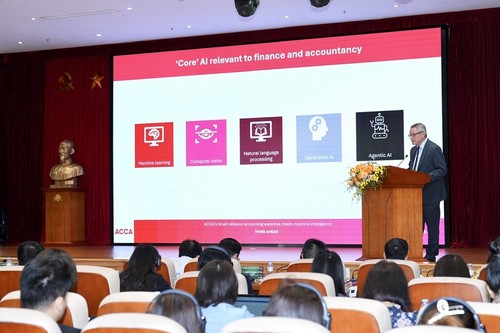 Mike Suffield, Director of Policy and Insights at ACCA Global (photo: sbv.gov.vn) Mike Suffield, Director of Policy and Insights at ACCA Global (photo: sbv.gov.vn) |
According to Mike Suffield, Director of Policy and Insights at ACCA Global, creating a sustainability report requires a vast amount of data from different sources, data collection parameters, and the capacity to analyze and aggregate data. AI tools are already being adopted by international credit institutions in sustainability reporting.
Mr. Suffield recommended core AI applications relevant to financial accountancy, such as machine learning can be used for predictive analysis, sales analysis, classification of profit and loss data, risk assessments, fraud detection, and customer segmentation.
“Computer vision can assist with automated document processing, scanning expense reports, and verifying signatures. Natural language processing comes in with analysis of financial reports, reviewing contracts, and automating customer service for financial products. Generative AI can support automated report writing, scenario analysis for financial planning, and complex financial modeling. Finally, agentic AI can automate invoice processing, coordinate month-end closing activities, manage accounts payable workflows, and handle routine queries,” said Suffield.
ESG reports provide multidimensional information, enabling investors to better assess a company’s risks and opportunities in order to improve the quality and efficiency of their investment decisions. Studies worldwide have shown that combining financial reports with sustainability reports creates a more complete version of the traditional financial report. This highlights an urgent need for Vietnam to implement ESG reporting in the banking system in alignment with global standards.
Dr. Le Hung Cuong, Deputy General Director of FPT Digital of FPT Group, said that ESG data often comes from scattered sources. Manual ESG reporting is time-consuming, prone to errors, and hard to ensure schedule and completion. FPT is developing the VertZero solution to fully digitize the ESG data collection process and help business measure carbon footprints.
“VertZero is a solution that helps us measure carbon footprints to work toward achieving net-zero emissions in the future. This solution helps businesses, like us at FPT, manufacturers, and banks measure carbon emissions and implement sustainable practices. It’s able to collect a wide range of benchmarks and data points, including around 60,000 emission factors across industries. From this, the system can make recommendations to predict carbon consumption and propose actions to reduce the carbon footprint in businesses,” said Mr. Cuong.
The VertZero solution has already been deployed in several Vietnamese businesses, delivering practical values to both the banking sector and manufacturing enterprises. FPT also supports businesses in three key areas: building ESG strategies and reports, partnering with green networks, including international organizations and government agencies, to promote green finance, and developing technologies that aid digitization, data collection, and sustainability reporting.
While applying AI in sustainability reporting, experts also emphasize the importance of authenticity and AI ethics, especially in sensitive areas like banking and finance. Mike Suffield stressed the role of human ethics in AI use, including integrity, competence, prudence, objectivity, confidentiality, and professionalism managing AI-related risks. “Generative AI and agentic AI are not yet mature technologies. We still have way to go in terms of efficiency and reliability. AI can help with verification work, check for errors, completeness, and compliance with specific formats or characteristics. AI can process large volumes of data, but again, AI is not foolproof, and the outputs will still need to be tested and verified by humans.”
The AI ecosystem will automate ESG report submission, standardize data, and connect with green credit rating systems, helping Vietnamese businesses and banks access green capital at international standards and channel it to the right companies in the shortest time possible.