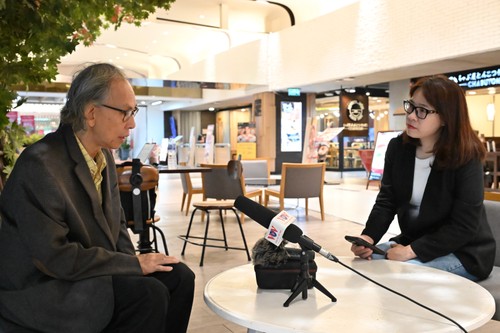
 VOV correspondent in Thailand Ngoc Diep interviews prominent international scholar Kavi Chongkittavorn VOV correspondent in Thailand Ngoc Diep interviews prominent international scholar Kavi Chongkittavorn |
Reporter: Could you please elaborate about the context of the Thai Prime Minister's visit to Vietnam and how the visit would open up new opportunities for enhancing bilateral ties?
Kavi Chongkittavorn: The visit of Prime Minister Phae Thong Thanh-China Wat to Vietnam this time is very important. It's a much-awaited visit because it has been postponed several times due to several circumstances. With this visit, I expect to see a lot of developments, especially both countries will alleviate their strengthened strategic partner to a much more pivotal level that is a comprehensive strategic partnership, which is very important.
It comes at a time where there is a big change in both regional and geopolitical landscape. And you know, both Thailand and Vietnam are two big trading partners, not only within ASEAN, but between each other. They're moving toward 25 billion USD goal. I think the latest figure I got is about 20 billion USD, so they're moving up very fast. In addition, I think Vietnam and Thailand and also other ASEAN members are players in driving ASEAN as a regional bloc that promote peace and stability, not only in the regional cooperation, but within the global contact, which is at the moment facing uncertainty.
Reporter: Thailand has recently approved a number of economic development projects in the Northeast of Thailand, which is home to a large Thai-Vietnamese community. What specific types of projects are being prioritized, and how are they expected to benefit the regional growth?
Kavi Chongkittavorn: This is a very good project because it's made the proposal of three connections, you know, at what you call at the ground level. You have supply chain, you have local producer, you have the local community that connect with one another, and the project will link the northeastern part of Thailand with central Vietnam, and they can collaborate in doing trade and people-to-people exchange. One of the most important things of this project is that Issan is the home of Thai-Vietnamese community, you know, there are large number, over 100,000 people. And for Issan, the legacy of Bac Ho or what we know in Thailand, President Ho Chi Minh is very well known, you know, there's no other place that will have three different memorial sites of President Ho Chi Minh inside a country like Thailand.
I think this is a good project, so we have to see how they proceed, and I think there will be other projects coming at this time, because there will be new project between Thai Higher Learning Institute and FPT University in robotics. This is something new, but I think you have to wait because they have to still discuss. So, there will be the first collaboration of higher education on robotics and AI, which I think is really wonderful because this is something new that Vietnam and Thailand can cooperate beyond the traditional area.
Reporter: Amid many global uncertainties like U.S. tariffs, how can Thailand and Vietnam work together to strengthen ASEAN’s internal strength and resilience?
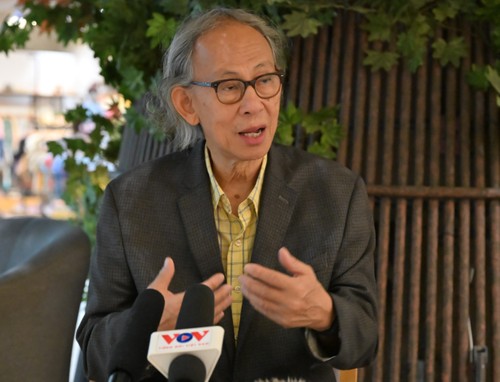 Prominent international scholar Kavi Chongkittavorn (Photo: Ngoc Diep/VOV) Prominent international scholar Kavi Chongkittavorn (Photo: Ngoc Diep/VOV) |
Kavi Chongkittavorn: One important character of Thai-Vietnam relation within ASEAN, besides they're a key player, they always follow each other. Thailand becomes the chairman, and then after what Thailand has done, and Vietnam will be the next chair. Vietnam will pick up and strengthen what Thailand has done within the ASEAN framework. Both of them will collaborate and continue the agenda. One of the agenda is to make sure that ASEAN is a driving force in multilateral trade and international rule-based order. These are the points that are very important within ASEAN context.
Given the current tariff heights, both of the countries strongly support Malaysia as the chair, that ASEAN must have a common position in negotiating with America. Of course, both countries support that there will be no retaliation. We will maintain the dialogue and consultation.
And thirdly, we will follow the international rules, especially World Trade Organization. These are the things. And I think at this coming summit, both of them will also push for ASEAN common strategies.
Reporter: Thank you very much.