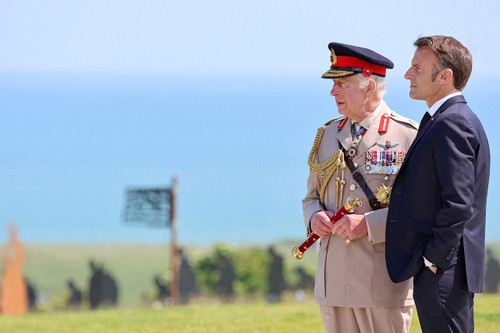
 King Charles III and French President Emmanuel Macron (Archive photo: Chris Jackson/Pool via REUTERS) King Charles III and French President Emmanuel Macron (Archive photo: Chris Jackson/Pool via REUTERS) |
This is the first state visit to the UK by a French president in 17 years, since Nicolas Sarkozy’s visit in 2008.
Migration problem
Since the EU–UK summit in London in mid-May, President Macron's visit has been seen as a continuation of what British and European officials have described as a comprehensive renewal of their relationship after Brexit. The assessment matches the increasingly warm UK-France ties since the 2023 coronation of King Charles III, who has a deep affection for France, and the election last summer of Labor Party leader Keir Starmer, a pro-European politician, as the UK Prime Minister.
Reflecting this new relationship, the UK received President Macron with the highest-level welcoming ceremony. Following his meeting with Prime Minister Starmer, President Macron was welcomed at a royal banquet hosted by King Charles at Windsor Castle and invited to deliver a speech to the UK Parliament.
However, after all the grand protocols, the UK and France face challenges to turning their renewed commitment into concrete action, with migration being the primary issue – specifically, preventing illegal crossings of the English Channel from France to the UK.
Migration cooperation is currently governed by the 2003 Touquet Agreement, under which the UK provides funding to French customs and police to detect and stop illegal migrants. The agreement is now criticized by both sides, as the number of illegal migrants surged in the first half of this year to 20,000, up 42% from last year. The UK has blamed France for ineffective enforcement, while France argues that the 543 million euros the UK has provided for three years (2023–2026) is insufficient.
French Police Union representative Régis Debut said: "The problem is that money alone can’t solve everything and buy social stability. They think they can pay money and the French will take action, but we have our own internal systems. Who knows exactly where the money goes? We need to find real solutions."
Prime Minister Keir Starmer and President Emmanuel Macron will announce new joint measures to prevent Channel crossings. The UK wants to promote a new “one in, one out” migrant return deal, under which France will accept one refugee from the UK for every eligible asylum seeker the UK accepts from France. But the two sides remain divided on this measure.
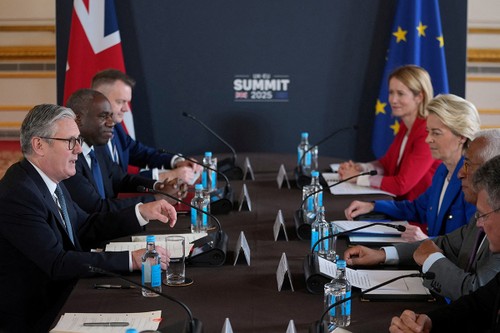 UK Prime Minister Keir Starmer discusses with the EU representatives closer ties in the post-Brexit era on May 19, 2025. (Photo: Kin Cheung/Pool via REUTERS) UK Prime Minister Keir Starmer discusses with the EU representatives closer ties in the post-Brexit era on May 19, 2025. (Photo: Kin Cheung/Pool via REUTERS) |
Enhancing Europe’s role
Defense cooperation is another focus of President Macron’s visit to the UK. The two countries signed the Lancaster House Treaties in 2010 to boost security and defense collaboration, but with growing geopolitical instability in Europe and globally, observers say the UK and French leaders want to expand the cooperation framework to other European partners, such as Germany and Poland, and – at a more limited level – to Italy and Spain.
The UK and France are leading efforts to form a Coalition of the Willing, comprising countries willing to send peacekeeping troops to Ukraine once a long-term ceasefire is achieved between Russia and Ukraine.
Recently, France has sought greater UK involvement in the "Weimar Triangle" mechanism of France, Germany, and Poland, aimed at bolstering Europe’s defense capabilities and deterrence amid the prolonged Russia–Ukraine conflict and the shifting European security landscape.
Sébastien Maillard, special advisor with the Jacques Delors Institute (France) and expert in the European Program at Chatham House (UK), said: “We're talking about two countries that share more or less the same capacities in terms of industrial weapons manufacturing and most have nuclear deterrence. They're the only two countries in Europe that have so, they have the same outreach in terms of diplomacy, so they really want to show that they have their might.”
In the long term, deeper UK–France defense cooperation will be important to Europe as the US reduces its security commitments to the EU. At the EU–UK Summit in May, Prime Minister Starmer said it’s time for Europe to take responsibility for its own security and the UK’s security interests are closely tied to Europe. His statement represents a turning point in the thinking of UK politicians, who have traditionally prioritized defense, security, and diplomacy with the US over Europe.
According to Mr. Maillard, both Starmer and Macron have considerable influence with President Donald Trump, so, if the UK and France can reach common ground and act together, they might influence US policy toward Ukraine and elevate Europe’s role in such global issues such as the Iran nuclear program, the Gaza conflict, and the global trade war.