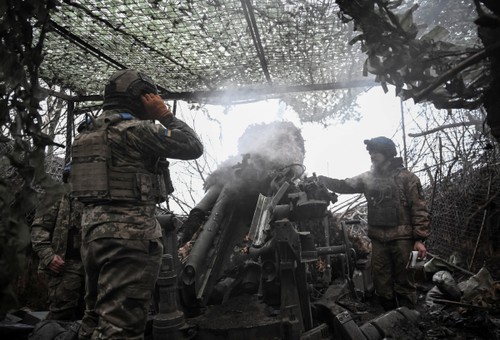
 Artillerymen of the Armed Forces of Ukraine in Dnipropetrovsk region, Ukraine, December 24, 2025. (Photo: REUTERS/Stringer) Artillerymen of the Armed Forces of Ukraine in Dnipropetrovsk region, Ukraine, December 24, 2025. (Photo: REUTERS/Stringer) |
New concessions
After several rounds of talks in Geneva, Berlin, and Miami, US and Ukrainian negotiators revealed a 20-point peace plan in which Ukraine would maintain its armed forces at a peacetime level of around 800,000 troops, the US, NATO, and Europe would provide security guarantees to Ukraine similar to NATO’s Article 5, and Ukraine would become a member of the European Union at some point.
President Zelensky raised issues related to Ukraine’s reconstruction and economic development, such as mobilizing 800 billion USD for post-war-recovery, and accelerating the signing of a free trade agreement with the US. The plan also suggests the exchange of all prisoners of war on the principle of “all for all” and the establishment of a humanitarian commission to address pending issues.
A notable point in the plan is Ukraine’s willingness to withdraw its forces from areas it controls in Donetsk province and establish a demilitarized zone or a free economic zone. Ukraine’s concession would be conditional on Russia withdrawing its troops from corresponding areas.
Observers say that although the economic prospects of this conflict-devastated territory are unclear, Ukraine’s proposal appeals to President Donald Trump and US businesses, who are interested in Ukraine’s rich mineral resources in areas near the front lines.
Another special economic zone could be set up around the Russia-controlled nuclear power plant in the Zaporizhzhia region of southern Ukraine. The plant has been shut down since 2022, but has significant economic potential as Europe’s largest nuclear power plant with a capacity of 6 gigawatts.
The 20-point peace plan has been sent to Russia for consideration. US Secretary of State Marco Rubio, who has been involved in negotiations with Ukraine, said that although many issues require further discussion, the new plan represents a positive step.
“This is not about imposing a deal on anybody. It is about determining what both sides expect and need to have and what both sides are prepared to give in return for it and figuring out whether we can have those two overlap. Of course, that takes a lot of time and a lot of hard work. I think we've made progress, but we have ways to go. And obviously the hardest issues are always the last issues,” said Rubio.
The plan suggests that Ukraine hold an election as soon as possible once an agreement is signed. Implementation of a legally binding agreement will be monitored and guaranteed by a peace council chaired by US President Donald Trump. The plan says a ceasefire can only take effect once those two sticking points have been addressed.
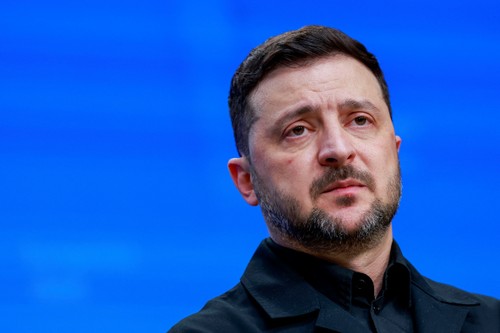 Ukrainian President Volodymyr Zelenskiy attends a press conference on the day of the European Union leaders' summit in Brussels, Belgium, December 18, 2025. (Photo: REUTERS/Stephanie Lecocq) Ukrainian President Volodymyr Zelenskiy attends a press conference on the day of the European Union leaders' summit in Brussels, Belgium, December 18, 2025. (Photo: REUTERS/Stephanie Lecocq) |
Waiting for Russia’s response
The question now is how Russia will respond to it. Many Russian politicians and experts have expressed skepticism.
Dmitry Novikov, First Deputy Chairman of the State Duma Committee on Foreign Affairs, said the plan does not address Moscow’s concerns and still differs significantly from Russia’s position. It does not demonstrate readiness to move toward a compromise solution that Russia could consider.
State Duma Vice Chairman Alexey Chepa said the plan is more of a media initiative than a concrete negotiation framework.
Andrey Kortunov, an expert of the Valdai Discussion Club, said the likelihood of Russia accepting Ukraine’s proposal without substantial changes is low.
Expert Aleksandr Grishin said the plan doesn’t mention what President Trump and President Putin agreed upon at their meeting in August in Alaska, which Russia consistently views as the foundation for negotiations to end the conflict.
In its first official response on Thursday, Moscow said only that it is analyzing the plan and will hold separate discussions with the US.
“Special envoy Kirill Dmitriev reported to President Putin on the detailed results of his trip to Miami. Based on the information President Putin has received, we will further clarify our positions and resume contacts with the US in the near future through the existing communication channels,” Kremlin spokesperson Dmitry Peskov said.
Observers say that among the points Russia is unlikely to accept are two issues on which even the US and Ukraine have yet to reach consensus: control of Donbas and the Zaporizhzhia nuclear power plant. Russia has insisted that control of Donbas is “non-negotiable”. And Russia would hardly accept Ukraine’s proposal that the Zaporizhzhia nuclear power plant be managed solely by a US-Ukraine joint venture.