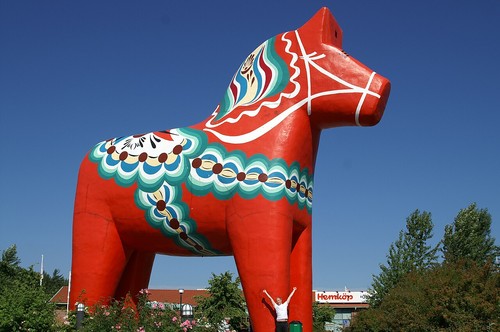
 The world's largest Dala horse is located in Avesta, measuring 13 meters high and 12.8 meters long (Photo: Teknos) The world's largest Dala horse is located in Avesta, measuring 13 meters high and 12.8 meters long (Photo: Teknos) |
"Greetings to the people of Vietnam and all of Asia. We at Grannas A. Olsson in Nusnäs, Sweden, are proud makers of this handmade symbol of our country, and we have been around for the past 104 years. But the Dala horse is much older than that. It started in the 15th century as a toy and an homage to a very important animal at the homestead and in the forest."
In Sweden, the horse isn’t just an animal—it’s an icon. You’ve seen it in gift shops and airports – the bright red, hand-painted wooden figure known as the Dala horse. But today, we’re not talking about a wooden keepsake, we’re talking about a tradition that has shrunk to the size of a blood cell.
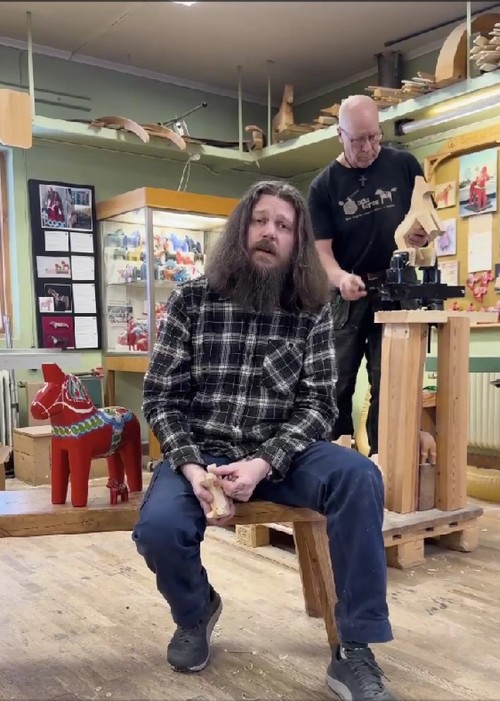 At the Grannas A. Olsson workshop in Nusnäs (Screen shot photo) At the Grannas A. Olsson workshop in Nusnäs (Screen shot photo) |
A century-long company history began in 1920, when a 24-year-old Anders “Pelle” Olsson began carving wooden toys in his family’s bakery to help support his eight siblings. By 1922, his hobby had grown into a business.
Back then, the tools were simple—hand-drawn saws and sharp knives. It wasn’t until the late 1920s that electric motors were added to the workshop. Over time, the small village of Nusnäs became synonymous with Swedish craftsmanship and identity.
Even now, each Dala horse is a combination of traditional handicraft and small-scale production. Approximately 50,000 are produced annually—and no two are exactly alike.
As we move deeper into the 21st century, artists are asking new questions: How does tradition survive in an age of high-tech? How small can a legacy become?
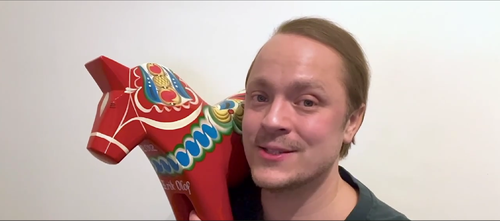 Erik Olof Wiklund and a Dala horse, the Swedish beloved symbol (Screen shot photo) Erik Olof Wiklund and a Dala horse, the Swedish beloved symbol (Screen shot photo) |
Erik Olof Wiklund, a 36-year-old artist from Hälsingland, has spent two decades exploring his region’s cultural history. For his graduation project at Umeå University, he decided to view the Dala horse through a different lens—literally.
"Sweden is known for many things. We have Zlatan, we have ABBA, but we also have something very special – we have the Dala horse, or Dalahäst in Swedish. This year is the Year of the Horse, which makes this moment very special. I want to show you something very small, but it’s also very meaningful. This is the world’s smallest Dala horse," said Erik.
When Erik says “small”, he’s not talking about something you can hold in your hand. He’s talking about something just 7 micrometers long—about one-tenth the width of a human hair. Dozens could sit on the tip of a needle, invisible to the naked eye and visible only under an electron microscope.
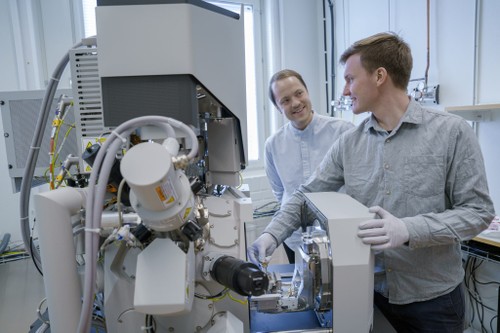 Erik Olof Wiklund and Nils Hauff at Umeå Centre for Electron Microscopy (Photo: Mattias Pettersson, Umeå University) Erik Olof Wiklund and Nils Hauff at Umeå Centre for Electron Microscopy (Photo: Mattias Pettersson, Umeå University) |
This is where traditional art meets nanotechnology. Erik collaborated with Nils Hauff, a staff scientist at the Umeå Centre for Electron Microscopy. Their goal was to create something—to sculpt with precision on the nanoscale using something finer than a laser beam as a chisel. They worked with a Focused Ion Beam, or FIB, which is normally used to slice into cells to reveal hidden structures. Erik and Nils used it to carve a microscopic block of platinum into the unmistakable silhouette of a Dala horse.
One of the toughest technical challenges, Nils said, was ensuring the tiny structure wasn’t destroyed by the beam’s energy. At that scale, the slightest force can be overwhelming.
The collaboration of the two men became a lesson in possibility. Their effort demonstrated that scientific instruments need not be restricted to scientific research. They can also serve culture and art.
What makes their “Nano-Horse” especially poetic is its origin. It’s the twin of a family heirloom.
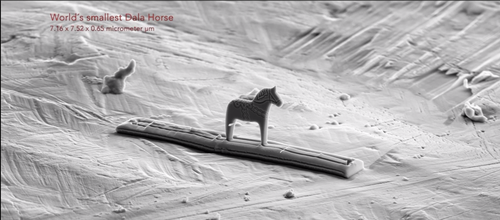 The worlds smallest Dala horse using advanced nanotechnology (Screen shot photo) The worlds smallest Dala horse using advanced nanotechnology (Screen shot photo) |
Erik recalled, "The design of my tiny horse comes from my family. It’s based on a Dala horse my grandfather got from his father in the 1940s and carried with him his whole life, so this tiny horse carries memory, love, and tradition."
From the 13-meter-tall Dala horse statue in Avesta to one 7-micrometer speck of platinum in a laboratory, the Dala horse connects Sweden across time, distance, and scale. Technology doesn’t have to replace tradition. It can amplify it—or, in this case, shrink it to a dimension our ancestors could never have imagined.
In 2026, the Year of the Fire Horse, this microscopic masterpiece shows us that no matter how the world evolves—from wood to platinum, from carving knives to ion beams—the spirit of the horse––a symbol of strength, home, and heritage–– endures.
As we celebrate the Year of the Horse, we are reminded that across continents — from the warm spring air of Vietnam to the icy landscapes of Dalarna — people look to the horse for inspiration for strength, determination, and cultural identity.