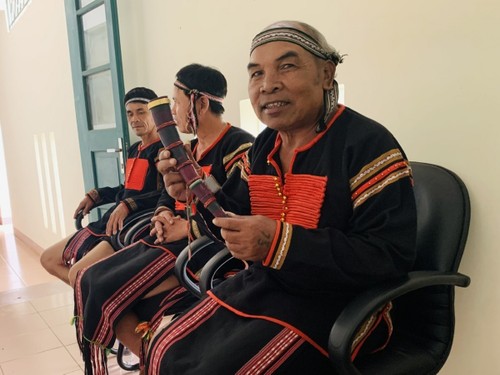
 Artisan Y-Dak Nie with the Ki pah musical instrument (Photo: H Zawut Bya/VOV–Central Highlands) Artisan Y-Dak Nie with the Ki pah musical instrument (Photo: H Zawut Bya/VOV–Central Highlands) |
Ki pah is made from the horn of a mature male buffalo, an animal closely tied to the daily life, labor, and spiritual beliefs of the Ede.
In the Ede language, Ki means horn, and Pah means to tap or beat. To vary the pitch, the player blows while covering and uncovering the narrow end of the horn with the left thumb and tappingthe larger end with the right hand.
Crafting a soulful Ki pah requires a careful process and experience. The artisans choose large, intact buffalo horns, clean them thoroughly, hollow out the interior, and shape them.
Artisan Y-Dak Nie from Dak Lak province said the key to producing loudly echoing sound lies in attaching a reed made of bamboo or wood at the mouthpiece.
"When I was little, I saw elders using a piece of wood to make the mouthpiece and a bamboo piece to make the reed. They are glued to the buffalo horn by beeswax. In the past, the Ki pah was only allowed to blow outside the village. Now, we try to encourage our children and grandchildren to preserve this cultural item," artisan Y-Dak Nie said.
The Ki pah produces a powerful sound and was traditionally used to issue commands in battle or to drive away wild animals. During sacred elephant worship ceremonies, it serves as a medium to communicate with deities, expressing prayers for peace, health, and good fortune for both the elephants and the community. The Ede also use the Ki pah to call villagers together, announce the arrival of honored guests, or warn of impending danger.
 Artisan Y-Du Eban performs Ki pah at VOV's Bureau in the Central Highlands. (Photo: H Zawut Bya/VOV–Central Highlands) Artisan Y-Du Eban performs Ki pah at VOV's Bureau in the Central Highlands. (Photo: H Zawut Bya/VOV–Central Highlands) |
Y-Du Eban, an artisan from Dak Lak province, said: "The elders say that in the past, Êđê people only blew the Ki pah during two very sacred occasions. Firstly, this would be at the funeral of the wealthiest person in the village, who had passed away at the age of 70 or older. Secondly, the horn was blown at the ceremony to start making a long kpan bench and bring it in to the stilt house. It informed the community of the joyful event."
With urban development on the rise, the traditional soundscape of the Ki pah is shrinking. The craft of Ki pah-making faces the risk of fading, as skilled artisans get old and pass away.
Artisan Y-Trinh Eban said: "It’s difficult to make a Ki pah.No one in my village can craft this instrument anymore. In other villages, maybe only a few people still can. We occasionally use it for festivals or to show to tourists."
Ede villagers are striving to preserve the Ki pah, which is not only a piece of history, but also a part of their unique spiritual beliefs.