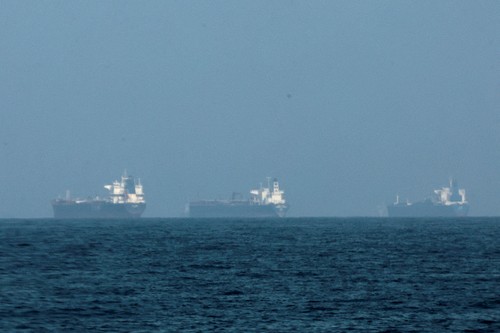
 Oil tankers off the coast of Fujairah, United Arab Emirates, on March 3, 2026, after Iran says it would fire on vessels passing through the Strait of Hormuz. (Photo: REUTERS/Amr Alfiky) Oil tankers off the coast of Fujairah, United Arab Emirates, on March 3, 2026, after Iran says it would fire on vessels passing through the Strait of Hormuz. (Photo: REUTERS/Amr Alfiky) |
On Feb. 28, the United States and Israel launched joint attacks on Iran. On March 8, global oil prices surpassed 100 USD per barrel, the highest level since the outbreak of the Russia-Ukraine conflict in February 2022.
Energy crisis concerns
Oil prices continued to surge as the US-Israel conflict with Iran entered its second week, marked by further Israeli attacks on Iranian oil refineries and retaliatory strikes by Iran targeting other oil-producing countries in the Gulf region. Shipping through the Strait of Hormuz, which carries about 20% of the world’s oil and gas, was suspended at the start of the conflict. Since then WTI crude prices have risen more than 75%, and Brent crude has risen more than 60%, and the upward trend will not be easing soon.
Oil prices surpassing 100 USD per barrel for the first time in more than four years suggests a looming global energy crisis. Stephen Innes of SPI Asset Management, Switzerland, said oil above 100 USD is not a commodity rally. It’s a tax on the global economy. Gulf producers are cutting output because their storage facilities are full, export routes are closed, and supply chains could take weeks to recover even if tensions ease.
Saul Kavonic, Director of Energy Research at MST Marquee, Australia, said oil prices will continue to rise daily as long as the Strait of Hormuz remains closed. If the US and other Western countries deploy warships to escort oil tankers through the Strait, the impacts could be somewhat mitigated, but shipping would still not return quickly to normal.
“But even then, there will still be disruptions of flow because the convoy system will be inherently slower than what prevailed previously, and in particular, gas could be impacted a lot more than oil. Because oil still can get, you can still get some of the Saudi oil and the UAE oil out without the Strait of Hormuz. But LNG is 100% dependent on the Strait of Hormuz,” said Kavonic.
Despite the US’s reassurance that the oil price surge will soon subside, and the G7’s plan to tap its strategic reserves and inject 400 million barrels into the oil market, medium-term risks are still high.
Richard Tullis, Managing Director of Water Tower Research, US, said, “At the end of the day, what's going to drive pricing in the midterm is just activity that flows through the Strait of Hormuz and just the sentiment and outlook there. And then secondly, is there going to be any widespread damage to the energy facilities throughout the Middle East? That's been limited. We hope that remains to be the case, because to repair damage is going to take a lot longer potentially than to open up the Strait of Hormuz.”
 (Illustrative photo: REUTERS/Dado Ruvic) (Illustrative photo: REUTERS/Dado Ruvic) |
Widespread economic losses
Economists have begun modelling the long-term impacts on national economies and global growth. In Europe, a region highly vulnerable to energy shocks, natural gas futures rose 60% over the past week.
Professor Thierry Bros of Sciences Po University, France, said that in 2022, Europe spent over 4.6 trillion USD on energy subsidies. He warned that such policies cannot be repeated and Europe would face any new crisis without the same level of financial protection as before. If gas prices exceed 115 USD per megawatt-hour, some European factories may be forced to shut down and relocate production to the United States.
Many Asian economies will begin to see oil shortages in the coming weeks, as most of the oil transported through the Strait of Hormuz is destined for Asia. Francis Lun, Chief Executive Officer of Venturesmart Asia in Hong Kong, China, said, “For countries in East Asia, except for Malaysia and Indonesia, everybody else is a net importer of oil. And that will create inflationary pressure. And also, of course, that will bring on economic damage. And certainly, economic growth will slow and the inflation will pick up. And this is the worst case scenario we saw when the US and Israel started to attack Iran. And everything is getting out of control now.”
The Asian Development Bank (ADB) said last week that if the Middle East conflict lasts less than a month, its impact on Asian economies will be relatively small. Albert Park, ADB’s Chief Economist, said that even in the worst-case scenario, Asia’s economic growth this year is unlikely to decline by more than one percentage point.
However, the longer the conflict, the greater the damage to Asian economies. Air cargo transport costs from Asia to Europe have increased 45% since the conflict began, more than double the increase for routes from Asia to the United States.
Maurice Obstfeld, former chief economist of the International Monetary Fund, said Asia is more dependent on energy imports and geographically closer to the conflict zone, making it more vulnerable to the crisis.
Impacts are now beginning to appear in the US, where the average gasoline price is now 3.41 USD per gallon, up from 2.98 USD a week earlier, according to the American Automobile Association. Disruptions in global energy markets can quickly translate into higher input costs for farmers. If the Middle East conflict continues longer than President Donald Trump expects, food prices could rise in many places.