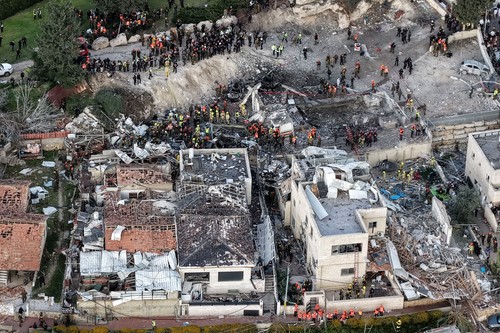
 The scene of Iran's attack on Israel in Beit Shemesh on March 1, 2026, following US-Israel strikes. (Photo: REUTERS/Ilan Rosenberg) The scene of Iran's attack on Israel in Beit Shemesh on March 1, 2026, following US-Israel strikes. (Photo: REUTERS/Ilan Rosenberg) |
Since last Saturday, the US-Israel alliance and Iran have struck thousands of targets. The conflict has spread across the Middle East and beyond. A US submarine attacked an Iranian warship off the coast of Sri Lanka.
Questions for Washington
The question being most often asked is what drove President Donald Trump to embark on a risky military adventure in Iran, a scenario that all previous US presidents have cautiously avoided. Confusion about the decision has been compounded by inconsistent statements from the most senior officials in the US administration.
In his remarks following the initial attack, President Trump said he decided to strike Iran to prevent it from developing a nuclear weapon and to eliminate the threat to US interests and allies in the region from Iran’s ballistic missile capability.
Secretary of State Marco Rubio offered another explanation for the strikes: Iran posed an “imminent threat” because it was sure to retaliate against US forces after an imminent planned attack by Israel.
Defense Secretary Pete Hegseth said Wednesday that the Iranian regime “are toast.” On Thursday President Trump said the US should be involved in choosing the person who will lead Iran in the future.
Ali Vaez, Director of the Iran Project at the International Crisis Group, said the initial rationale of making a pre-emptive strike to halt Iran’s weapons program is gradually being replaced by the rationale of trying to bring about regime change in Iran, or at least a policy change by Iran’s top leadership.
Trump’s mention of choosing Iran’s new leader suggests that he expects an outcome similar to Venezuela, replacing the old government with a government more friendly to the US. Ali Vaez thinks that outcome is far-fetched, as the conflict escalates and Iranian leaders consider the long-term consequences of the US-Israeli attacks killing a number of top Iranian officials.
“The Islamic Republic of Iran is a system and has never been a one-man show. The current leaders in the Islamic Republic understand that if they don't reach some sort of an equilibrium with the United States, if they are seen as being in a position of weakness, it is not going to put them in a position to be able to get any kind of fair or equitable outcome after this conflict.”
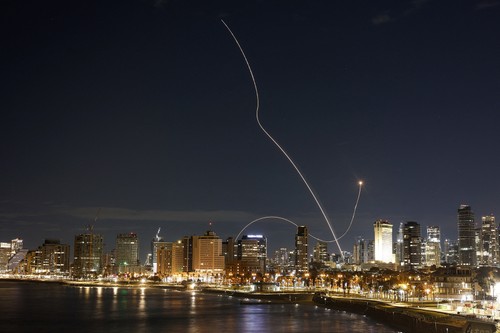 Israel's air defense system intercepts missiles from Iran on March 1, 2026. (Photo: REUTERS/Jamal Awad) Israel's air defense system intercepts missiles from Iran on March 1, 2026. (Photo: REUTERS/Jamal Awad) |
Questions of international law
Geopolitical incidents around the world since the beginning of the year, from Venezuela to Iran, have raised a fundamental question: do international law and multilateral institutions still have sufficient influence to ensure world peace and stability?
Canadian Prime Minister Mark Carney said that what is happening in Iran shows a failure of the global order. Most European countries have made cautious responses, but some have openly condemned the US-Israeli military actions. The UK, the US’s closest ally, has refused to allow US forces to use British bases to attack Iran. Patrick Bury, Associate Professor in Security at the University of Bath, said British Prime Minister Keir Starmer has concerns about the legality of the US attack and prefers having a strained relation with the US to joining its ally’s military adventure.
“The only justification that the US and Israel could use to justify their use of force on Iran is self-defense. Under Article 51 of the United Nations Charter, such self-defence must be based on the fact that Iran has launched a military attack on Israel or the United States,” said Marko Milanovic, Professor of Public International Law at the University of Reading School of Law. “And there's simply no evidence that Iran was imminently going to attack either by nuclear weapons or otherwise.”
Another big question is what lies ahead for the Middle East and the world. The scenario of a prolonged and expanding conflict is taking shape. The attacks have already spread to 15 countries. An old flashpoint has reignited in southern Lebanon, where Israeli forces have resumed ground operations.
South Asia and Central Asia are also beginning to be involved. A US submarine sank an Iranian warship on Tuesday in international waters off Sri Lanka, and two UAVs exploded at an airport in Azerbaijan.
The closure of the Strait of Hormuz, through which 20% of the world’s oil passes, has already driven up oil prices and the price of many foods and raw materials. A long blockade will inflict economic damage on many countries.
Naveen Das, an analyst at Kpler, a global specialist in real-time market data and analysis, said, “If the situation continues for a few more weeks, we’ll really face a critical situation in terms of the food stocks in the Middle East. I'd say first and foremost getting food on your plate in this situation is critical. Then it’s the cost of energy and how it impacts every aspect of our lives.”
Marion Messmer, Director of the International Security Programme at the UK’s Chatham House, said the conflict sends to countries around the world the message that negotiations can quickly be replaced by force. Countries may grow reluctant to trust diplomatic efforts or the goodwill of major powers, increasing the fragility of an already strained global security environment.