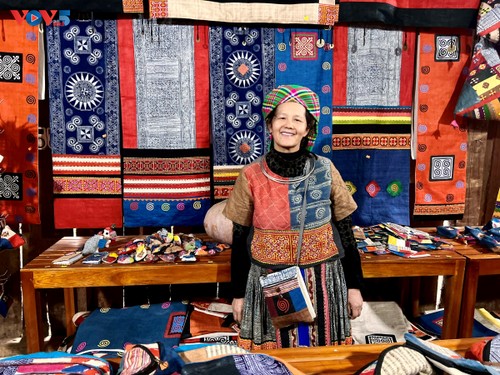
 Vang Thi Mai has changed the lives of Mong women in her community and brought traditional flax weaving to the global market. (Photo: Huyen Trang) Vang Thi Mai has changed the lives of Mong women in her community and brought traditional flax weaving to the global market. (Photo: Huyen Trang) |
"The Mong people use a piece of flax cloth to wash the face of the deceased before the cloth is burned. If the smoke forms a pattern appears, the person will be reborn as a woman; if not, as a man. This story illustrates that the Mong and flax are bound together like husband and wife. One pattern represents four generations living under one roof, with the children close by. One pattern depicts the stone fences you see around houses in Dong Van. Everything is stitched by hand."
A Mong woman in her 60s holds up a flax scarf, then a flax bag, explaining the spiritual meaning behind the motifs to visitors. This gentle woman sharing her passion for flax is Vang Thi Mai, one of the 50 most influential women in Vietnam, according to Forbes Vietnam in 2017. It was she who revived Mong flax weaving when the craft seemed destined to disappear.
"Mong flax is our spiritual soul. Today, we preserve and promote its cultural value to international friends,” Mai said. She recalled since 2008, their flax products have been showcased at fairs in Luxembourg, the US, Germany, France, and Russia. In 2010, they were invited to a fair in Paris.
“Our village represented the 54 ethnic groups of Vietnam in a UN cultural preservation program from 2015 to 2017. In 2017, when 160 countries attended a craft fair in the US, Vietnam was awarded the Gold Cup," Mai concluded.
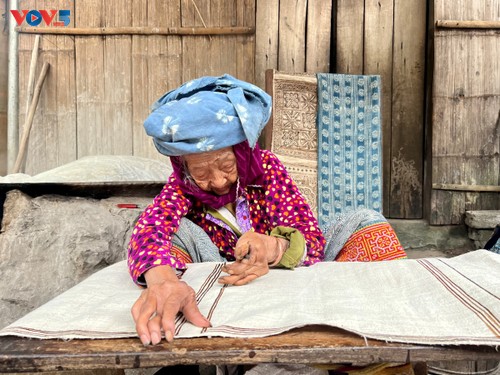 Sung Thi Co, 96, is a guardian of the essence of the flax weaving craft. (Photo: Huyen Trang) Sung Thi Co, 96, is a guardian of the essence of the flax weaving craft. (Photo: Huyen Trang) |
Today, Lung Tam flax products are exported to the US, Canada, France, Switzerland, and Italy. Here in their homeland, Mong women have become ambassadors of the craft, and have made their village a living gallery for visitors to explore.
Above the chatter of foreign visitors rings the laughter of Ms. Sung Thi Co. At 96 years old, she’s an iconic figure in Lung Tam. Dressed in traditional clothing beside a fire, she uses a tool made by her son to apply beeswax to fabric. Her hands are weathered and gnarled from a lifetime of weaving and embroidery, but her eyes are still sharp, and her movements are graceful.
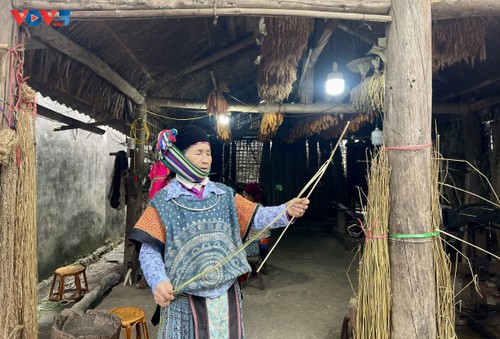 Separating flax bark into thin, delicate fibers is one of the 41 steps in the traditional handmade flax-weaving process. (Photo: Huyen Trang) Separating flax bark into thin, delicate fibers is one of the 41 steps in the traditional handmade flax-weaving process. (Photo: Huyen Trang) |
She’s the guardian of Mong craft, particularly the art of drawing patterns with beeswax, and has passed these skills down to generations of villagers. Co told VOV, "My mother taught me flax skill when I was 13 years old, and I’ve practiced it ever since. I love this fabric because it belongs to the village. We take white cloth and turn it into floral skirts. I draw leaves and flowers—whatever I like. I can only finish three squares a day. When they’re done, the cloth is dyed in indigo and boiled. If someone wants it, I cut a piece for them. One square sells for about 11.40 USD."
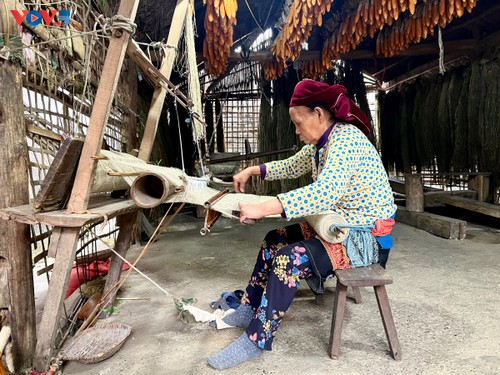 Being able to weave flax fabric is considered an important criteria of a Mong woman’s talent, skill, and diligence. (Photo: Huyen Trang) Being able to weave flax fabric is considered an important criteria of a Mong woman’s talent, skill, and diligence. (Photo: Huyen Trang) |
Creating a single flax product requires about 40 steps. Green flax fields stretch across steep hillsides. After harvesting and drying, elderly women strip the fibers and young girls tie them together. The rhythmic thud of pounding flax echoes through the village until the pulp is removed, leaving only tough, durable fibers.
By the wood stove, Ms. Mua Thi My boils the flax in ash water and beeswax to make the fibers soft and white. "My family grows flax. Our largest plot is about 1,000 square meters. Our living conditions are better now. We don’t make a fortune, but we keep the tradition. Without it, there would be no flax clothing. Only the Mong people do this," My said.
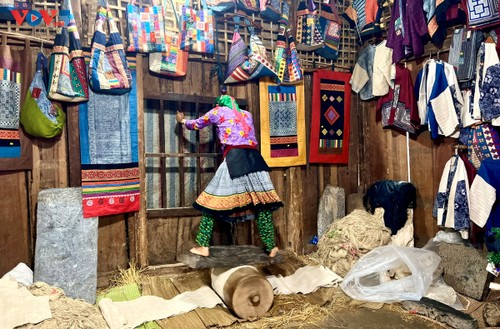 A woman stands on a stone slab, rolling a heavy piece of wood over newly woven cloth to make it soft, shiny, and smooth. (Photo: Huyen Trang) A woman stands on a stone slab, rolling a heavy piece of wood over newly woven cloth to make it soft, shiny, and smooth. (Photo: Huyen Trang) |
At the loom, a grandmother is weaving threads. In the next room, a young woman is standing on a stone slab, rolling a heavy piece of wood over newly woven cloth to make it soft, shiny, and smooth. These women are both artisans and tour guides. As they work, they explain the intricate processes of fiber splitting, indigo dyeing, and embroidery to visitors.
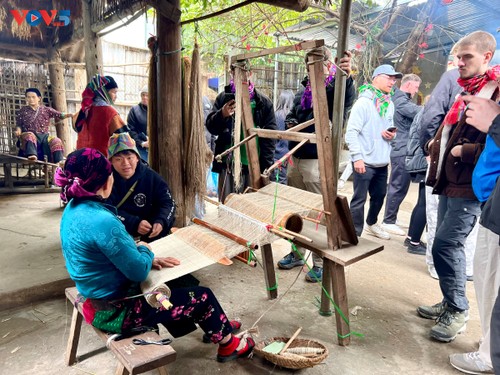 Domestic and international visitors to Lung Tam want to learn about and experience the traditional flax-weaving process. (Photo: Huyen Trang) Domestic and international visitors to Lung Tam want to learn about and experience the traditional flax-weaving process. (Photo: Huyen Trang) |
According to Ms. My, "In the past, our elders wore only flax. When someone passes away, they must have flax clothing to wear. I draw what’s in my heart and follow what the elders left behind. The craft gives us enough to live."
While flax weaving has faded in many places, it continues to thrive in Lung Tam, where Mong women have woven the remarkable story of their village and its people and shared it with the world.