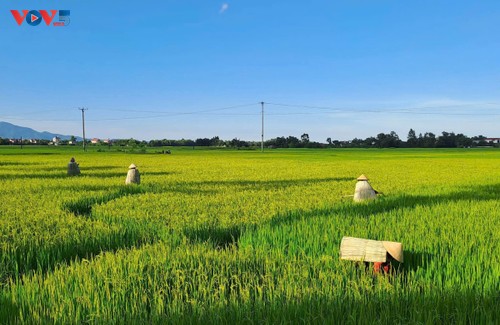
 Palm-leaf raincoats have popularly been used in Yen Lac hamlet, Ha Tinh province for hundreds of years. (Photo: Kim Lieu/VOV5) Palm-leaf raincoats have popularly been used in Yen Lac hamlet, Ha Tinh province for hundreds of years. (Photo: Kim Lieu/VOV5) |
In small homes tucked behind bamboo hedges along Yen Lac’s village paths, the sound of needles piercing leaves blends with the rustle of palm fronds. These familiar sounds come from artisans stitching palm-leaf raincoats. Practiced in Yen Lac for 300 years and handed down through generations, the craft has become an inseparable part of local culture.
Villagers make palm-leaf raincoats year-round, but the busiest period is from the third to the sixth lunar month, when palm leaves reach their ideal maturity for durability and flexibility. The first step in making the raincoats is gathering palm leaves, rattan, and bamboo from Khe Giao, the mountain communes of what used to be Huong Khe district.
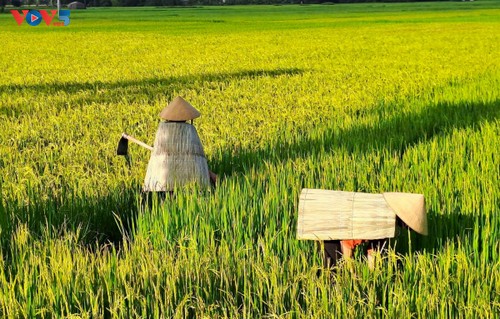 Farmers consider palm-leaf raincoats their friends to protect them from the bad weather. (Photo: Kim Lieu/VOV5) Farmers consider palm-leaf raincoats their friends to protect them from the bad weather. (Photo: Kim Lieu/VOV5) |
57-year-old Nguyen Van Thuan, who has devoted 40 years to the trade, said the hardest part is collecting the leaves. “We must go all the way to Huong Khe. For each trip, we must wake up at 4 a.m. If we’re lucky, we can return the same day. Usually, it takes two days. The leaves must be dried for three sunny days and two nights of dew, so they turn a nice color and last longer,” Thuan explained to VOV.
Making a raincoat requires patience, precision, and skill. Leaf selection is crucial—the leaves must be neither too old nor too young. Freshly harvested leaves are singed with fire until evenly white, bundled, then dried for two days and one night until they spread flat and toughen.
For assembly, artisans use a wooden frame about one square meter in size, plus 5 to 7 wooden slats 3 cm wide and 1 m long to align the leaves. Palm leaves are layered like roof tiles and stitched with 25-centimeter iron needles threaded with rattan fibers. A typical raincoat has five stitched seams.
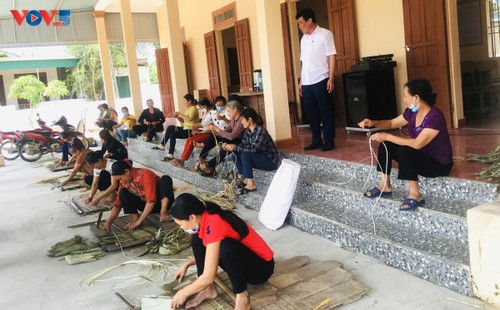 Female members of the Yen Lac Raincoat Cooperative (Photo: Kim Lieu/VOV5) Female members of the Yen Lac Raincoat Cooperative (Photo: Kim Lieu/VOV5) |
The collar, the most important part, is carefully woven from multiple layers of leaves and secured with rattan ties to fasten around the neck and back. According to Pham Van Hung, 59 years old, “The most difficult step is stitching the collar. You need two or three layers of leaves before it starts to take shape. Without the collar, you can’t make the raincoat at all.”
Xuan Loc commune has 188 households, two-thirds of which still practice the craft. During peak season each household can earn more than 600 USD per month. To preserve and promote the tradition, the Yen Lac Raincoat Cooperative was established in 2022 with 25 members. Its aim is to expand markets and seek new opportunities.
Dang Dinh Vinh, former Chairman of the Quang Loc commune People’s Committee, said, “Our raincoats are sold in many parts of Vietnam and even exported to Laos. In hot weather demand rises and orders come through the cooperative. The cooperative helps villagers promote the product to reach wider markets.”
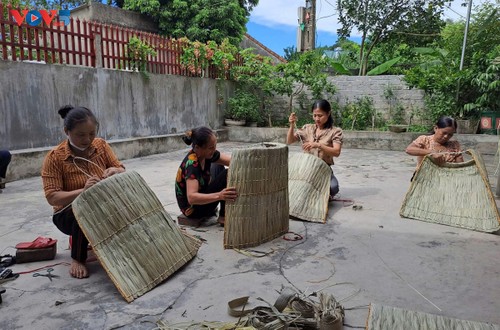 People in Yen Lac hamlet have been engaged in making palm-leaf raincoats for more than 300 years. (Photo: Kim Lieu/VOV5) People in Yen Lac hamlet have been engaged in making palm-leaf raincoats for more than 300 years. (Photo: Kim Lieu/VOV5) |
Thanks to promotional efforts, the Yen Lac raincoat has attracted attention from the tourism sector. Nguyen Quoc Hiep, Director of the Xuan Loc Community Learning Center, said, “Recently our center organized an experiential tour for city students to witness each stage of making a palm-leaf raincoat. They were very interested in it. We see this as a way to develop the craft. We’re working with the cooperative to improve our designs so the raincoat can serve broader, more diverse markets.”