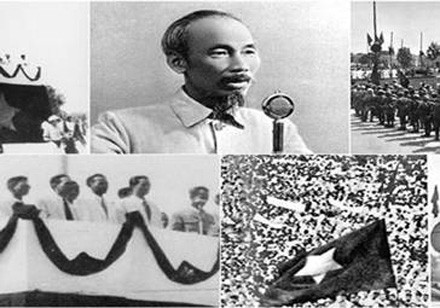
 (Photo: VNA) (Photo: VNA) |
Based on the foundation of a socialist rule-of-law state, the revolutionary Vietnamese State, born from the great victory of the August Revolution, promotes reform, building, and fine-tuning to fulfill its historic mission of being a state of the people, by the people, and for the people.
A rule-of-law state must belong to the people
President Ho Chi Minh once defined as a guiding principle that a rule-of-law state must belong to the people. This is a goal, a characteristic, and a decisive factor to ensure the success of a revolution.
During the August Revolution of 1945, the Party’s determination to establish a “democratic republic” after defeating colonialism and fascism became a crucial reason for its victory. The new government was not the instrument of a single class but a government representing the entire nation, a government of the people of the Democratic Republic of Vietnam, elected by the National Congress, representing the unity and collective will of the Vietnamese people.
Throughout history, in each specific phase of resistance, national construction, socialism building in the North, liberation of the South, and reunification, the Party charted policies that empowered the state apparatus to carry out the democratic national revolution while safeguarding the fundamental rights and interests of the people.
In the Political Platform for National Development during the transition to socialism (supplemented and developed in 2011), the principle of “building a socialist rule-of-law state of the people, by the people, and for the people” was affirmed as one of eight fundamental orientations toward achieving the national development goal of becoming a modern industrialized country, oriented toward socialism, by the mid-21st century.
Over the past 80 years, this principle has been institutionalized, becoming a constitutional doctrine and a guiding principle for the organization and operation of the Vietnamese state apparatus at all levels.
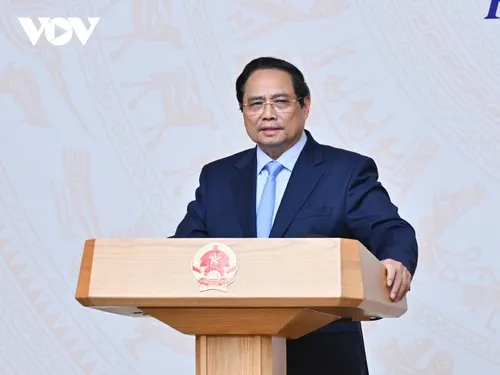 Prime Minister Pham Minh Chinh (Photo: VOV) Prime Minister Pham Minh Chinh (Photo: VOV) |
By the people, for the people means protecting human, citizen rights
In the last 80 years, from the Democratic Republic of Vietnam to today’s Socialist Republic of Vietnam, the organization, institutions, and methods of state governance have evolved to meet the demands of each revolutionary stage. Yet, through all the changes, the principle of a state of the people, by the people, and for the people has remained unchanged.
The new two-tier local government system that began on July 1, 2025, is a leap forward in decentralization, removing bottlenecks, and bringing state governance closer to the people. Meanwhile, administrative reforms, e-government initiatives, and digital transformation have advanced strongly, helping the Government better carry out socio-economic development tasks and improve people’s lives.
At a conference on professional training of Party building, state management, organization and operation of the Fatherland Front and political organizations at the new commune level on June 14, 2025, Prime Minister Pham Minh Chinh said: “Party committees and administration at all levels must foster creativity, flexibility, and a deep sense of responsibility to the people and the nation. As we transition to new models, the government, the Fatherland Front, and political organizations must listen to the people, stay aligned with reality, engage with communities, and maintain a humble spirit of learning from the people.”
80 years of building a state of the people, by the people, and for the people is a story of Vietnam actualizing human rights and citizens’ rights and establishing a multi-layered, comprehensive social security system. These rights and this social security are the embodiment of a state of the people, by the people, and for the people.