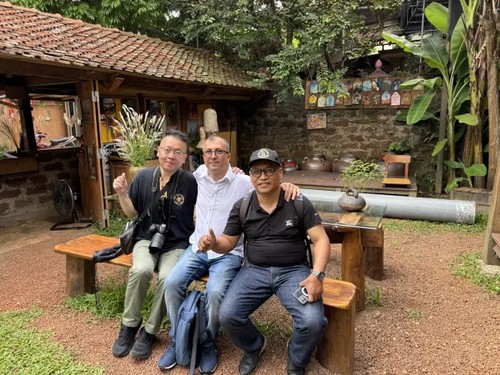
 (From left) Kazuaki Oikawa of Japan, Vicentiu Daniel Gheorghe from Romania, and Rudy Hartono of Indonesia visit Duong Lam ancient village. (photo: Vincentiu Daniel Gheorghe) (From left) Kazuaki Oikawa of Japan, Vicentiu Daniel Gheorghe from Romania, and Rudy Hartono of Indonesia visit Duong Lam ancient village. (photo: Vincentiu Daniel Gheorghe) |
B: Oikawa of Japan, Vincentiu Daniel Gheorghe of Romania, and Rudy Hartono of Indonesia all left Vietnam with unforgettable memories and many great photos of the places they visited. After returning home, Oikawa sent us a recap of the most memorable moments of his trip in English.
A: “One of the most moving experiences was the boat ride in Tam Coc, where I saw wild lotuses blooming in abundance for the first time. It reminded me that the lotus is Vietnam’s national flower, a symbol of purity and resilience. Watching birds living freely along the riverbanks also touched me deeply, as a birdwatching enthusiast. Their presence in such a rich natural environment stirred my appreciation for the harmony between wildlife and landscape.”
B: That’s such a beautiful reflection, Oikawa! Tam Coc is called “Ha Long Bay on land” because of the limestone karsts that rise from its rice fields. The boat ride along the Ngo Dong river offers a serene escape that’s especially wonderful in lotus season when the riverbanks burst with color and life.
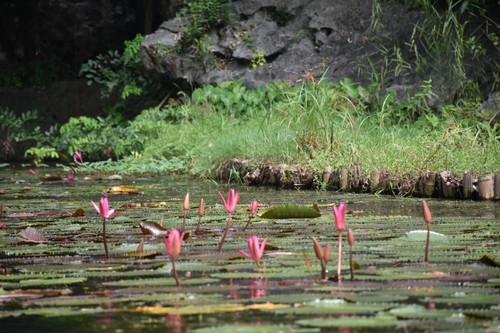 A photo taken by Kazuaki Oikawa on Ngo Dong river at Tam Coc (photo: Kazuaki Oikawa) A photo taken by Kazuaki Oikawa on Ngo Dong river at Tam Coc (photo: Kazuaki Oikawa) |
A: Oikawa said of Duong Lam village: “I got to try traditional crafts like tile painting and lantern making. The colors used in tile painting resonated with the techniques found in Japanese ink wash painting, revealing a shared aesthetic sensibility across Asian cultures. Vietnamese calligraphy, like Japanese shodō, uses brushes and emphasizes expressive brushwork. I felt a strong cultural connection through the art of writing.”
B: The Vietnamese and Japanese cultures indeed share many aesthetic values rooted in harmony, simplicity, and respect for tradition. In places like Duong Lam, these values come alive through crafts, architecture, and the quiet rhythm of village life.
A: Oikawa wrote: “Vietnamese cuisine, now increasingly popular in Japan, also offered insights into shared cultural values. Though it differs from Japanese food in many ways, the use of chopsticks and the communal style of eating reflect a common Asian heritage. I was struck by how the differences coexist with deep-rooted similarities.”
B: We’re glad to hear that you enjoyed our Vietnamese food, Oikawa. The VOV organizers carefully planned the menus to suit all three of you, coming from different countries and culinary backgrounds. It’s wonderful that, through food, you felt the connections that link our Asian cultures.
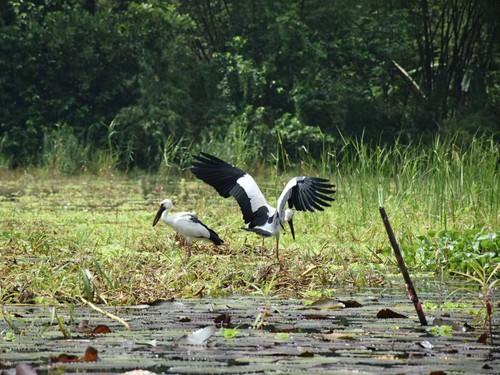 The riverbanks burst with color and life. (photo: Kazuaki Oikawa) The riverbanks burst with color and life. (photo: Kazuaki Oikawa) |
A: Oikawa concluded: “Above all, the greatest treasure from this program was the friendship I formed with my fellow winners from Indonesia and Romania. Through shared experiences and heartfelt conversations, we became long-life friends, proof that cultural exchange can build bridges across borders. I sincerely thank VOVWorld for making this journey possible. It was not only a celebration of Vietnamese culture but also a powerful reminder of how art, nature, and tradition can unite people from around the world.”
B: We’re happy to know that the trip created beautiful memories of Vietnam and lasting friendships that transcend borders and cultures. Thank you for capturing the spirit of VOV’s “What do you know about Vietnam?” contest, which hopes to connect hearts through shared experiences and cultural understanding. It’s always inspiring to hear that VOV is helping our listeners connect with Vietnam and with each other.
|
The three listeners try their hand at crafting items at Duong Lam village.
|
B: Speaking of our listeners, we received a message this week from Gerry Neumann, a long-time friend in the UK, who has been following VOV’s English programs for many years.
A: Mr. Neumann said: “I’m proud to say that I belong to the big family of listeners to VOV English, and have met a number of the staff over the years when I've visited you at 45 Ba Trieu street. I hope VOV will continue to broadcast for many years to come.”
B: Thank you for your long-standing friendship. It’s always nice to hear from you and know that you’re still tuning in to our programs. We appreciate your continued support and the fond memories you’ve shared with us of your visits to our station at 45 Ba Trieu street.
A: And now, we’d like to mention another familiar name, Juan Carlos Pérez Montero of Spain. In his October message, he reflects on the passing of time, the joys of friendship, and new hopes as autumn arrives.
B: Besides giving us a reception report, he told us a little about his life and mentioned that his birthday was September 24th.
A: Happy belated birthday, Juan Carlos! We wish you good health, happiness, and many wonderful days ahead.
B: It was heartwarming to hear about the new joy in your life. You said September marked a year since you met someone who adds warmth and excitement to your life. We hope your upcoming trip together will be full of laughter and love, and create some unforgettable memories.
A: Juan Carlos said he’ll be traveling with his mother, brother, and sister-in-law to Rome and Vatican City during Christmas. We hope their fondest hopes and expectations for the trip will come true.
A: We’d like to answer a question from Mr. Najimuddin, an Indian listener: “How many Indian students are studying in Vietnam?”
B: We don’t know the exact number. We only have figures from certain universities. There are more than 400 Indian undergraduate students currently enrolled at Can Tho University of Medicine and Pharmacy and the International University of Vietnam National University – Ho Chi Minh City.
A: Vietnam National University – Hanoi launched a master’s programs in medicine this year, for international students seeking advanced training in Internal Medicine, Surgery, Pediatrics, Radiology, and Nuclear Medicine.
B: The first intake will include 100 Indian doctors. The foreign students will gain clinical experience at 29 hospitals in Hanoi and central Vietnam and earn a master’s degree that meets international standards.
A: In recent years, the number of international students in Vietnam has steadily increased, reflecting a recognition of Vietnam’s improving education quality. According to the Ministry of Education and Training, 22,000 international students enrolled in Vietnamese institutions during the 2023–2024 academic year —4,000 under bilateral agreements and the rest on a self-funded basis or through university partnerships.
B: The Letter Box would like to thank our listeners for your condolences for victims of the recent typhoons and flash floods that struck many parts of Vietnam. Your words of sympathy and support have meant a lot in these difficult times.
A: Our thoughts are with the families affected by these natural disasters. Typhoon Bualoi brought floods, landslides, and whirlwinds in late September that left 56 people dead, 11 missing, and 172 injured. 200,000 houses were destroyed or damaged, and hundreds of thousands of cattle and poultry were killed or swept away.
B: Over the last two days typhoon Matmo brought heavy rain and strong winds to northern Vietnam, causing widespread flooding and landslides.
A: Wrapping up this week’s Letter Box, we’d like to thank all our listeners once again for your encouragement and continued support. Join us again next week for more stories, letters, and messages from our global VOV family. Goodbye! Take care!