 The forum “Promoting Innovation and Developing Strategic Technology Sectors” is held as part of the 2025 National Innovation Day and Vietnam International Innovation Exhibition. (Photo: NIC) The forum “Promoting Innovation and Developing Strategic Technology Sectors” is held as part of the 2025 National Innovation Day and Vietnam International Innovation Exhibition. (Photo: NIC)
|
Investing in the future
The Politburo’s Resolution 57 identifies science, technology, innovation, and digital transformation as national breakthroughs — the key driving forces to modernize production, strengthen economic resilience, and reduce the risk of falling behind.
Deputy Minister of Finance Nguyen Duc Tam insisted that investing in innovation and strategic technology is investing in Vietnam’s future.
“With rapid globalization and the world witnessing rapid shifts in geopolitics and socio-economics, a nation’s strength today is measured by its ability to master and lead in strategic technologies, not by the scale of its trade or financial capacity,” said Tam, adding, “With the government’s strong leadership and the collaboration of ministries, sectors, schools, intellectuals, and international partners, Vietnam can go from running to catch up to leading the competition in strategic industries.”
World Bank: building Vietnam’s ‘three plus one’ innovation formula
Mariam Sherman, World Bank Division Director for Vietnam, Cambodia and Laos, called the current moment a historic opportunity for Vietnam to go from being a technology adopter to being a technology creator.
“Science, technology and innovation will shape Vietnam’s future, its standing in the world, and the lives of its people for decades to come. Vietnam has some real advantages: a young, talented workforce, macroeconomic stability, a strategic location in Asia's growth corridor, and a proven ability to learn and adapt. What it needs now is the right strategy,” said Sherman.
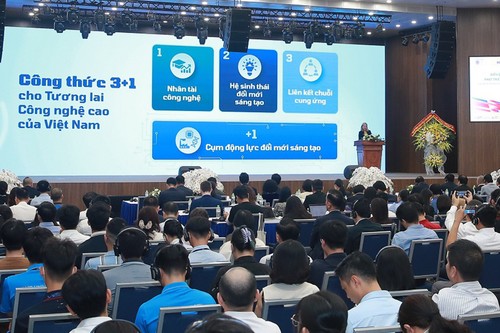 Mariam Sherman presents the “three plus one” formula for Vietnam. (Photo: Bao Tram) Mariam Sherman presents the “three plus one” formula for Vietnam. (Photo: Bao Tram)
|
Drawing from the World Bank’s latest report on talent and innovation in Vietnam’s semiconductor industry, Sherman proposed a “three plus one” formula for success that focuses on skilled workers, a strong innovation ecosystem, and linkages between domestic and foreign firms, with the ‘plus one’ being a few targeted clusters of innovation excellence – the crucial element that will make it all work.
She added, “Across semiconductors and other high-tech industries, the foundation of success is built on people – skilled workers, top-tier researchers, and technopreneurs. Universities and vocational colleges should sit at the center of talent development, co-designing training programs with firms and supplying the skilled technicians that high-tech industries rely on.”
Vietnam, Sherman said, must also create conditions to attract its overseas talent back home as nearly 65% of Vietnam’s top tech talent currently work overseas in critical and emerging technologies.
To compete globally, Sherman called on Vietnam to create the right conditions for this talent to return and thrive in Vietnam can close knowledge and networking gaps that might otherwise take decades to fill.
She said strengthening the “triple helix” partnership of academia, industry, and government is essential to unlocking innovation and putting Vietnam’s high-tech future within reach. But for that future to become real, vision must be turned into action, starting now, she noted.
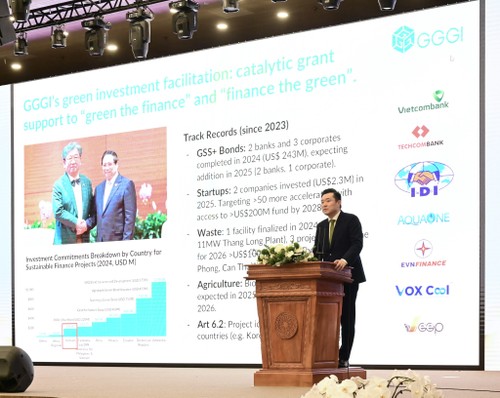 Juhern Kim, Country Representative to Vietnam at GGGI (Photo: NIC) Juhern Kim, Country Representative to Vietnam at GGGI (Photo: NIC) |
GGGI: Linking innovation with green growth
But innovation should be associated with sustainability. As Juhern Kim, Country Representative to Vietnam at the Global Green Growth Institute (GGGI), a 52-member inter-governmental treaty-based organization, put it.
“First, the tech boom and science and innovation transformation need to go hand in hand with the net zero transition and climate action, since the government already has a net zero goal. Moving toward a happier life means moving toward a greener world, a greener life.”
To reduce emissions, scientific innovation offer powerful ways, Kim said and took the agriculture sector as an example.
There are companies with autonomous robots to do the farming and unmanned vehicles to do the harvesting. The Mekong Delta, one of the biggest methane emission sources, has lots of rice straw. If the rice straw is collected with an unmanned vehicle, that will reduce future emissions enormously,” according to Kim.
In addition, because Vietnam is uniquely positioned as a rising tech hub and a growing economy ready to be a test bed linking innovation to climate goals, Kim said, GGGI plans to mobilize 1 billion USD by 2028 to support green projects and climate-tech startups in the country.
A strategic and sustainable path ahead
The Hanoi forum highlighted a shared commitment to build Vietnam’s future on innovation and sustainability.
As the World Bank’s Mariam Sherman concluded, “Investing in people is fundamental. It's what drives science and technology forward, and gives firms confidence that the right talent will be there at every level, from skilled technicians and engineers, to visionary scientists and leaders. The investment will give Vietnam the confidence and capability to lead in the industries of tomorrow.”
Sherman’s message, echoed by GGGI’s call for green growth, underscores a national imperative: Vietnam must invest boldly and strategically in science, technology, and human resources to ensure sustainable prosperity in the decades ahead.