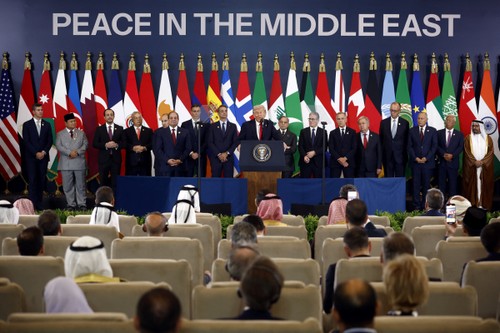
 US President Donald Trump speaks during a world leaders' summit on ending the Gaza war, in Sharm el-Sheikh, Egypt, October 13, 2025. Photo: Yoan Valat/REUTERS US President Donald Trump speaks during a world leaders' summit on ending the Gaza war, in Sharm el-Sheikh, Egypt, October 13, 2025. Photo: Yoan Valat/REUTERS |
20 world leaders, including the US President and leaders of European and Arab countries, signed a declaration supporting the ceasefire and peace in Gaza.
A new chapter for Gaza
Mediated by the United States, Egypt, Qatar, and Turkey, the Gaza ceasefire deal formalized commitments Israel and Hamas agreed to on October 10. Both sides agreed to an immediate and complete ceasefire, a hostages–prisoners exchange, and a gradual withdrawal of Israeli troops to previously agreed positions in Gaza. Just before the signing, 20 living Israeli hostages held by Hamas were released, and Israel freed 1,986 prisoners, most of them Palestinians. The bodies of deceased hostages will be returned to Israel within a week.
Co-chairing the signing ceremony with Egyptian President Abdel Fattah al-Sisi, US President Donald Trump praised the ceasefire deal as a “momentous breakthrough” and “the new beginning for an entire beautiful Middle East”, saying that, despite widespread doubts about the possibility of reaching such a deal, they ultimately achieved it.
President Trump and 20 Arab and European leaders, including UK Prime Minister Keir Starmer, French President Emmanuel Macron, and Italian Prime Minister Giorgia Meloni, signed a declaration pledging to pursue a comprehensive vision of enduring peace and prosperity, and welcoming progress toward a sustainable peace agreement in Gaza.
“This is a monumental moment in the history of the world beyond the Middle East. We've all agreed that supporting Gaza must be done to lift up the people themselves, but we don't want to fund anything having to do with the bloodshed, hatred, or terror as has happened in the past. For the same reason, we're also agreed that Gaza's reconstruction requires that it’s be demilitarized and that a new honest civilian police force must be allowed to create a safe condition for the people in Gaza,” said Trump.
Following the signing, Egyptian President Abdel Fattah al-Sisi said Egypt, the US, and other partners will soon lay the groundwork for Gaza’s reconstruction and plan to host an international conference on recovery and development. Trump said "A new and beautiful day is rising, and now the rebuilding begins. Rebuilding is maybe going to be the easiest part." He confirmed "Humanitarian aid is now pouring in, including hundreds of truckloads of food, medical equipment and other supplies”.
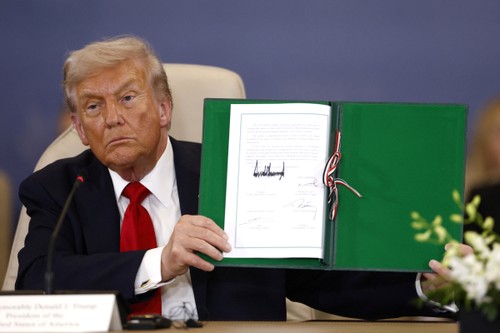 US President Donald Trump poses with the signed agreement at a world leaders' summit on ending the Gaza war, in Sharm el-Sheikh, Egypt, October 13, 2025. Photo: Yoan Valat/REUTERS US President Donald Trump poses with the signed agreement at a world leaders' summit on ending the Gaza war, in Sharm el-Sheikh, Egypt, October 13, 2025. Photo: Yoan Valat/REUTERS |
The challenges ahead
While the ceasefire deal is widely seen as an important step forward, many analysts see Trump’s declaration that “the Gaza conflict has ended” as overly optimistic. According to Trump’s 20-point Gaza Peace Plan announced in late September, once the ceasefire and prisoner exchange are completed, Phase 2 will begin establishing an interim governing body for Gaza and negotiating important issues like the disarmament of Hamas and a political roadmap for Gaza’s future.
Professor Shibley Telhami of the University of Maryland and senior fellow at the Brookings Institution said the next phase will be the most challenging. “This time it's tied to something more than just a ceasefire, because there is at least a plan that the President of the United States has put forth and there are other interlocutors internationally, including Arab and Muslim countries that have been playing the role of mediator behind it. But it hasn't been accepted by the Israelis and Palestinians. For that reason, I think what we see is the prospect of another explosion once the dust settles,” said Telhami.
Sanam Vakil, Director of the Middle East and North Africa Programme at the UK’s Chatham House, said Trump’s 20-point Peace Plan is vague and lacks detailed mechanisms for implementation.
“I think the building blocks are there in this framework. What's missing are the details. Above all, what is needed is sustained investment and attention from President Trump, who has been decisive in bringing both sides to the table, but also the international community, regional policymakers. That sort of pressure and momentum is going to be very important as the second phase of negotiations need to begin. And those require hard conversations on thorny issues of Hamas's disarmament, the composition of an international stabilization force, what will also become a governance body for Gaza,” said Vakil.
Observers say that, among the challenges of Phase 2, disarming Hamas will be the most difficult task. If Hamas refuses or only partially disarms, Israel is unlikely to fully withdraw from Gaza, making it very likely that the conflict will resume.