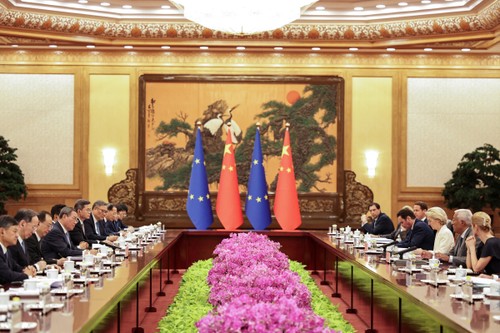
 The 25th European Union-China Summit at the Great Hall of the People in Beijing, China, 24 July 2025. (Photo: Andres Martinez Casares/REUTERS) The 25th European Union-China Summit at the Great Hall of the People in Beijing, China, 24 July 2025. (Photo: Andres Martinez Casares/REUTERS) |
President of the European Council Antonio Costa and President of the European Commission Ursula von der Leyen led the EU delegation to the EU-Japan Summit in Tokyo Wednesday and the EU-China Summit in Beijing on Thursday.
Seeking a balanced stance with China
As a key event marking 50 years of diplomatic relations, the EU-China Summit was viewed by both sides as a significant milestone in bilateral relations economically and geopolitically. The EU aims to reach consensus with China on forming a more balanced economic and trade relationship, and urge China to use its influence over Russia to help end the conflict in Ukraine. These were main topics raised by von der Leyen during her discussions with Chinese President Xi Jinping and Premier Li Qiang.
The EC President said the EU's trade deficit with China still exceeds 300 billion euros annually, and the imbalance in market openness between the two sides hinders the sustainability of bilateral economic and trade relations. The EU also expressed concerns about China's rare earth export restrictions and competition in the electric vehicle industry. The EU believes that China, given its role, influence, and responsibilities, should do more to encourage serious negotiations by Russia.
Both sides failed to reach any major agreement on either issue, except for acknowledging each other’s goodwill in having a frank dialogue.
Fabian Zuleeg, Chief Economist at the European Policy Centre in Brussels, said the lack of breakthroughs despite the frank discussion was unsurprising, given the many unresolved issues between the two sides and concerns over their respective ties with the US, as the August 1 tariff deadline approaches.
“What happens between America and China will also impact on the European Union. These are all interrelated. They are also politically interrelated. Europe is being very careful. So all of that doesn't make this summit easier,” said Zuleeg.
Although yielding no breakthroughs, the EU-China Summit gained some notable outcomes, including a joint communiqué to enhance cooperation on environmental and climate issues. The EU and China are seen as pillars of the 2015 Paris Climate Agreement since the US withdrawal.
President Xi put forward three propositions for the future development of China-EU relations. First, the two sides should show mutual respect and consolidate their relationship as a partnership. Second, they should stay open to cooperation, and properly manage their differences and frictions. Third, the two sides should practice multilateralism and uphold international rules and order.
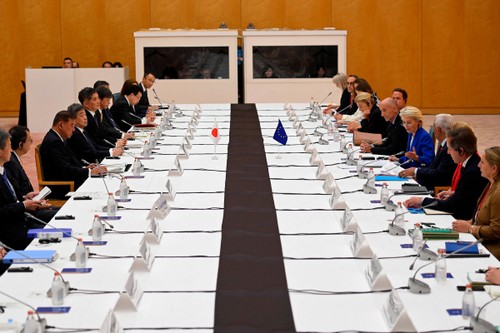 European Commission President Ursula von der Leyen, European Council President Antonio Costa and Japanese Prime Minister Ishiba Shigeru attend a meeting at the Prime Minister Office, in Tokyo, Japan, July 23, 2025. (Photo: David Mareuil/REUTERS) European Commission President Ursula von der Leyen, European Council President Antonio Costa and Japanese Prime Minister Ishiba Shigeru attend a meeting at the Prime Minister Office, in Tokyo, Japan, July 23, 2025. (Photo: David Mareuil/REUTERS) |
Launching an EU-Japan Competitive Alliance
The EU-Japan Summit further bolstered the traditional alliance between Europe and Asia’s second-largest economy. The EU leaders and Japanese Prime Minister Shigeru Ishiba announced the launch of a Competitive Alliance aimed at expanding bilateral trade cooperation, strengthening strategic supply chains, and enhancing economic autonomy amid rising global geopolitical volatility and challenges from the US and China.
The two sides will enhance policy coordination in industry, energy, supply chains, green transition, and digital technology, and promote regular high-level economic dialogue. This mechanism will serve as a framework for strategic cooperation from addressing supply chain risks to safeguarding critical technologies and fostering investment. The Alliance will discuss potential joint investments by European and Japanese businesses to tap mineral resources in third countries.
Observers say the Alliance aims to deepen bilateral cooperation and enhance their shared role in shaping global trade with the World Trade Organization facing operational difficulties. Some analysts say this may be the EU’s first step toward building a new multilateral trade framework in the Asia-Pacific region.
“We believe in global competitiveness, and it should benefit everyone. That's why Europe is stepping up cooperation with CPTPP countries, not only to defend open trade, but to shape it. Together, the European Union and CPTPP countries can lead a meaningful reform of the WTO, so that global trade rules reflect today's challenges and the risks of tomorrow,” EC President Ursula von der Leyen said.
Another important EU-Japan initiative is developing a reliable supply chain for strategic minerals and essential materials in high-tech, defense, and renewable energy industries.
The EU and Japan pledged to jointly protect emerging technologies and boost research collaboration in AI, semiconductors, and 6G technology. Prime Minister Ishiba said they began negotiations on an information protection agreement and industrial defense dialogues in the private sector.