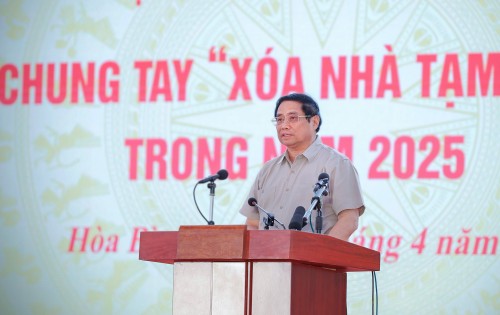
 Prime Minister Pham Minh Chinh speaks at the launch of the campaign on April, 2024 to eliminate makeshift houses nationwide by 2025. (photo: Nhat Bac/ VGP) Prime Minister Pham Minh Chinh speaks at the launch of the campaign on April, 2024 to eliminate makeshift houses nationwide by 2025. (photo: Nhat Bac/ VGP) |
A home for our people
On April 13, 2024, Prime Minister Pham Minh Chinh set a goal of completing the task in 2025. Since then, his call for everyone to contribute whatever they can (“those with labor contribute labor, those with resources contribute resources, those with more contribute more, those with less contribute less”) has been widely responded to by individuals and businesses. The Ministry of National Defense, the Ministry of Public Security, the Vietnam Fatherland Front, and the banking sector have been leading the campaign.
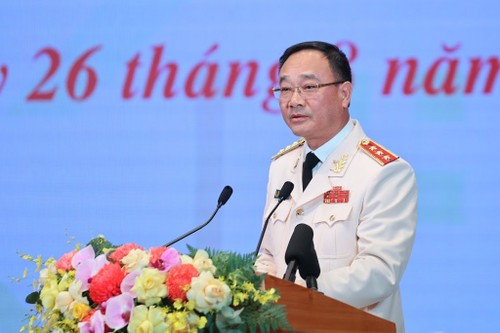 Senior Lieutenant General Pham The Tung, Deputy Minister of Public Security (photo: Nhat Bac/ VGP) Senior Lieutenant General Pham The Tung, Deputy Minister of Public Security (photo: Nhat Bac/ VGP) |
Senior Lieutenant General Pham The Tung, Deputy Minister of Public Security, said: “The People’s Public Security force has launched simultaneous campaigns in many localities to implement the program. Over 750 billion VND (28.4 million USD) were raised, exceeding 106% of the target in a spirit of community and social responsibility. All officers and soldiers voluntarily contributed two days’ salary to fund the program. The Ministry of Public Security worked with construction material suppliers and contractors to reduce, or waive transportation and construction costs, and sell materials at base prices. As a result, many houses were built with higher investment, better quality, and greater durability.”
With the engagement of the entire political system and the collective efforts of the people, Vietnam has almost achieved the goal of eliminating makeshift and dilapidated houses nationwide ahead of the deadline.
Dao Ngoc Dung, Minister of Ethnic and Religious Affairs and Deputy Head of the Central Steering Committee for the campaign, said: “Nationwide, 334,234 makeshift and dilapidated houses have been demolished, after 50 trillion VND (1.7 billion USD) were invested and 2.7 million working days were contributed by about 454,000 people. These results reflect the Party and State’s special attention and guidance in ensuring people safe, stable housing and sustainable livelihoods, and highlight the strengths of the socialist regime and its social policies to safeguard citizens’ rights.”
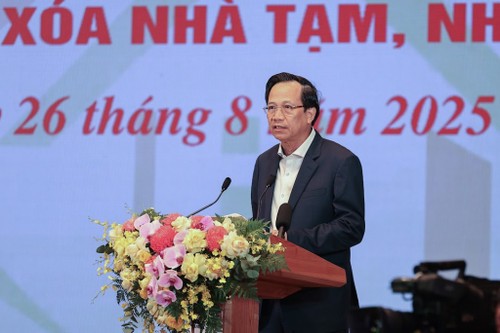 Dao Ngoc Dung, Minister of Ethnic and Religious Affairs and Deputy Head of the Central Steering Committee for the campaign to eliminate makeshift houses. (photo: VGP) Dao Ngoc Dung, Minister of Ethnic and Religious Affairs and Deputy Head of the Central Steering Committee for the campaign to eliminate makeshift houses. (photo: VGP) |
Building trust, inspiring hope
The campaign to eliminate makeshift and dilapidated houses is a major policy of the Party and State to provide people homes and inspire their hope for advancement. Many families are now living in more spacious and sturdy homes, enabling them to focus on their economic development.
“We thank the Party and State for building this new home for our family. We now feel secure and can focus on production.”
“Thanks to the support of the Fatherland Front, our ethnic minority community in the mountains has been able to replace bamboo and thatched houses. We are now living in our new home and raising our children and grandchildren. I’m very happy and excited.”
The success of the program is the first step in the mission to completely eradicate such housing and multidimensional poverty in line with the Party Central Committee’s Resolution 42 on continuing to improve the quality of social policy. The Resolution sets the goal of completely eliminating makeshift housing for poor and near-poor households and people negatively impacted by natural disasters and climate change by 2030.
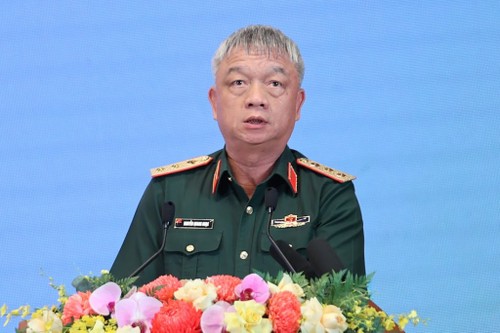 Deputy Minister of National Defense Senior Lieutenant General Nguyen Quang Ngoc (photo: Nhat Bac/ VGP) Deputy Minister of National Defense Senior Lieutenant General Nguyen Quang Ngoc (photo: Nhat Bac/ VGP) |
Deputy Minister of National Defense Senior Lieutenant General Nguyen Quang Ngoc said: “The program builds new homes, enhances trust, and inspires hope. The Central Military Commission and the Ministry of National Defense consider this task a regular duty for all officers and soldiers. We’ll work closely with local authorities to fulfill the targets and support the people.”
The elimination of makeshift and dilapidated houses just before the 80th anniversary of National Day on September 2 is an apt affirmation of the strength of national solidarity and social responsibility.