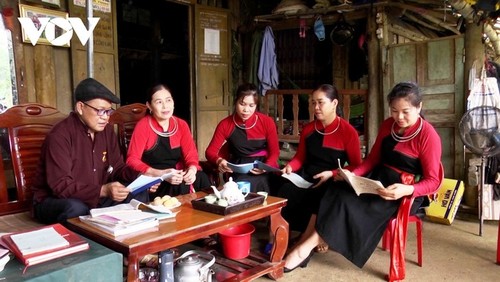
 Artisan Ninh Quang Thanh. Artisan Ninh Quang Thanh. |
At the age of 70, emeritus artisan Ninh Quang Thanh of Hoa Cuong commune, Tran Yen district, passionately sings ‘Sinh’ songs. Born into a family with a zeal for ‘Sinh’ folk melodies, Thanh followed his parents and other local artists when he was small to perform at festivals.
“We often sing ‘Sinh’ songs in January and February of the lunar calendar, and then again in August when the weather is cool and the harvest is finished,” said Thanh.
‘Sinh’ folk songs of the Cao Lan ethnic group embodies a unique call-and-response singing style in quatrain form. ‘Sinh’ songs not only have beautiful melodies, but also meaningful lyrics, depicting production, nature, love, and filial piety. Artisan Thanh has done lots of research on singing styles, folk dances, and musical instruments used to accompany ‘Sinh’ songs such as the flute, the monochord, drums, and gongs.
“Each occasion like a festival or the New Year has its own songs. Some depict the love for the homeland. Others praise crops like rice, cassava, and potatoes which are customarily sung when people are working in the field,” said Thanh.
12 years ago, Thanh and other ‘Sinh’ lovers established a ‘Sinh’ singing club, which now has more than 50 members, including Me Thi Van.
“My homeland is rich in folk melodies. I have learnt to play musical instruments so that I can teach my children and grandchildren,” said Van.
While ‘Sinh’ songs are a cultural symbol of the Cao Lan people, “Khap Cooi” are unique romantic songs of the Tay in Luc Yen district. Emeritus artisan Hoang Quang Nhan of Muong Lai commune has traveled to many villages to collect and teach “Khap Cooi” melodies to the young generation. Nhan has now collected more than 200 ancient melodies.
“I found books about ‘Khap’ songs hand-written in Chinese-transcribed Vietnamese between 1912 and 1920. Those songs were traditionally transmitted orally. If the old artisans pass away, those melodies would probably vanish. That’s why I have tried to collect and keep records of those songs,” said Nhan.
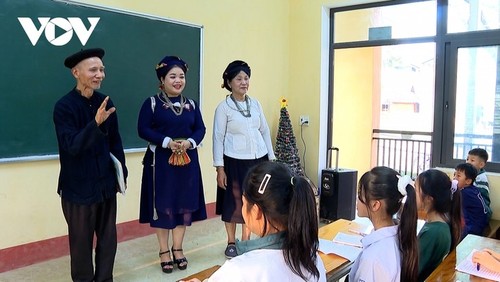 Artisans including Hoang Quang Nhan teach Khap Cooi at schools. Artisans including Hoang Quang Nhan teach Khap Cooi at schools. |
Artisan Hoang Quang Nhan has also been very active in teaching “Khap Cooi” to young people through activities at local clubs or schools.
“I participate in the ‘Khap Cooi’ club at my school. I am so happy because I can preserve the cultural values of our Tay ethnic group,” said Ma Thi Quynh, an 8th grader of Muong Lai middle and high school in Luc Yen district.
Yen Bai province currently has over 96,000 elderly people, many of whom are knowledgeable about local history, culture, customs and practices. They are taking on important roles in cultural and religious events in the community and preserving their traditional culture. As a result, the “Xoe Dance” of the Thai, “Khap Cooi” and “Then” singing of the Tay, the “Sinh” songs of the Cao Lan, and the “Panpipe Dance” of the Mong, have stood the test of time.
“Yen Bai sees cultural identity as a great spiritual asset and artisans as the core factor to preserve it. Over the past years, we have established art troupes which must include artisans,” Vu Thi Mai Oanh, deputy head of the Yen Bai provincial Department of Culture, Sports, and Tourism, said.