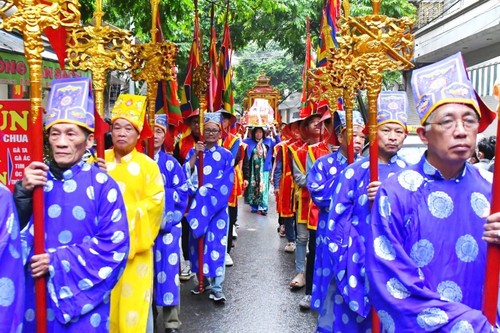
 The sacred palanquin procession ritual at the Mai Dong village wrestling festival. (Photo: tapchinongthonmoi.vn) The sacred palanquin procession ritual at the Mai Dong village wrestling festival. (Photo: tapchinongthonmoi.vn) |
The wrestling festival in Mai Dong village in Hoang Mai district is held annually from the fourth to the seventh day of the first lunar month. This is the capital’s oldest wrestling festival, with a history of nearly 2,000 years, and is said to represent the essence of Hanoi folk culture.
“The Mai Dong wrestling festival originated in the time of the Trung Sisters (around 40 AD), attracting participants from many neighboring areas. Before the game, the wrestlers must first pay their respect to their ancestors and then perform a move to demonstrate their skill to their opponent,” said historian and researcher Vu Van Au.
One of the highlights of the festival is the “sacred wrestling match”, which is reserved for esteemed elderly wrestlers with great virtue and skill. These matches showcase traditional wrestling techniques to the spectators.
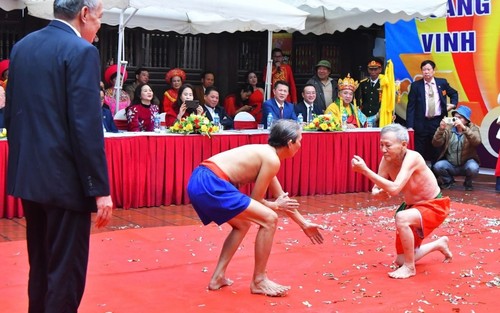 A showdown between two older wrestlers in Mai Dong village (Photo: tapchinongthonmoi.vn) A showdown between two older wrestlers in Mai Dong village (Photo: tapchinongthonmoi.vn) |
“I’ve participated in the festival since 1982. The village has long upheld the tradition of organizing wrestling competitions where people from different areas come to participate. Local youths are only allowed to wrestle for demonstration purposes if there are no external challengers present,” Nguyen Doan Thuy, a veteran wrestler from Mai Dong village, said.
The Mai Dong wrestling arena, renowned for generations, draws wrestlers from Hanoi and other provinces for competition and cultural exchange. Villagers are proud of their tradition.
“I’m very happy to see the local wrestling movement growing stronger. It fosters solidarity and a sporting spirit in the community, and gives young people an opportunity to meet and interact. It’s very beneficial mentally and physically for everyone.”
“Mai Dong wrestling is an ancient cultural tradition in Hanoi. I attend the festival every spring. It brings joy to the village and is a great way to stay fit. The event is well-organized and professional, the audience is enthusiastic, and their passionate support motivates the wrestlers to give their best performance.”
Famous wrestling festivals are also held in Trieu Khuc village in Thanh Tri district, Bung village and Khu Ba village in Thach That district, Dong Lao village in Hoai Duc district, and Nanh village in Gia Lam district.
Depending on the locality, wrestlers are matched by height, weight, or age. Some festivals also feature women’s wrestling, attracting great interest from spectators.
At the Phuong Son wrestling festival in Quoc Oai district, wrestlers compete in pairs grouped by age. The wrestlers deliver intense and visually impressive performances for the audience.
At the festivals, older wrestlers teach younger wrestlers, passing down their skills and techniques. The festival is not just a competition. It’s a way to preserve local traditions and instill the martial spirit in future generations. Many professional wrestlers have emerged from the wrestling festivals.
“For many years, wrestling arenas in villages and towns throughout Quoc Oai district have been attracting athletes, including national champions and even international wrestlers. Since the Lunar New Year, six early spring wrestling arenas have been set up in the district, drawing large crowds,” said Nguyen Duc Thinh of Quoc Oai district’s Department of Culture, Information, and Sports.
Wrestling arenas, closely tied to traditional village and commune festivals, embody the unique cultural values of each locality as well as their martial spirit and their hope for favorable weather, bountiful harvests, and happiness in the new year.